Celebrating safe drinking water
Almost 50 years ago, on December 16, 1974, the U.S. Safe Drinking Water Act was first signed into law to help safeguard our access to clean drinking water. As science and water quality challenges have changed over time, so to have the regulations. |
|
 |
Building filtration treatment is one of the ways the Water Bureau is working protect public health, comply with regulations, and continue delivering clean, safe drinking water every hour of the day, every day of the week.
Filtration treatment involves moving water through a series of large concrete process basins, including sedimentation basins where silt and small particles will settle out of the water and filtration basins where microorganisms like Cryptosporidium and any remaining silt or particles will be removed.
Filtration construction update
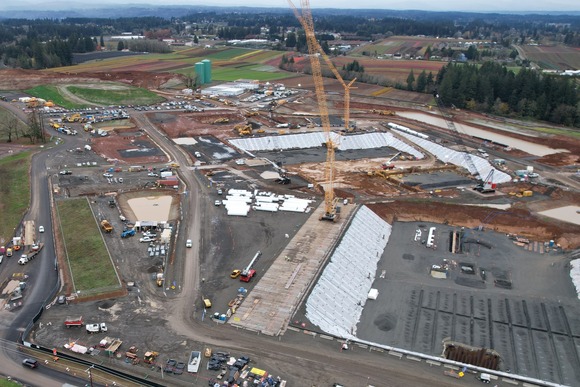 Since breaking ground at the facility site this summer, the construction team has completed mass excavation and grading for these large basins making sure the elevations are just right so water can continue to flow by gravity through the treatment process. Now, the construction team is gearing up for a productive start to 2025 with piping, forming, and concrete work to build the basins and prepare the foundations for other facilities needed on site.
In addition, tunneling contractors are getting ready for excavation where new raw water pipelines buried deep underground will connect the existing water system to the filtration facility. Construction is also ramping up along segments of the finished water pipeline routes that will travel from the filtration facility through public right-of-way and city easements to tie into existing conduits.
Moving a mountain of dirt
Digging the basins created a small mountain of dirt onsite and contractors have been steadily working to move these stockpiled soils to permitted locations using approved haul routes. In December, we expect to start moving the excavated topsoil that was found to be contaminated based on Oregon Department of Environmental Quality (DEQ) standards. These soils have low levels of pesticides that are below risk levels for human health concerns but exceed screening levels that protect ground-feeding birds and mammals. The pesticides are frequently detected on agricultural properties. The soils will be taken to a permitted disposal location under the terms of DEQ’s beneficial use determination.
Serving local taps
Our pipeline contractors started early preparations on Cottrell Road for the new gravity-fed 12-inch local distribution main that will be installed as part of the Bull Run Filtration projects. The roughly half mile of new main will be built using both trenchless and open cut methods within the public right-of-way of Cottrell Road, connecting the new big pipes in Dodge Park Boulevard with the existing water main near the Lusted Hill Treatment Facility.
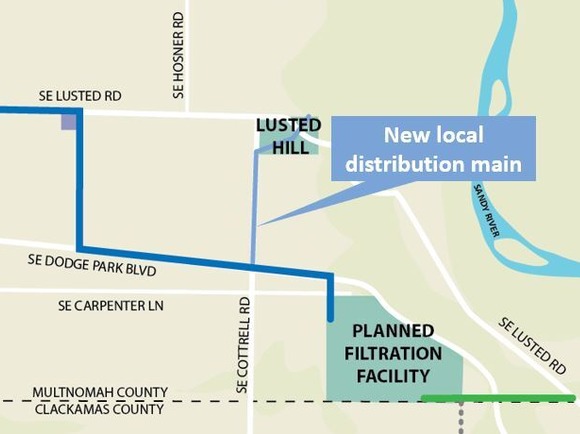 Recent work along Cottrell Road includes tree protection fencing and erosion control measures to get ready for construction currently planned to start late 2025/early 2026. Following construction, the work areas will be restored to their existing condition—resurfaced roadway or native soil and ground cover.
After the filtration facility comes online in 2027, the new distribution main will supply filtered Bull Run water to the current local water customers and five wholesale water districts. The Water Bureau provides drinking water for roughly 11,800 people within 5 miles of the filtration facility site.
|