|
Replies to this message are sent to an unmonitored mailbox. To contact me, please click here: Sen.FloydProzanski@oregonlegislature.gov. If you're having trouble viewing this message, please visit my legislative web page at http://www.oregonlegislature.gov/prozanski/, click "News and Information" on the left.
Dear friends,
With the 2026 primary election and 60-day communications "blackout" (Senate rule for current legislators running for re-election) now behind us, I'm resuming my monthly e-bulletins to keep you apprised of happenings in Salem and around Senate District 4. As a reminder, you can update your subscription preferences using the "Manages Preferences" link at the bottom of this e-mail.
Even though it's old news by now, I want to share how pleased I am that PeaceHealth abandoned its ill-conceived effort to outsource local emergency department services and instead renewed its contract with Eugene Emergency Physicians (EEP). This is a significant "win" for our community. EEP has been providing emergency services at PeaceHeath for 35 years! I was proud to fight alongside my colleagues in the Eugene-Springfield legislative delegation to get PeaceHealth to reverse course. Due to PeaceHealth's efforts to replace EEP with an out-of-state corporation, I want to acknowledge that some of the EEP providers will no longer be part of our community. Those providers accepted employment elsewhere to ensure they had jobs! This is very unfortunate and a loss to the community. Hopefully, PeaceHealth’s administration will work to rebuild their relationships with both EEP and the community.
Thank you to everyone who attended our Eugene-Springfield legislative delegation virtual town hall on April 9 at 6 p.m. Senator Manning, Speaker Fahey, Representative Fragala, Representative Nathanson and I recapped the 2026 "short" session and fielded great questions about our work in lead-up to the 2027 session.
Below you will find information on:
- June Revenue Forecast
- Session Accomplishments: Public Safety & Justice
- Cottage Grove to Martin Creek I-5 Improvements
- $1.95 Million in Community Resilience and Capacity Building Grants
- New Tech Helps Improve Threatened Species Surveys in State Forests
I hope this information is helpful and informative for you or someone you know. As always, feel free to share your comments, questions or concerns with me by phone, mail or e-mail.

June Revenue Forecast
The latest revenue forecast was released at a joint meeting of the Senate and House interim Revenue committees by the Oregon Office of Economic Analysis (OEA). Below is a summary of the forecast. While hiring is up and layoffs are down in Oregon, a hard truth lies below the surface of these bright spots: even as our state's economy grows, too many working families are being left behind. Income for wealthy investors is rapidly rising while working families' paychecks are not keeping up. Oregonians face a growing affordability crisis fueled by President Trump's reckless war with Iran.
Revenue Outlook
The net General Revenue for 2025-27 is $35.7 billion, up $345 million from the March 2026 forecast. The 2025-27 General Fund net resources are now $37.9 billion, an increase of $345 million from March's forecast. Lottery revenue for the 2025-27 biennium is $1.84 billion, a $26 million increase from March. Reserve accounts as of March are $1.13 billion (Education Stability Fund) and $1.96 billion (Rainy Day Fund). The projected ending balances for the 2025-27 biennium are as follows: Education Stability Fund ($1.27 billion) and Rainy Day Fund ($2.19 billion).
Kicker Outlook
There is no personal kicker projected for the 2027-29 biennium. Corporate tax revenue of $157.3 million is projected to be dedicated to K-12 education spending in 2027-29.
OEA Economic Outlook
The overall economic forecast reflects a softening economy, with the growth forecast more modest and broadly aligned with last year’s performance, meaning Oregon will continue to grow but at a slower rate. Our state's unemployment rate appears to be stabilizing, with the unemployment rate at 4.7 percent, down from 5.2 percent in the March 2026 forecast. This is an indication that the labor market has slowed, reflecting a "low hire-low fire" economy. Population growth is expected to have a slow positive increase in the future, averaging 0.4 percent through 2035.
OEA Corporate Activity Tax (CAT) Projections
Anticipated revenues for the current biennium (2025-27) are $3.08 billion, up $24 million from the March 2026 forecast. For 2027-29, projected revenue is now $3.45 billion, up $14.9 million from the March 2026 forecast.
Session Accomplishments: Public Safety & Justice
Following the 2026 short Legislative Session, I'm sharing in-depth summaries of bills passed by subject area. Below is a comprehensive listing of accomplishments related to public safety & justice — by Senate/House bill and in numeric order. Most of these bills were considered by the Senate Judiciary Committee, which I chair. My priority during the 2026 session (and ongoing) was to fight constitutional overreach by the current federal administration.
Senate Bills
SB 1515 - Compensation for Wrongful Convictions: As science and technology continue to evolve, our laws governing forensic science must keep up. This legislation creates a new post-conviction relief petition process when a person has a conviction that is based on scientific expert testimony, scientific expert evidence, or scientific expert opinion derived from discredited forensic science.
SB 1516 - ALPRs and Pre-trial Release: Automatic License Plate Readers (ALPRs) are camera systems that capture license plate data and related information from passing vehicles. They can be fixed and mounted in specific locations, often using existing infrastructure, or they can be mobile, such as on police vehicles. This legislation limits use and retention of ALPR data. Nationally, Immigration and Customs Enforcement (ICE) has been utilizing ALPRs to track vehicle locations, creating a massive surveillance network to identify, target, and deport people. SB 1516 limits their ability to do so. I was proud to convene a workgroup consisting of stakeholders, including Eyes of Eugene, the ACLU and law enforcement, to consider this issue.
Notably, SB 1516 also includes provision fortifying a judge's authority to consider primary and secondary release criteria when making pretrial release decisions. This is in direct response to concerns raised by the "Skyline 7" burglary ring that terrorized AAPI families in Eugene and beyond. (Ironically, an ALPR photo broke open the Skyline 7 case when it provided detectives a significant lead.)
SB 1557 - Confidentiality in Surrogacy Contracts: This legislation changes the way a person may file for contempt of court and renders confidential the court records relating to parentage of a child born by assisted reproduction under a surrogacy contract.
SB 1570 - Establish Clear Hospital Protocols for Law Enforcement Access: Immigration enforcement authority primarily rests with the U.S. Department of Homeland Security under the Immigration and Nationality Act, while Oregon statutes govern the roles of local law enforcement and protections for sensitive information. However, overlapping legal frameworks involving law enforcement, health care providers, and confidentiality laws can create uncertainty about the limits of state and local involvement in immigration-related enforcement activities. This legislation requires hospitals to designate public and nonpublic areas and assign an administrator to respond to law enforcement authorities upon arrival, ensuring clarity, safety, and compliance.
SB 1587 - Protecting Personal Data from Federal Entities: As ICE has increased immigration operations, communities across Oregon have been fearing their personal data will be released to the federal government. This legislation protects Oregonians' personal data from federal entities like ICE by putting new restrictions on how digital footprints are traded.
SB 1594 - Centering the Experiences of Immigrant and Refugee Communities: This legislation centers the experiences of immigrant and refugee Oregonians in our state's response to federal immigration practices. The measure requires the Department of Justice to collaborate with the Office of Immigrant and Refugee Advancement when they update sanctuary law model policies.
House Bills
HB 4041 - Public Safety Omnibus: This legislation is a public safety omnibus bill with multiple provisions. It reduces two categories of driving while suspended from a misdemeanor to a violation; increases the presumptive sentence for fleeing or attempting to elude a police officer in a vehicle for repeat offenses and for causing an injury to another person; creates new procedural requirements for petitions for post-conviction relief for nonunanimous jury verdicts; establishes new procedures for sentence computations and for addressing erroneous releases; and increases the monetary value thresholds for varying degrees of theft and criminal mischief.
HB 4045 - Social Media Companies Responding to Warrants: When someone is being stalked or threatened online, it can take weeks to months for law enforcement to obtain and receive actionable information from warrants issued to communications companies. This delay is dangerous for victims facing harassment. This legislation protects Oregonians by requiring that social media platforms responding to a search warrant in a domestic violence or stalking case do so within 72 hours.
HB 4072 - Post Custody Arraignment Requirements: Currently, a person who is arrested and then released by a jail must appear in court for arraignment within 96 hours. The 96 hours includes weekends, holidays, and other times when the court is closed, often causing lengthy arraignment dockets where defendants and their attorneys wait through long hearings. This legislation expedites arraignment timelines by excluding holidays, weekends, and days when a court is closed from the 96 hours within which a person must be arraigned after being arrested and released from custody.
HB 4079 - Strengthen School Policies for Federal Immigration Authority Access: Students have a constitutional right to attend public school regardless of immigration status under Plyler v. Doe. However, evolving federal enforcement guidance from U.S. Immigration and Customs Enforcement has created uncertainty for schools about how to maintain safe and uninterrupted learning environments. This legislation requires school districts and higher education institutions to adopt clear policies for responding to federal immigration authorities on campus and to implement reporting requirements, ensuring transparency, compliance, and protection of students and staff.
HB 4092 - Counterfeit Car Seats: Car seats that look like legitimate child safety systems but do not meet the actual safety standards set by the National Highway Traffic Safety Administration are easy to purchase and have devastating consequences in the case of an accident. This legislation protects children by holding sellers of counterfeit car seats accountable and creating a legal pathway for families who purchase car seats that do not meet nationally recognized safety standards.
HB 4111 - Anti-discrimination Protections: Due to attacks on immigrant and refugee communities from the federal government, Oregonians are feeling afraid to go to work, access the legal system, or even leave their homes. This legislation strengthens Oregon's anti-discrimination laws by making it unlawful for employers to retaliate against workers updating their work authorizations, limiting the use of immigration status in civil court cases if it is irrelevant to the case, and adding immigration status to the state's anti-profiling law.
HB 4114 - Protect Your Door Act: ICE has increased immigration enforcement operations nationwide, including executing warrantless arrests. This legislation protects Oregonians in their homes by requiring out-of-state and federal law enforcement to provide notice to Oregon's DOJ before carrying out operations in Oregon. It also requires law enforcement to identify themselves during these operations and prohibits state and local law enforcement from coordinating with federal agencies who fail to meet these requirements.
HB 4138 - Law Enforcement Accountability & Visibility Act: ICE agents have been wearing face masks and failing, in some situations, to identify themselves to the people they arrest. This legislation requires law enforcement agents operating in Oregon to visibly display their name or badge number and agency affiliation while on duty. It also gives people the ability to go to court to stop a violation before it continues or causes further harm.
HB 4140 - Metal Theft: In recent years, Oregon and other states have seen an increase in attacks targeting telecommunications infrastructure. This legislation protects Oregon's infrastructure from theft and damage by expanding the types of telecommunication entities that are covered under the offense of criminal mischief. It also requires scrap metal sellers to subscribe to and use a free scrap metal theft alert system.
HB 4151 - Protecting Oregonians from Swatting: Calling false reports of a severe threat to law enforcement, also known as "swatting," can pose serious danger to both law enforcement and the victims of swatting. These false reports can lead to trauma, serious injury, and death. HB 4151 protects Oregonians from false reports of enhanced law enforcement operations by increasing the criminal penalties for calling in this type of enhanced law enforcement operation against unknowing community members.
HB 4157 - Protecting Survivors of Sex Crimes: Human trafficking and sex trafficking is a billion-dollar criminal industry that has grown more sophisticated in Oregon and across the country. Traffickers and abusers know that if a survivor cannot appear safely in court, their testimony may never enter the record. This legislation closes that gap and protects survivors of sex crimes by allowing the survivor's statement to be considered in court even if the testimony is provided by a third party, who must be a trained professional.
Cottage Grove to Martin Creek I-5 Improvements
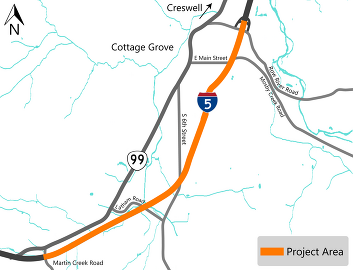
If you drive south on I-5, you've likely already noticed work happening between Cottage Grove and Martin Creek Road. Improvements include guardrails, bridge surface and joints, pavement, shoulder rumble strips, and permanent striping. ODOT is continuing this work into June. Drivers can expect:
- Crews working mostly at night, from 7 p.m. to 8 a.m.;
- Single lane, shoulder and ramp closures as needed;
- The speed limit reduced to 55 mph in the work zone;
- Construction noise and delays.
$1.95 Million in Community Resilience and Capacity Building Grants
Oregon Housing and Community Services (OHCS) has awarded $1.95 million in capacity building grants to 13 community partners working for expansion and preservation of affordable rental housing across the state. These grants are designed to help organizations be more efficient, deepen regional collaboration, and pilot innovative outcomes-based solutions that aim to build stronger, more resilient housing ecosystems in Oregon.
The 2025–27 grant cycle offered two pathways:
- Organizational Strengthening Grants to help partners improve internal systems, staffing, and processes that support the development or operation of affordable rental housing.
- Innovative and Regional Projects Grants to encourage collaboration across neighboring regions or to pilot creative approaches to longstanding capacity challenges.
This year's cohort reflects the strength, diversity, and determination of Oregon's housing partners, including rural nonprofits, local housing authorities, and Tribal Nation housing providers who bring cultural expertise and deep community trust to their work. Each grantee was awarded $150,000 to be used in a two-year period.
I'm happy to report that two Lane County organizations received grants for their work to expand access to safe, stable, and affordable housing throughout the state: Homes for Good and Sponsors, Inc.
More detailed information regarding the ORCA-CB grant program and grantees can be found, here.
New Tech Helps Improve Threatened Species Surveys in State Forests
(From the Oregon Department of Forestry)
Oregon's state forests are home to a wide variety of wildlife including two threatened bird species, the northern spotted owl and the marbled murrelet. As part of the Oregon Department of Forestry's (ODF) compliance with the federal and state endangered species acts, ODF surveys where these species are and develops a plan to protect and enhance their habitat.
Most of the field call-back survey work is done by contract biologists and has some limitations. Another recent concern that limits the effectiveness of call-back surveys is the encroachment of the invasive barred owl into traditional spotted owl areas. This makes the call-back protocols less effective and had ODF looking for better methods to survey the birds.
Autonomous Recording Units (ARUs) are devices that automatically record environmental sounds such as bird calls, frog choruses, or other wildlife vocalizations over extended periods without the need to have a human present. The units are designed similar to a trail camera, but instead of a camera they have a microphone. They also run on batteries and have removable memory cards. ODF is optimistic ARUs could save on survey costs too.
ODF currently has 23 ARUs but plans to deploy more and move away from sole reliance on call-back surveys. Another big change for the biologists will be state forests moving to a new Habitat Conservation Plan (HCP) that is expected to be approved by the USFWS and NOAA Fisheries later this year after a several years-long development and approval process. The HCP will give ODF 70 years of certainty in how ODF manages for 17 terrestrial and aquatic species, including northern spotted owls and marbled murrelets, as it manages state forests.
The HCP combined with improving technology has the potential to give managers better data to better manage the forests. State forests by law must provide social, economic, and environmental benefits to Oregonians.
For more on Oregon’s state forests, please visit: https://www.oregon.gov/odf/working/pages/stateforests.aspx.
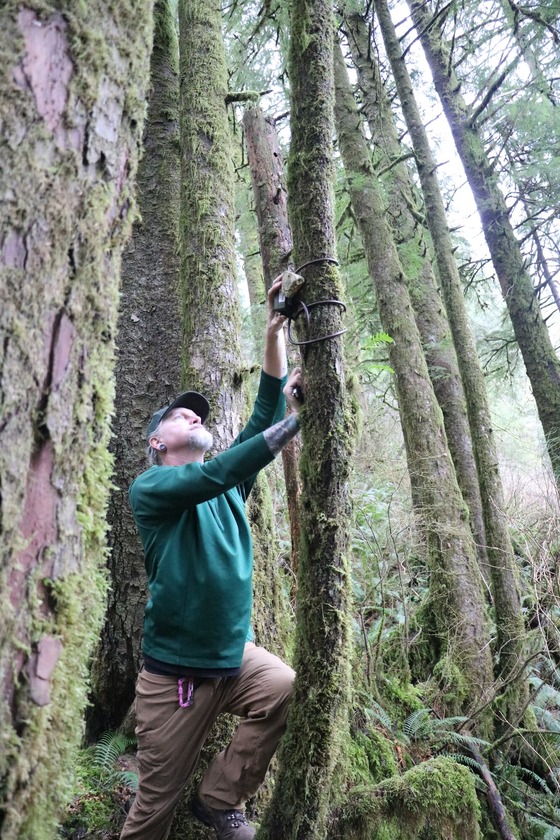
Mike Davis, an ODF wildlife biologist, sets up an Autonomous Recording Unit (ARU) in a known mature tree stand that northern spotted owls have used in the past. After 60 days in the forest the units are brought back and the calls analyzed to determine what types of birds and other wildlife were recorded.
|