|
Replies to this message are sent to an unmonitored mailbox.
To contact me, please click here: Rep.PamMarsh@oregonlegislature.gov
July 2025
Dear friends and neighbors,
The 2025 legislative session ended just after 11 p.m. Friday night, June 27. In the intervening days, I’ve had a chance to reflect on our achievements in Salem over the past six months. Highlights of the good work include:
-
K-12 school funding—Despite a tight budget, we allocated $11.4B for our K-12 schools, and passed accountability requirements to ensure state investments are helping students learn and achieve.
-
Wildfire mitigation—For the first time ever, we dedicated permanent funding to wildfire mitigation work, such as defensible space, home hardening and landscape resilience.
-
Housing programs—We stabilized our shelter system and passed legislation to spur housing innovation and production.
-
Energy affordability—We passed a bill to make sure the financial impacts on consumers are clear when utilities request rate increases, and another to require big energy users to pay the costs for their power.
-
Civil commitment reforms—With the help of NAMI, National Alliance on Mental Illness, we reformed standards to enable a judge or family member to get an individual with severe mental illness the help they need.
-
Labor reforms—New legislation will protect workers from wage theft and trafficking, and provide modest unemployment benefits to sustain workers on long strikes.
-
Firearms restrictions—We passed legislation that bans the conversion of firearms with rapid-fire devices like bump stocks.
Despite herculean efforts by some of my colleagues, the proposed Transportation Reinvestment Package fell one vote short in the Senate. Our failure to act will have real results in the form of layoffs and draconian service cutbacks. To characterize my response as deep disappointment would be a vast understatement. This cannot be the end of the story. Instead, we will step back, regroup and come up with a new amended plan. At this moment we don’t know if that will include a special session or another approach—please stay tuned.
This newsletter describes legislation that my staff and I shepherded through the process to become law. I am exceedingly fortunate to have Paige Prewett as my long time Chief of Staff, and Selena Blick as our Legislative Aide. If you have encountered Paige or Selena, I think you will agree that these two do stellar work for all of us in House District 5.
Finally, many thanks for your calls and emails over these past months. I am honored to represent you, and so grateful for the input that guides my work.
Best,
 State Representative
Oregon House District 5 - Southern Jackson County
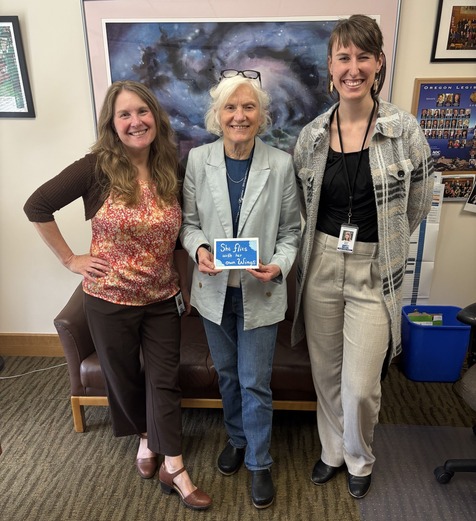
Me with my marvelous staff, Paige and Selena, and a card Selena made celebrating Oregon's motto, "She Flies With Her Own Wings."
As chair of the House Committee on Housing and Homelessness, I focused on stabilizing our shelter system and finding solutions to increase the housing supply, maintain and upgrade existing homes, and encourage affordability.

Manufactured Housing Affordability (HB 3054)
HB 3054 limits annual rent increases for homeowners in manufactured home parks and marinas with over 30 spaces to a maximum of 6%.
Residents in manufactured home parks own their own homes, paying rent for their spaces to the park landlord. These manufactured homes are permanently installed in place and cannot easily be moved, so residents on fixed or limited incomes have few options when park costs escalate. Surging rents are outstripping residents’ capacity to pay and threatening their ability to remain in homes that were intended to provide lifelong security.
HB 3054 also prohibits landlords from requiring a selling tenant or a prospective purchaser to make aesthetic or cosmetic improvements to the home. Landlords will continue to be able to require maintenance and repair of homes.
|

Senior Housing Development (HB 3589 & HB 3506)
People aged 50+ are the fastest-growing group of people experiencing homelessness in America and their numbers are estimated to triple by 2030. Oregon faces a deficit of approximately 102,760 affordable rental units, a gap that disproportionately affects older adults living on fixed incomes. Fewer than 10% of housing is aging-ready.
HB 3589 and its companion bill HB 3506 aim to ensure that older Oregonians have housing they can afford by establishing the Senior Housing Development Initiative, directing Oregon Housing and Community Services (OHCS) to develop and implement a program that incentivizes housing development for Older Adults and Persons with Disabilities with an allocation of $23.5M for vital senior programs, and $500,000 to establish the “Older Adult Housing Technical Assistance” fund to support housing location, design, development, and the delivery of non-licensed home and community-based services for older adults.
HB 3506 provides $3M for home upgrades like ramps or installation of grab bars that will help vulnerable seniors or individuals with disabilities remain in their homes.
|

Middle Housing Development (HB 2138)
Tucked into existing neighborhoods, accessory dwelling units, duplexes, triplexes, four-plexes, and cottages can provide much needed affordable rental or ownership housing. HB 2138 expands our existing middle housing program to make these projects more feasible. It 1) requires that accessory dwellings units and duplexes be allowed on all lots with existing single-family units, 2) removes red tape on the construction of new middle housing developments, 3) streamlines the land division processes so that fee-simple homeownership can become a reality for more families, and 4) creates a density bonus to promote development of affordable and accessible units without needing public subsidy.
|

Statewide Shelter Program Development (HB 3644)
HB 3644 sets up a statutory framework for a statewide shelter system to ensure that dollars we put into the state network are well spent, transparent, fairly distributed, and locally directed. Shelters are an entry point to a system of services that help individuals move forward in their lives. The state budget allocates $205M to keep the shelter system stable over the next biennium.
|

Housing Materials & Methods Innovations (HB 3145)
HB 3145 provides Oregon developers, builders, factory operators, and communities the opportunity to test new approaches to production of rental or ownership housing. OHCS will use $25M from the Local Innovation and Fast Track Housing Program Fund (LIFT) to support the construction or acquisition of factory-produced housing projects for low-income households in up to five locations. The program will prioritize projects using Oregon-based developers, environmentally friendly materials, and geographically diverse locations.
Getting out of this housing hole requires us to re-examine our conventional ideas on so many fronts, including land use, permitting, design, and financing. The use of factory-based components that can get homes on the ground more quickly and, perhaps more inexpensively, needs to be a pillar in our state’s housing strategy.
|

Oregon Homes Program (HB 2258)
Housing construction is often delayed by long, unpredictable permitting processes and the requirement for local review every time a set of plans is submitted for use. HB 2258 creates the Oregon Homes Program to inject innovation into the housing development process by pairing pre-approved building plans with standardized land use approvals—creating an off-the-shelf development package for use across jurisdictions and on multiple sites within a neighborhood for accessory dwelling units, prefabricated, and modular housing. Pre-approved housing options can speed up middle housing development and homeownership opportunities across the state.
|

Condominium Liability Reform (HB 3746)
Condos are an excellent entry level option for new homeowners, a much-needed alternative for older people, and a good choice for anyone who wants to own a home without mowing the grass every weekend. HB 3746 reduces barriers to developing condominiums and reforms Oregon's condominium construction defect laws, which have been seen as hindering the development of affordable housing.
|

Manufactured Housing Statutory Fixes (HB 3144)
Manufactured and modular homes can provide good affordable housing, but planning and design barriers (as well as stigma) have sometimes effectively barred these homes from neighborhoods. During the 2022 session, I sponsored HB 4064 to clarify that modular and manufactured homes can be placed in neighborhoods, subject to the same design requirements that affect other kinds of housing; HB 3144 addresses the final barrier by stipulating that this includes new planned communities.
|

POWER Act (HB 3546)
HB 3546 ensures that electricity rate payers, already overloaded with growing costs due to wildfire mitigation, erratic weather events, and inflation, are not saddled with costs attributed to new large users that are putting enormous strain on the system. The POWER Act—Protecting Oregonians With Energy Responsibility—sets up a separate rate class for data centers and crypto mining operators to shield families and small businesses from the extra costs attributed to those very large users.
|

Fan Fairness and Transparency Act (HB 3167)
Oregonians who buy tickets to attend entertainment and sports events deserve transparency in the marketplace. HB 3167, the Fan Fairness and Transparency Act (aka Fan Fair Act) will protect consumers from scams and unscrupulous operators and allow venues to better serve their communities. Notably, HB 3167 establishes the most stringent law in the nation to prohibit deceptive websites and branding tactics. It also strengthens anti-bot protections, empowers prosecution through the Attorney General’s office, and extends enforcement to a private right of action under the Unlawful Trade Practices Act.
|

Oregon Lifeline / Broadband Affordability (HB 3148)
Broadband is vital for our social, economic, emotional, and physical health. But having access to the internet isn’t just about having cable to your house. If you can’t afford the service or don’t know how to use it, you’re still on the wrong side of the digital divide. HB 3148 will expand the state’s existing Oregon Telephone Assistance Program, or OTAP, to increase subsidies for telephone and broadband services to qualifying Oregonians. Expansion of the OTAP program, to be renamed Oregon Lifeline, will also provide a one time subsidy of $100 to assist Lifeline participants who want to purchase internet devices, such as tablets or laptops.
|

Beavers & Water Quality (HB 3932)
Here in the Beaver State, it is widely understood that beavers are nature’s engineers. We know that their instinctive behavior benefits landscapes across Oregon by recharging groundwater, inhibiting wildfire, and creating habitat for fish and wildlife. Beavers help address water quality issues because their dams and ponds slow flowing water, which allows pollutants to settle out, while wetland vegetation acts as a filter.
HB 3932 closes recreational and commercial beaver trapping on over 100,000 miles of impaired waterways within state and federal land in Oregon. We want to retain beavers where they are, and encourage their dispersal to creeks and streams, where they can perform their ecological functions–for free!
|

Wildfire Mitigation Funding (HB 3940)
For the first time ever, HB 3940 will establish permanent funding specifically for wildfire mitigation and prevention efforts. Dedication of 20% of the interest generated by the Rainy Day Fund, and funding from a new tax on oral nicotine products, will provide baseline support for mitigation programs directed by the State Fire Marshal’s office and the Oregon Department of Forestry. I am particularly pleased that the bill establishes the Wildfire Prepared Structure Program to provide subsidies for fire-resistant construction for homeowners rebuilding after a wildfire, and support for proactive home hardening for lower income households living in the wildland urban interface.
|

Cannabis Workers Resilience Partnership (HB 3194)
In southern Oregon we’ve seen horrendous consequences from the siting of illegal cannabis and hemp operations. Those impacts have included environmental degradation, the criminalization of neighborhoods, and, worst of all, the exploitation and even trafficking of workers. It is not unusual to hear reports of workers camped in makeshift cardboard shelters, in storage sheds, or in vehicles. When camps are busted or otherwise abandoned, so are the workers, often far from home in an unknown community and without the ability to communicate in English.
HB 3194 holds negligent landowners who rent to illegal operations liable for establishment of unregistered worker camps. It ensures fairness for farm operators who follow the law, and provides legal pathways for workers to seek civil remedies.
|

Farmworker Disaster Relief Allocation
Severe smoke and devastating heat are now predictable, although unwelcome, elements of our summer season. The 100,000 farmworkers who are a vital part of our communities and our farming economy deserve a reliable safety net when extreme weather events keep them from the work that pays their bills. This session, I advocated for funding that will provide farmworker disaster relief to keep our workers stable when the weather makes work impossible.
|

Child Care Facilities Siting (HB 3560)
Child care is a must-have for most American parents, but Oregon’s child care crisis means that care is frequently unavailable or too expensive for families. Many factors contribute to the lack of capacity, including siting barriers that too often prevent childcare facilities from locating close to where people live and work. HB 3560 expands locations where child care centers are permitted, making it easier to open and operate facilities in neighborhoods, near schools, parks, and places of worship. By eliminating zoning barriers that keep children at bay, this bill helps Oregon communities to support families, and the youngest among us.
|
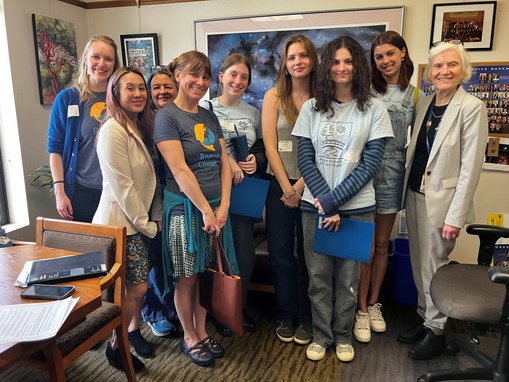
A group of advocates from Rogue Climate visited my Salem office in May to discuss climate-friendly legislation.
Capitol Phone: 503-986-1405
District Phone: 541-282-4516
Capitol Address: 900 Court St. NE, H-375, Salem, Oregon 97301
Email: Rep.PamMarsh@oregonlegislature.gov
Website and e-Subscribe: http://www.oregonlegislature.gov/marsh
|