
2025 Legislative Update
Oregon State Legislature sent this bulletin at 04/30/2025 09:19 AM PDTGreetings constituents and neighbors,
With a great amount of work left to accomplish in the 2025 Legislative Session, I wanted to highlight some of the work that has been ongoing in the Capitol and share with you my legislative priorities. This session, I am grateful to serve a Co-chair of the Joint Committee On Ways and Means and the Joint Committee On Legislative Audits.
Legislative Priorities
House Bill 2134
This session I introduced House Bill 2134 to make it easier for tenants to relocate in Oregon’s expensive, limited rental market. As it stands, during a lease, property owners may give a tenant a 90-day notice to vacate the residence if the owner is returning to the residence to sell it. If the tenant finds and ideal place to move during this 90-day period, they must either be forced to pay rent for both the old property and the new for the extent of the 90 days or give up on the new property altogether.
This bill makes the simple change to allow tenants who are in good standing to move out with a 30-day notice within the 90-day period to the home that works for them without penalty. The rental market is complicated enough as is, and HB 2134 will give renters and their families the flexibility and freedom to find a place to move without massive time constraints or the fear of paying double the amount of rent.
HB 2134 has passed in the House and is now in the Senate Housing Committee and is scheduled for a Work Session today and once passed it will proceed to the Senate floor for a vote.
House Bill 3197
I introduced House Bill 3197 in response to Oregon’s need for addiction treatment services in the face of a crippling addiction crisis. We have the third highest untreated addiction rate among the states and rank 47th in access to addiction treatment. Oregon also has one of the lowest excise taxes on beer, wine and cider in the nation; in fact, it hasn’t been raised for nearly fifty years. Not only is this not in line with the rest of the country, but it also comes at the public health cost of incredibly low revenue generated to address Oregon’s high rate of alcohol related harm.
During the 2023 Legislative Session, we passed HB 3610, which created the Task Force on Alcohol Pricing and Addiction Services. This task force included a diverse set of representatives, from legislators to the alcohol industry, all with the collective goal of studying issues relating to alcohol addiction, as well as the effects of imposing taxes on beer, wine and cider. The extensive research and consultation that occurred in this task force led me to introduce HB 3197. If you would like to learn more about the task force’s findings, you can find a comprehensive report here.
HB 3197 would implement a sales tax on beer, wine and cider, the revenue of which is approximated to reach $296 million by 2032. Youth are disproportionately harmed by Oregon’s addiction crisis, as they often have the most difficult time acquiring treatment, so the revenue from HB 3197 would be put towards addiction treatment services for youth. If passed, this bill would be a huge step towards healing from Oregon’s addiction crisis and will play a vital part in helping our youth get the recovery they need.
This bill now awaits a Work Session in the Joint Committee on Addiction and Community Safety Response.
House Bill 3375
House Bill 3375 would direct the Alcohol and Drug Policy Commission to study programs related to youth substance abuse use prevention and substance use disorder treatment. As it stands, there are simply too many gaps in Oregon’s provider workforce and service delivery systems to sufficiently give youth struggling with SUDs the treatment they need. HB 3375 would give our state vital insight into how to go forward addressing Oregon’s addiction crisis.
This bill is scheduled for a Work Session tonight in the Joint Committee on Addiction and Community Safety Response.
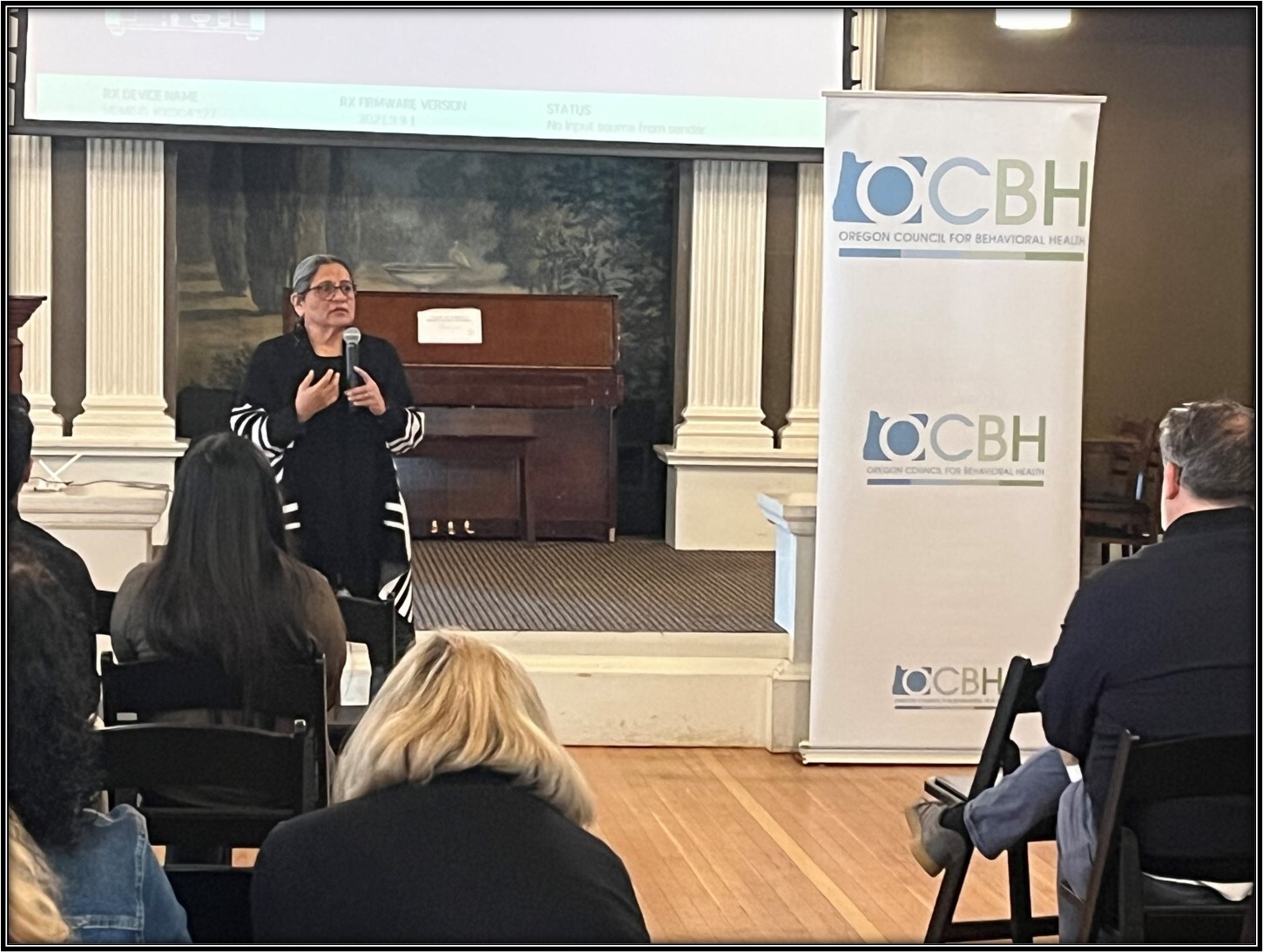
Speaking at the Oregon Council for Behavioral Health’s lobby day.
House Bill 3532
House Bill 3532 would complete a nearly 25-year project initiated by former Governor Kate Brown. When Governor Brown was a Senator, she introduced two pieces of legislation to rename locations in Oregon bearing historically offensive names. While one of these bills passed, to this day, many of these names remain unchanged.
HB 3532 would finalize this multi-decade effort by directing the Oregon Historical Society to identify Oregon mountains, buttes, gulleys, gulches, rivers, creeks, highways, roads and streets bearing offensive names and requiring change, with consultation from Oregon’s nine federally recognize tribes as well as the Oregon Geographic Names Board. The OHS would then recommend non-offensive names for these locations to submit to the U.S. Board of Geographic Names for immediate change.
Removing derogatory language from our public lands is a vital step towards assuring our state is welcoming to all. For more on why the names of our public lands are so important, I recommend reading this piece by Amanda Grace Santos.
This bill is currently awaiting a vote in the House and will most likely be scheduled early next week.
House Bill 3946
HB 3946 came to be following a recent situation in North Portland where the owner of a convenience store was arrested on numerous drug-related charges. Many of these charges were based on the store’s proximity to a nearby preschool. However, these charges were dropped as preschools are not technically considered “schools” in relation to drug crimes in proximity to schools. House Bill 3946 would make the simple change to include preschools under this definition to properly protect Oregon preschools from the dangers surrounding drug crimes.
This bill is currently awaiting scheduling for a Work Session in the Joint Committee on Addiction and Community Safety Response.
House Bill 3953
There are numerous systemic barriers that Oregon’s federally recognized Tribes face when attempting to establish public charter schools through traditional local sponsorship processes. House Bill 3953 would create a direct pathway for the Tribes to apply for public charter school sponsorship through the State Board of Education, which would ensure equitable access to this process while fostering culturally relevant, community-driven education for Native students. This bill would be a big step in helping address educational disparities in Oregon, as well as reducing bureaucratic barriers tribes face surrounding education.
HB 3953 currently awaits a Work Session in the House Rules Committee.
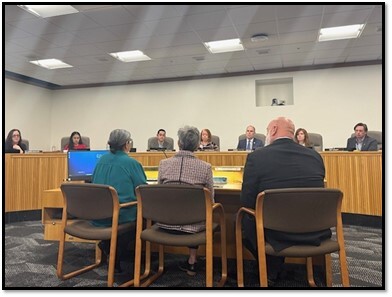
I was lucky to be joined by both Grand Ronde tribal member and lobbyist Justin Martin and former Governor Kate Brown in testifying for HB 3953 and HB 3532 in the House Committee on Rules!
House Bill 2069, 2233, & 3198
These three pieces of legislation have passed out of their respective policy committees and are currently awaiting passage in the Joint Committee on Ways and Means.
HB 2069 would establish a Task Force on Tribal Consultation, with membership from the Senate, the House, the Commission on Indian Services, the office of the governor, all nine federally recognized Tribes in Oregon, and state agencies. This task force would be established to identify and clarify requirements of state agencies to engage in Tribal consultation and would be vital step in establishing clearer expectations between state and Tribal governments.
HB 2233 would re-authorize funds for Re*Membering, a program under the Oregon Justice Resource Center established by the legislature in 2019 to provide legal assistance to people incarcerated in Oregon’s women’s prison, Coffee Creek Correctional Facility. Re*Membering has provided vital, statewide legal assistance to justice-involved women, and continuing to invest in these legal services directly reduces rates of recidivism in Oregon, assuring that formerly incarcerated women can find the stability during the tumultuous re-entry process.
HB 3198 would direct the Oregon Health Authority to create a dedicated Tribal Affairs position to address the critical issue of Missing and Murdered Indigenous People in Oregon. This epidemic has gone widely unresolved due to lack of coordinated response, insufficient data, and cultural insensitivity in service delivery. The position within OHA would take a collaborative response with Native-led organizations, law enforcement, Oregon’s nine federally recognized Tribes, and other community leaders in order to ensure the welfare and safety of Oregon’s Indigenous communities.
Federal Response
To address the elephant in the room: what’s happening at the federal level is a mess. I know that there is a lot of fear and unease surrounding the federal level’s sweeping chaos, but the legislature, as well as Attorney General Rayfield, Governor Kotek, and other agencies are working hard to serve as a state-level check to the efforts to roll back our rights as Oregonians. To stay up to date on what Oregon is doing to protect our state from the federal administration, I would recommend reading this document put together by House Democrats on the state’s response to federal attacks.
One Last Note
Please know that I am aware of how difficult, frightening, or maybe just uncertain things feel at this moment in time. Many of us wake up every day wondering what now - whether we, our families, or our friends will still have a job, or what groceries will cost today. These are all normal concerns and stressors, but they seem magnified right now. I will not try to convince you that we are fine and that there is nothing to worry about, but I will tell you that Oregon is in better shape than many other states.
We are not starting from a place of deficit, and we are waiting for the May revenue forecast to finish building a balanced budget. We may not be able to do everything we want to do, but we will focus on the core needs of the state and bring a budget that we hope will meet the needs of every Oregonian.
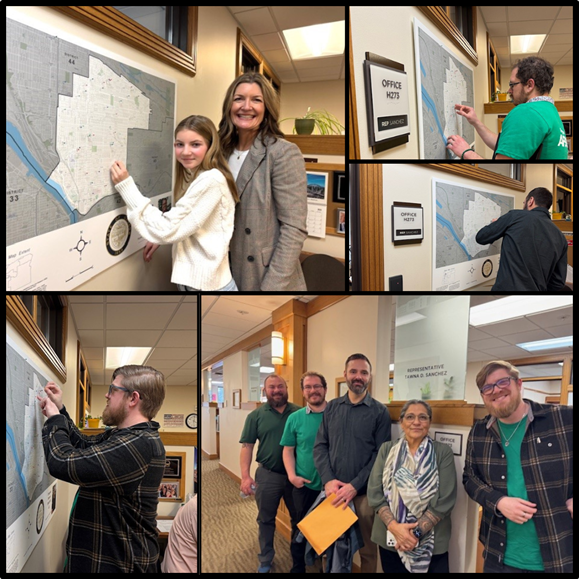
A few of my many fantastic constituents.
In community,
Tawna Sanchez