|
If you're having trouble viewing this message, please visit my legislative web page at http://www.oregonlegislature.gov/prozanski/, click "News and Information" on the left.
Dear friends,
Friday, March 21, marks a major procedural deadline of the 83rd Legislative Assembly: Any bill assigned to a regular policy committee must be scheduled for a "work session" to remain in play this year. If not, it will be "dead" and no longer considered this session. As a result, we've entered a particularly busy stretch at the Capitol.
The early months of long legislative sessions provide opportunities for meaningful recognition of Oregonians or organizations for notable accomplishments. On February 20, I had the honor of carrying two Senate Concurrent Resolutions to passage: SCR 5, commending the 2023 and 2024 Thurston High School baseball teams for winning the state champion two years in a row; and SCR 6, honoring the South Eugene Robotics Team (SERT) for its accomplishments in robotics. You can read the resolutions in full by clicking on each in the preceding sentence. I was impressed listening to testimony offered by members of SERT who traveled to the Capitol to address the Senate Rules Committee, which considered both resolutions before they advanced to the full Senate for a vote.
I've also enjoyed welcoming various constituent groups to the Capitol. It's always great when folks from Senate District 4 make the trip to Salem to engage on important topics and see their state legislators in action!
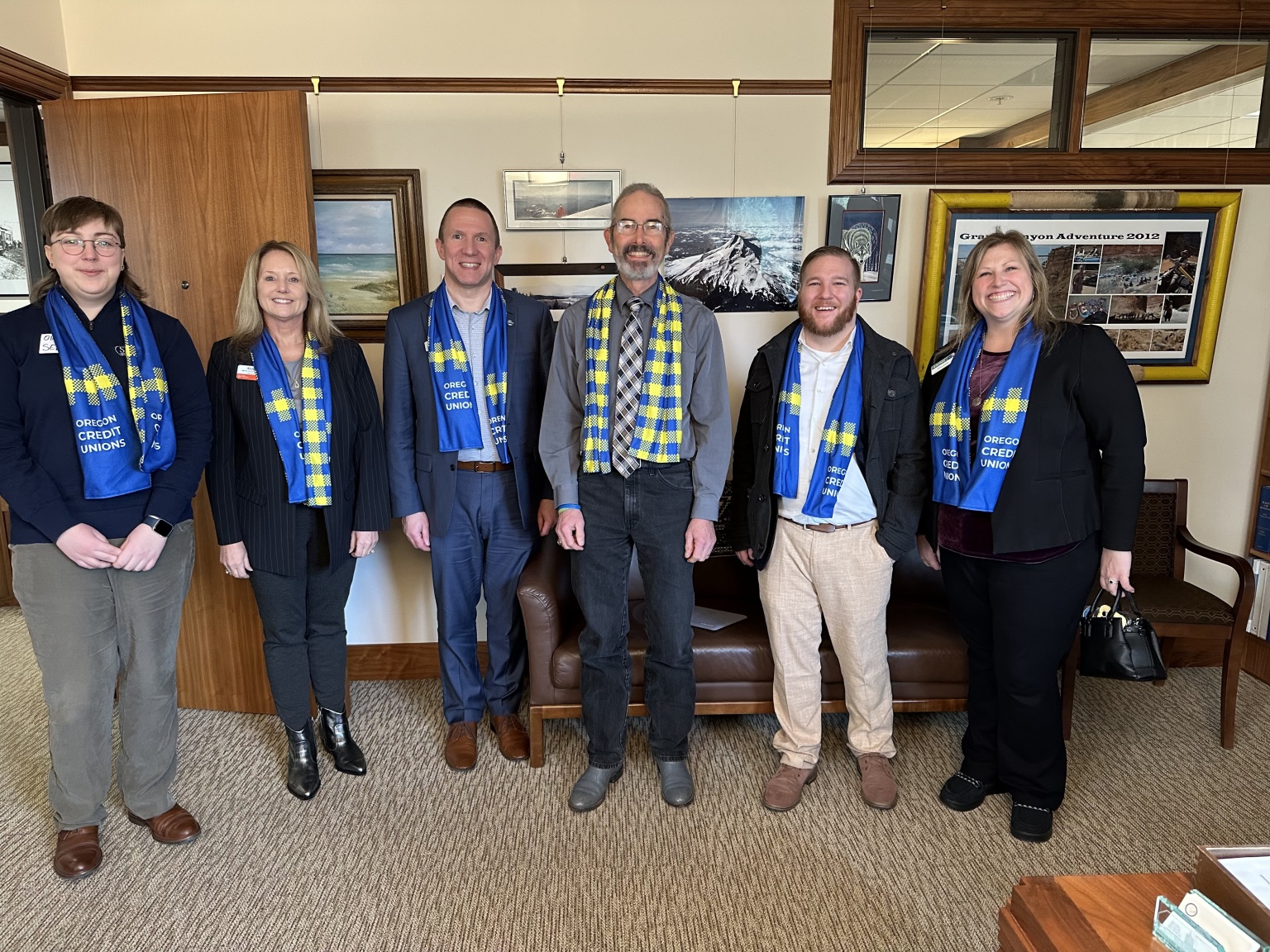
Meeting with representatives from Oregon's credit unions during "Credit Union Day" on February 5.
Over the past few weeks, many people have reached out to my office confused and upset by unprecedented disruptions ongoing at the federal level. Constituents have expressed concern — and even alarm — at losing access to critical federal services and being laid off work. People are understandably afraid of potential privacy breaches in federal agencies and departments negatively impacting Oregon residents. They are afraid their jobs or benefits may be at risk. The constant flow of information — and, too often, misinformation — does little to alleviate these very valid fears, with each headline creating new questions but failing to provide meaningful answers to old ones.
Given the situation we find ourselves in, I want to let you know what I am doing to help alleviate some of these concerns. As chair of the Senate Judiciary Committee, I am working to strengthen our state's rights under the 10th Amendment of the U.S. Constitution. I am also working with other legislators to protect every Oregonian under the Oregon Constitution's Bill of Rights.
Oregon's Attorney General has joined at least 16 other states in opposing overreach by DOGE. Oregon's federal congressional delegation has been vocal in their opposition to the present administration's efforts to destroy basic civility and trample so many of our democratic norms.
During these uncertain times, it is imperative that we stick together as a community. We can share a bold message of hopeful defiance in the face of a burgeoning constitutional crisis.
Here's what you can do to help your voice be heard on the national level. Contact your family members and friends throughout the country and urge them to reach out to their own representatives and senators in the U.S. Congress to tell them to do their job! As the first branch of federal government, Congress must use its power to be a "check and balance" on the executive branch. The founders of our great country expected the legislative branch to push back and hold the President and the executive branch accountable when they overreach their authority. That time has come.
Whatever your political affiliation, everyone will be affected by this current administration’s flagrant encroachment on the powers of Congress to allot funds and make laws. Now is the time to stand together to ensure that our democracy endures and that our Bill of Rights are respected. As patriot Patrick Henry famously said, “United we stand, divided we fall."
Below you will find information on:
- March Revenue Forecast
- Tax Season Assistance and "Where's My Refund" Tool
- Senate Honorary Page Program
I hope this information is helpful and informative for you or someone you know. As always, feel free to share your comments, questions or concerns with me by phone, mail or e-mail.

March Revenue Forecast
On February 26, yet another robust economic and revenue forecast was released at a joint meeting of the Senate and House Revenue Committees by the Oregon Office of Economic Analysis (OEA). Below is a summary of the forecast. The strength of Oregon's economy is its people. Revenue and economic forecasts show that a greater share of working-age Oregonians are employed than the national average. Workers fuel Oregon's economy; too many of our neighbors are struggling to get by. Bucking the national trend, my democratic colleagues and I are advancing bills to make raising children more affordable, health care more accessible, and education more attainable.
Revenue Outlook
The Net General Fund revenue for 2025-27 is $35.9 billion, up $550.7 million from the November 2024 forecast. The 2025-2027 General Fund net resources are now $38.1 billion versus November’s projected net estimate of $37.8 billion, an increase of $350.1 million. Lottery revenue for the 2025-27 biennium is down $82.7 million from the November 2024 forecast.
Reserve accounts are currently at $940 million (Education Stability Fund) and $1.7 billion (Rainy Day Fund). The projected ending balances for the 2023-25 biennium reserve account are as follows: Education Stability Fund: $1 billion and Rainy-Day Fund: $1.9 billion. The Rainy-Day Fund is projected to receive $330 million following the end of the 2023-2025 Biennium.
Kicker Outlook
A personal kicker of $1.7 billion is projected for 2025. Corporate tax revenue of $993 million is projected to be dedicated to K-12 education spending in 2025-2027.
OEA Economic Outlook
The overall economic forecast remains stable. While job growth is slightly lower than previously expected, the changes are minor, measured in tenths of a percentage point. However, income projections have been revised upward, largely due to significant adjustments in non-wage income reported by the Bureau of Economic Analysis (BEA).
Oregon's economic outlook anticipates a modest rebound in migration, supporting slow but steady population growth. The labor market is expected to stay strong, with the unemployment rate holding in the low 4 percent-range and the share of working-age Oregonians employed remaining at or near historic highs. Additionally, wage growth is projected to continue at an annualized rate of approximately 4 percent, reflecting the strength of Oregon's workforce and economic resilience.
OEA Corporate Activity Tax (CAT) Projections
Anticipated revenues for the current biennium (2023-25) are down $31.6 million to $2.757 billion. For 2025-27, projected revenue is now $3.1 billion, down $9.5 million from November.
Tax Season Assistance and "Where's My Refund" Tool
(From the Oregon Department of Revenue)
Tax season is underway at the Oregon Department of Revenue (DOR). For faster service and potential refunds, they encourage taxpayers to file electronically. Helpful resources are available on DOR's website, including an interactive map showing locations for free tax help and access to free file tax preparation software.
By filing a tax return, low- to moderate-income Oregonians can claim the federal Earned Income Tax Credit (EITC) and other state and federal refundable tax credits. Families may be eligible for a maximum EITC benefit of $6,935 on their federal tax return, and a maximum Oregon Earned Income Credit of $807 on their state tax return. Certain taxpayers without children may also be eligible for these credits.
You may qualify for the EITC and the Oregon EIC even if you are not required to file. To receive the refundable credits, however, you must file a federal and state tax return. More information about EITC, Oregon EIC, and other refundable credits is available on the Tax Benefits for Families page of the Department of Revenue website.
Oregonians can check the status of their state tax refund using the Where's My Refund tool on Revenue Online. You will need your:
- Social Security Number (SSN) or Individual Taxpayer Identification Number (ITIN);
- Filing status; or
-
The exact refund amount shown on:
- Line 46 of their Form OR-40, or
- Line 71 of their Form OR-40-N, or
- Line 70 of their Form OR-40-P
Here are common reasons refunds may take longer and what to do about it:
- Filing a paper return. Paper returns take longer to process and, as a result, they take longer to issue related refunds. File electronically instead.
- Filing electronically and requesting to receive a refund via a check takes longer. Request direct deposit instead.
- Filing more than once. Sending a paper return through the mail after e-filing will delay a refund. Taxpayers should file just once.
- Filing during peak filing periods. Refunds are also issued slower during peak filing periods, like the last few weeks before the April 18 deadline. Filing well ahead of the deadline will help taxpayers get their refunds sooner.
- Refunds may be delayed when errors are identified on returns. Taxpayers who receive a letter requesting additional information are urged to respond promptly through Revenue Online to speed the processing of their return.
Taxpayers should check their tax status online (add the link?) at “Where’s My Refund” one week after they file. If you receive a message saying your return is being manually processed, you should watch your mailbox for correspondence from the department. If it has been 12 weeks or more since you filed your return and you haven't received a letter from DOR, call 503-378-4988 or 800-356-4222 to speak with a customer service representative.
Senate Honorary Page Program
The Oregon Senate has a long-standing tradition of welcoming honorary pages from throughout Oregon to assist the Senate during its floor session for a day. The historic program dates to at least the first part of the twentieth century and is open to students 12-years-old and older. Click here for more information and how to apply!

|