Legislative Update: Major Changes to Marijuana Laws in Oregon

Representative John Davis


Overview of Changes to Recreational & Medical Marijuana Laws

As a bookend to my town hall series on the implementation of Recreational Marijuana (Measure 91), which legalizes recreational marijuana in Oregon beginning July 1, this week we will cover the two major bills passed out of the session-long Joint (House-Senate) Committee Implementing Measure 91. Each passed the House this week and are expected to pass the Senate and be signed by the Governor. 

As we learned from experts during our town halls and at the Joint Committee, under Measure 91 Oregon will in fact have three marijuana markets: the illegal black market, the (untaxed and largely unregulated) medical marijuana market, and the recreational marijuana market. Oregon cannot properly regulate and tax marijuana (therefore limiting its use), except by eliminating the black market and controlling the medical market - from which a significant amount of marijuana flows to the black market. Both regimes have lived relatively unchecked for decades in the state.  

The first bill, HB 3400A, submits both the Oregon Medical Marijuana Program (OMMP) and the implementation of Measure 91 to much tighter regulation and scrutiny, which collectively should help stamp out the black market.  The second bill, HB 2041A, imposes a 17 percent tax on marijuana items sold by recreational marijuana retailers at the point of retail sale starting January 1, 2016, replacing the problematic tax collection structure of Measure 91. 

HB 3400A - Changes to the Oregon Medical Marijuana Program

  • Caps new marijuana growers at 48 plants outside of residential areas in city limits and 12 plants if the grow site is in a residential area in city limits. Currently: There is no limit on the size of a medical marijuana grow site, regardless of whether it is within city limits or not. The largest in Oregon is currently registered at roughly 600 plants serving entirely California residents. 
  • Caps current marijuana growers at 96 plants outside of residential areas in city limits and 24 plants if the grow site is in a residential area in city limits. Currently: See above, but according to OHA the majority of current grow sites are growing 24 plants or fewer.
  • Requires OMMP cardholders (medical marijuana patients) to be Oregon residents. Currently: You don’t have to be an Oregon resident to have an OMMP card. 
  • Requires medical marijuana growers, processors and owners of dispensaries to be registered with OHA, Oregon residents for at least 2 years and be at least 21 years old. Currently: Dispensaries owners don’t have age or residency restrictions, but do have to register with OHA. 
  • Allows Oregon Health Authority (OHA) to only inspect grow sites of persons growing for others, not those growing for themselves. Currently: OHA rarely uses any inspection authority. 
  • Requires OHA to set up a tracking system for marijuana grown and transferred within the medical marijuana system. Currently: There is no requirement for OHA to be notified when a grower harvests their crop or transfers product to a medical marijuana dispensary.
  • Requires all medical marijuana items sold to be tested, packaged and labeled. All packaging and labeling must be unattractive to minors. Currently: There are inconsistent standards of packaging and labeling. Also, while marijuana sold in a dispensary must be tested, the testing lab practices and reporting system is very inconsistent, causing many growers to ‘lab shop’ for a lab that shows higher THC content or no pesticides. 
  • Defines what reasonable regulations a city or county may implement in the land use process. Currently: There is uncertainty about what exactly are ‘reasonable regulations’. 
  • Requires OHA to notify law enforcement if they suspend or revoke a grower, processor or dispensary owner’s registration. Currently: OHA does not need to notify law enforcement if a disciplinary action is taken. 
  • City and county governing boards can opt out of medical marijuana processing sites and medical marijuana dispensaries as long as less than 45% of the voters in that jurisdiction voted for Measure 91. Currently: The state moratorium on siting medical dispensaries sunset May 1, 2015. The moratorium was silent on processing sites. 

HB 3400A - Changes to Recreational Marijuana (Measure 91)

  • Requires Oregon Liquor Control Commission (OLCC) to make a rule about the maximum size of recreational marijuana grows. Currently: Measure 91 put no minimum or maximum limit on the size of recreational marijuana grows.
  • Allows all households to grow four mature marijuana plants. Currently: This is the same as Measure 91.
  • Requires all recreational marijuana growers, wholesalers, processors and retailers to be licensed by OLCC, Oregon residents for at least 2 years and be at least 21 years old. Currently: Measure 91 required only OLCC licensure, but no age or residency requirements for the licensee. However, Measure 91 does require all licensee employees be over 21 years of age.
  • Requires OLCC to develop a seed-to-sale tracking system, tracking all marijuana grown or transferred within the recreational marijuana market, up to the point of sale. Currently: OLCC has broad authorities in Measure 91, but this requires they develop a specific tracking mechanism for transfer, transport and sale of marijuana.
  • Allows OLCC to license and inspect registered medical marijuana growers who wish to sell excess marijuana into the recreational retail market. Currently: Medical growers can only sell to medical dispensaries, and Measure 91 only allowed OLCC licensees to sell to recreational retailers.
  • Allows local governments to tax recreational marijuana sales up to 3 percent, but any tax needs to be approved by a vote of the people. Currently: Measure 91 only allowed the state to tax, and specifically prohibited local governments from doing the same.
  • Requires all recreational marijuana items sold to be tested, packaged and labeled. All packaging and labeling must be unattractive to minors. Currently: Measure 91 has broad testing, packaging and labeling language, but the language in HB 3400 is more specific regarding all three topics. 
  • Reduces penalties for marijuana crimes to more closely match similar alcohol crimes. Currently: Measure 91 did not modify existing classifications of marijuana crimes.
  • Allows cities and counties to adopt land use or public health and safety ordinances when regulating all recreational marijuana sites. Currently: Measure 91 states that local governments can create time, place and manner restrictions. 
  • City and county governing boards can opt out of recreational grow sites, processing sites, recreational wholesalers and recreational retailers so long as less than 45% of the voters in that jurisdiction voted for Measure 91. Voters in every jurisdiction may still opt out by a vote of the people. Currently: Measure 91 had a local opt out process, but after the passage of the Measure, all local governments were opted in. 

HB 2041A - Changes to the Taxation of Marijuana from the Grower to the Retail Level

  • Originally, Measure 91 specified a tax on the grower of marijuana, with different tax rates for flowers, leaves, and immature marijuana plants. 
  • Replaces grower taxes with one tax rate of 17 percent at the point of sale. Also, the measure directs the Department of Revenue to administer, collect and enforce the provisions.  As a result of changing the point of taxation the price to consumers is likely to be lower benefiting from lower markup of the harvest tax and less product price impact. This impact is expected to move more marijuana buyers out of the black market and into the legal, regulated market.
  • Does not change the disbursement or estimated total amount of the revenue raised by the tax:  40% - Common School Fund  20% - Mental Health Alcoholism and Drug Services  15% - State Police  10% - Cities  10% - Counties  5% - Drug and Alcohol Abuse Prevention
  • Allow medical marijuana dispensaries to tax sales of marijuana to non-medical marijuana cardholders at a 25% rate, so long as Senate Bill 460 passes. 

Special thanks to my colleagues Representatives Andy Olson (R) and Carl Wilson (R), and Legislative Revenue Sr. Economist Mazen Malik, for their hard work on the bills and the foregoing summaries.


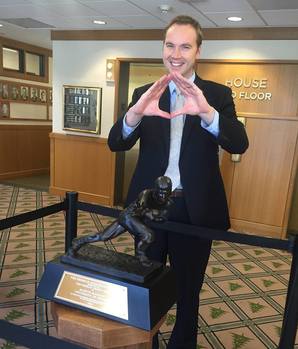
Capitol Visitor - Heisman Trophy


Trophy


The Heisman Memorial Trophy made an appearance at the Legislature on June 16th. I learned that one Heisman is presented to the winner, and one is presented to the player's school - thus the University of Oregon brought its original to the Capitol. It's about 25 pounds. Having personally witnessed Marcus Mariota's stunning Rose Bowl performance, I couldn't help but express some fan spirit. But ever-attempting to be the bipartisan Representative, I assure you I have attended exactly the same number of Beavers and Ducks home football games, and always root for the home team.


Other Bills Recently Passed By the House


June 14, 2015 - June 25, 2015

The following is a partial list of bills that recently passed the House. (Click This Link to Find the Status of All House Bills) or follow OLIS, the State’s system to track bills and see committee agendas: Oregon Legislative Information (OLIS) 


HB 3557 - A Relating to public records. Requires public bodies that receive requests for disclosure of specified personal contact information of public employees or certain other persons to forward copy of request to affected persons whose information is subject of request or their representatives.

SB 458 Relating to a day to commemorate Oregon statehood. Designates February 14 of each year as Oregon Statehood Day.

SB 580 - B Relating to landscaping. Authorizes landscape contracting business to install outdoor artificial turf.

SB 879 - B Relating to mortgage loan origination. Exempts individual from requirement to obtain mortgage loan originator's license if individual as seller during any 12-month period offers or negotiates terms for not more than three residential mortgage loans that are secured by dwelling unit that individual owns or that limited liability company of which individual is member owns and that did not serve as individual's residence if membership in limited liability company consists only of individual and individual's relatives, if individual and limited liability company do not advertise that limited liability company engages in business of making residential mortgage loans and if individual complies with other requirements. 

HB 2016 - B Relating to statewide education plans. Directs Department of Education to develop and implement statewide education plan for early childhood through post-secondary education students who are black or African-American or not covered by existing statewide education plan and have experienced disproportionate educational results.

HB 2228 - A Relating to retention of fingerprint information. Requires Department of State Police to establish voluntary program through which department retains fingerprint cards or creates facsimiles of fingerprints received from Federal Bureau of Investigation, or created during state criminal records check, for purpose of notifying agencies and districts that subscribe to program of receipt of fingerprints or other identifying information by department for reasons related to administration of criminal justice.

HB 3100 - A Relating to public health. Changes governmental framework for conducting public health activities in this state and for providing public health services to residents of this state. 

HB 3479 - A Relating to assistance for women veterans. Creates position of Oregon Women Veterans Coordinator in Department of Veterans' Affairs and specifies responsibilities.

SB 72 Relating to fees for nursing license. Increases fees to take nursing examination and renew nursing license.

SB 696 - B  Relating to autism spectrum disorders. Increases membership of Behavior Analysis Regulatory Board.

HB 2936 C Relating to substance abuse treatment. Defines "sobering facility." Requires facility to adopt policies in consultation with addiction treatment program or provider.

HB 3230 - B Relating to registered residential facilities. Modifies registration requirements for certain residential facilities. 

HB 3400 - A Relating to marijuana. Makes changes to Ballot Measure 91 (2014).

HB 2041 - A Relating to marijuana. Imposes tax on retail sale of marijuana items, to be imposed upon consumers and collected and remitted by marijuana retailers.

HB 2968 - B Relating to reports on State School Fund expenditures. Directs Chief Education Officer to convene work group to produce report on how State School Fund expenditures relate to educational achievements of students from families in poverty.

SB 293 Relating to statutory gift limit exemption. Expands exemption from statutory gift limit to include admission provided to, or cost of food or beverage consumed by, relative of public official who accompanies public official at reception, meal or meeting.

SB 473 - B Relating to identifying information at higher education institutions. Requires each public university to allow students, faculty and staff to identify sexual orientation on forms used to collect demographic data.


Sincerely,

State Representative John Davis
House District 26: Wilsonville, Sherwood, King City,
Hillsboro, Beaverton, Aloha, Tigard, & Bull Mountain

EmailRep.JohnDavis@state.or.us
Websitehttp://www.oregonlegislature.gov/Davis
Capitol Address: 900 Court St. NE, H-483, Salem, Oregon 97301


Legislative Staff 
Legislative Director - Michelle Felton - michelle.felton@state.or.us
Small Business Liaison - Sterling Smith - sterling.smith@state.or.us

Committees

House Committee on Revenue
Joint Committee On Tax Credits - Co-Vice Chair

Joint Committee On Health Insurance Transition
House Committee on Tansportation and Economic Development - Vice-Chair


Quick Links
The State’s system to track bills and see committee agendas: Oregon Legislative Information (OLIS) 

Our State of Oregon Legislative Website: Oregon Legislature