Responding to fiscal uncertainty
2026 is off to a dizzying start for Oregon’s substance use disorder (SUD) service ecosystem. In just the past week, providers heard a series of unexpected announcements related to SUD funding.
First, the federal government canceled nearly $2 billion in grants for addiction and mental health service providers – then, it completely reversed course, indicating the grants would stay in place.
Meanwhile, in Oregon, providers in the Behavioral Health Resource Network (BHRN) program learned the grants they’ll be receiving over the next few years will be smaller than expected. Thanks to the Oregon Opioid Settlement Prevention, Treatment and Recovery (OSPTR) Board, the cuts won’t be as large as they could be. The Settlement Board on Wednesday voted to contribute $13 million in funding for the BHRN program, helping close its budget gap for the next year.
The events of the past week bring into focus a major vulnerability that both the Settlement Board and the ADPC are committed to addressing: Oregon’s SUD services ecosystem is far too reliant on unstable funding streams.
To read more about this issue and the OSPTR’s vote to support BHRN funding, check out the ADPC Blog.
 |
|
Commission, Committee Updates
|
The ADPC had a very productive meeting on Monday, covering a number of important topics. The Commission heard a presentation about the impacts that HR 1, the massive federal budget bill passed last year, will have on SUD services and systems. Next, Sen. Lisa Reynolds told the ADPC about the bill she is introducing this year, the Safer Access to Marijuana Act. Then, John Brady from the Oregon Liquor and Cannabis Commission (OLCC) gave the ADPC a primer on the “cocktails in a can” debate. After that, April Roman, a behavioral health advisor to Gov. Kotek, spoke about the governor’s extension of Oregon’s state of emergency on unsheltered homelessness. Finally, the ADPC voted on revisions to its bylaws. Phew!
The ADPC Treatment Committee met on Wednesday, reviewing its work over the past year and engaging in a team-building exercise. Then the committee previewed the upcoming year, which starts with fact gathering and will encompass tasks like monitoring funding changes and developing best practices for the treatment field.
The Oregon Youth Addiction Alliance (OYAA) also met on Wednesday, hearing updates on two of their priority areas: Home and Schools. The Oregon Department of Education shared efforts to expand access to Recovery Schools via satellite sites. The Department also shared progress in implementing the OYAA's goal of providing funds to schools to increase early intervention and recovery programs - 5 schools have been identified so far! Then, OYAA members shared their experience hosting other youth for a forum on in-home behavioral health services. Building on that theme, OHA is developing a Request for Grant Proposals to provide substance use supports through the Intensive In-Home Behavioral Health Treatment program.
On Thursday, the ADPC Recovery Committee reviewed its charter and bylaws, as well as the main strategies the Recovery Committee will be pursuing as part of the ADPC comprehensive plan. The Committee took a closer look at its plans to support recovery community centers as well as peer recovery support services.
 |
|
Apply for the M110 Oversight and Accountability Council
|
Oregon Health Authority (OHA) is seeking applicants to serve on the Oversight and Accountability Council (OAC), a Council established by Ballot Measure 110 in 2020. The OAC is a public body of the state of Oregon that advises the Oregon Health Authority on the grant program described in ORS 430.389
OHA is seeking new members in the following categories:
- An academic researcher specializing in drug use or drug policy
- A representative of a coordinated care organization
Members of the OAC serve four-year terms. Members may be eligible for a stipend to compensate them for their time engaged official duties of the OAC. To apply, submit an application here by 11:59 pm, January 30.
A team at OHA will review applications and inform applicants of appointments by Feb 13, 2026. For questions or more information, email BHRN@OHA.oregon.gov or contact Karli Moon at Karli.moon@oha.oregon.gov or 971-240-8690.
 |
|
Dry January offers opportunity to 'Rethink the Drink'
|
As people across Oregon take part in Dry January, Oregon Health Authority (OHA) is encouraging them to use the popular no-drinking challenge as a chance to reflect and rethink the role of alcohol in their lives. Through its Rethink the Drink campaign, OHA is helping people in Oregon learn more about the health impacts of excessive drinking and explore changes that can make a difference in their health.
“Dry January is an opportunity to check in with yourself. Even taking a short break from alcohol can help people notice changes in their sleep, mood, energy, focus and overall well-being,” said OHA Deputy Health Officer Dr. Tom Jeanne.
The Rethink the Drink campaign encourages people to:
- Learn how alcohol affects the body and mind
- Reflect on their own drinking patterns
- Try alcohol-free options and new routines
- Make informed choices that support their health
- Talk to your friends and family about the role of alcohol in your lives
To learn more about Dry January and find tips and support, visit RethinkTheDrinkOregon.com.
 |
|
Virtual series: Grant Seeking 101
|
The Oregon Council for Behavioral Health is hosting a 3-part virtual learning experience designed for behavioral health leaders and staff with little or no experience in private grant seeking.
- Tuesday, February 10 at 11 AM - Why Private Grants?
- Tuesday, February 17 at 11 AM - Prospecting & Relationships
- Tuesday, February 24 at 11 AM - Applications, Reporting, and Grant Management
Each webinar will be 60 minutes (45 minutes of content, 15 minutes of Q&A). The webinars are led by Ari Breakstone, a versatile nonprofit leader with more than 15 years of fundraising experience.
More information can be found here.
The registration link can be found here.
 |
|
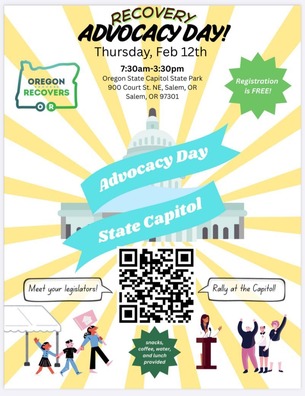
Register for Oregon Recovers Advocacy Day 2026!
|
Calling All Recovery Advocates! It’s time to for Oregon Recovers Advocacy Day 2026 at the Oregon State Capitol!
Oregon’s prevention, treatment, and recovery services are at risk due to proposed budget cuts. Now is the time to stand together and make our voices heard! Let’s show lawmakers that recovery saves lives and strengthens communities.
Thursday, February 12, 2026, 7:30 AM – 3:30 PM
Click here to register.
 |
|
Upcoming ADPC Meetings
|
- January 27, 9:30 am: ADPC Harm Reduction Committee Meeting
- January 28, 10:30 am: ADPC Prevention Committee Meeting
- February 9, 1 pm: ADPC Commission Meeting
- February 11, 3 pm: ADPC Treatment Committee Meeting
- February 11, 4 pm: Oregon Youth Addiction Alliance Meeting
- February 19, 1 pm: ADPC Recovery Committee Meeting
More ADPC meeting information is available here.
 |
|
Recent SUD-related headlines
|
-
Oregon’s slow but steady progress adding drug treatment beds is at risk – The Oregonian, Jan 2
-
‘Dry January Fest’ attracts hundreds in Portland, as demand spikes for booze-free drinks – OPB, Jan 4
-
Merkley, Scott Lead Bipartisan Legislation to Fight Opioid Overdose in Schools, Support School Access to Naloxone – Sen. Merkley’s Office, Jan 7
-
Cannabis and hemp industries might be looking at a sea change – OPB, Jan 8
-
Decrease in drug deaths stems from ‘shock’ to fentanyl supply, new research suggests – STAT News, Jan 8
-
Governor Kotek Issues Executive Order to Extend Homelessness Emergency – Governor’s Office, Jan 9
-
New state workplace safety laws prompt Oregon OSHA rulemaking process – Safety & Health Magazine, Jan 14
-
Oregon’s mental health workforce shortage is fueled by red tape; new bill aims to fix it – The Oregonian, Jan 15
|