Your feedback will help us understand community priorities and inform what's next for regional tolling in the Portland metro region
Over the last six years, ODOT has worked with community members and regional partners to develop a toll program that raises funds for transportation improvements, keeps drivers moving with less bumper-to-bumper traffic, and minimizes traffic on nearby streets caused by drivers avoiding a toll. The input we heard from thousands of comments helped us develop three tolling options on I-5 and I-205 and examine traveler and regional needs.
Now, we want to hear from you to help us understand what matters most.
 Click the image to take our survey.
The Regional Mobility Pricing Project would toll I-5 and I-205 in the Portland metro region to help pay for transportation improvements and get you a faster trip. This regional toll project is part of the Oregon Toll Program, which also includes the I-205 Toll Project.
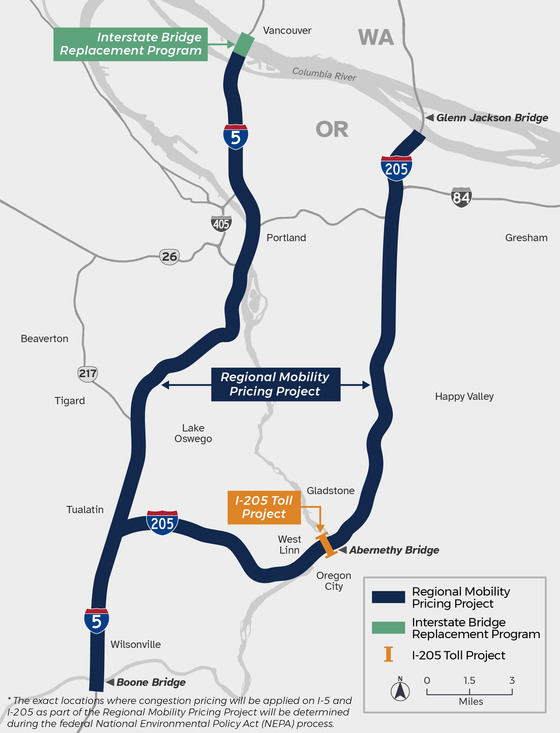 A map of the project area.
Developing and comparing tolling options
Metro, our regional government, conducts traffic analyses for major transportation projects in the Portland area. In Metro’s initial analysis of tolling options, they found that all proposed options would successfully result in average travel speeds of 40-55 mph. All options would also raise revenue for transportation improvements, reduce regional vehicle miles traveled, and minimize traffic on nearby roads caused by drivers avoiding a toll. All options also have similar average costs for travelers.
We developed three options for when, where, and how drivers would be charged a toll.
-
Option 1: All drivers would pay a base toll when they enter the highway during daytime hours. Drivers would pay an additional toll when they go through high-traffic toll points to keep traffic moving.
-
Option 2a and Option 2b: Drivers would only pay tolls when they travel through toll zones during high-traffic times of day. Compared to Option 1, there is no base toll and tolls in the zones would be $0 during low-traffic times of day.
We identified some key differences between the options when we looked at factors such as cost, construction considerations, potential to generate revenue for transportation improvements, and how well each option would encourage people to take transit or carpool instead of driving alone.
Key differences between the options include:
- Option 2a and 2b may be less expensive and simpler to design, build, and operate than Option 1.
- Option 1 would likely take longer to build than Option 2a or 2b.
- Option 1 may encourage people to take other modes of travel (like public transit) instead of driving alone more than Option 2a or 2b.
Read more about the findings of our analysis here.
Learn more and share your voice!
Tolling will bring changes to the Portland metro region—and it will help improve our transportation system. There are many decisions still to be made for this project, and we need to hear from you to help us build a regional tolling system that works for our communities.
Community members will help shape the Oregon Toll Program.
- Take our 5-minute survey by October 9. Surveys are available in:
- Come see us and ask your questions. Check out our events calendar for more detail.
- Sept. 26 | Glenfair Elementary Food Bank | NE Portland
- Sept. 27 | Adelante Farmers Market | Forest Grove
- Sept. 28 | Gladstone Senior Center | Gladstone
- Sept. 29 | Vancouver Library | Vancouver
- Sept. 30 | Moon Festival hosted by Vietnamese Community of Clark County | SW Washington
- Oct. 2 | Wilsonville Library | Wilsonville
- Oct. 4 | Beaverton Library| Beaverton
- Sign up for email updates or follow ODOT on social media for project updates.
- Learn more here
Next steps
Your input will help us refine the project before we analyze the benefits and effects and share the results for public review and comment in a report called an Environmental Assessment. The earliest tolling could begin is 2026.
We want to continue hearing from community members throughout the development of this project. Sign up for email updates, email us (Oregontolling@odot.oregon.gov) or follow ODOT on social media for project updates.
About the Oregon Toll Program
Tolling is part of ODOT’s long-term strategy to help pay for transportation improvements and provide faster, more efficient trips through the Portland metro region. The Oregon Toll Program consists of two toll projects in development: the I-205 Toll Project and the Regional Mobility Pricing Project. The Interstate Bridge Replacement Program is also proposing tolls as a source of funding and congestion management.
Project information and input opportunities are open to everyone
For ADA (Americans with Disabilities Act) or Civil Rights Title VI accommodations, translation/ interpretation services, or more information call 503-731-4128 or Oregon Relay Service 7-1-1.
Si desea obtener información sobre este proyecto traducida al español, sírvase llamar al 503-731-4128.
Nếu quý vị muốn thông tin về dự án này được dịch sang tiếng Việt, xin gọi 503-731-4128.
Если вы хотите чтобы информация об этом проекте была переведена на русский язык, пожалуйста, звоните по телефону 503-731-4128.
如果您想瞭解這個項目,我們有提供繁體中文翻譯,請致電:503-731-4128
如果您想了解这个项目,我们有提供简体中文翻译,请致电:503-731-4128
The information in this document, and the public and agency input received, may be adopted or incorporated by reference into the environmental review process to meet the requirements of the National Environmental Policy Act.
|