 July 9, 2020
People are depending on us to make it through the pandemic. We are grateful that we could temporarily expand access to many of our programs and offer more benefits to Oregonians during these trying times. We wanted to remind you of the helpful, web-based resources DHS has in place. The best way to get real-time updates about our response to the pandemic is to follow us on Twitter @OregonDHS. Help us spread the word about these resources at work and in your neighborhood.
 |
|
Needfood.oregon.gov: There are new and expanded resources available to help Oregonians meet their food needs. This website connects people with a comprehensive list of grocery and meal programs. A promotional flyer can be downloaded in 12 languages. Social media resources are available in English and Spanish.
|
|
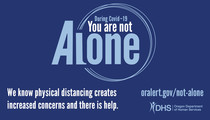
You Are Not Alone: More than 100 providers came together to create this resource to remind Oregonians that physical distancing creates an increased risk for neglect, abuse and exploitation, and to provide resources to help. Information is available in English and Spanish, and more languages are in the works.
|
|
 |
 Try this Skype for Business tip

I hear noises on my Skype meeting calls
Possible reasons; how to resolve:
- Poor audio equipment quality
- Are there loose connections to the headset, loose wires, or a bad plug?
- Check for background noise (on your device or from participants)
|
For instructions and more information:

Human Resources and local management notify staff as soon as possible when there is potential exposure to COVID-19 in an office. Human Resources also makes that information available to everyone through real-time updates on a webpage. The webpage includes a master list of notifications and individual notification letters.
Staff can help keep work environments safe by letting their supervisors or managers know when they are having coronavirus-like symptoms or have been medically mandated to be off work. Human Resources encourages staff to use COVID leave options to seek medical care and get tested when needed. There are options for staff without accumulated sick leave. Early communication and testing are vital to stopping the spread of COVID-19. Don’t delay!
|
New notifications since our last edition:
Staff, volunteers make conversation masks for people who are Deaf and hard of hearing
 |
|
It began with a conversation about how to help protect DHS staff. That conversation, and many volunteer hours of research and sewing, led to a different way to help people who are Deaf and hard of hearing.
Sue Wilson is the executive director for the nonprofit Sustainable Living Center. During a conversation with neighbor and DHS Director Fariborz Pakseresht, she learned that he wanted to find a way to get face coverings for DHS staff.
|
“After that discussion, a small group of us researched patterns and collected donations. By the next Monday we took in 100 prototype masks,” Sue said. “Fariborz shared them with DHS leadership and they were interested in more.”
Sue said they then reached out to the community beyond the neighborhood asking for volunteers to prepare and sew face coverings. The group provided completed face coverings as well as kits with material, fabric ties and instructions to DHS offices.
“We worked with Amy Church, volunteer coordinator at DHS, to find people who could sew,” Sue said. “Assuming all those kits were completed, more than 3,000 face coverings have been sewn for DHS.”
Need emerges for face coverings with clear inserts
Emily Armstrong, Vocational Rehabilitation (VR) strategic development and innovation officer, is the emergency management liaison for VR. “I saw this as an opportunity to assist others during a time where I was feeling rather limited in my ability to provide any kind of support,” Emily said. She and other VR staff used the Sustainable Living kits to sew face coverings, then distributed them to VR offices.
“We were so grateful to partner with Sustainable Living to distribute pre-made face covering and kits,” Emily said. “And we quickly discovered a need for people who are Deaf and hard of hearing.”
“We’ve been hearing from Deaf and hard of hearing people on challenges they’d had communicating with face masks,” said Barbara Robertson, hard of hearing specialist with the Oregon Deaf and Hard of Hearing Services unit in the Aging and People with Disabilities program. ODHHS is a resource for all Oregonians to improve quality of life for Deaf and hard of hearing people and their families.
“From the perspective of a person who is hard of hearing, a face covering makes communication enormously difficult,” Barbara said. Facial expressions, which are an important part of communication, can be unfathomable when any part of the face is covered.
“We were starting to see masks with clear insets in them. I wondered if we could modify the pattern to help Deaf and hard of hearing people when others are using the facial coverings,” Emily said.
Pattern, instructions available to public
“Emily asked us for advice on making modifications to the design and we reached out to some of our quilters and sewers,” Sue said. “It was a great opportunity to collaborate and share what we knew and then to see her using that.”
“Barbara and I ordered some,” said Krista Gallagher, Deaf specialist with ODHHS. “I want to share mine with other people because those masks are more of a benefit to me to have other people using them.”
“After Emily adapted the pattern, she shared it with us,” Sue said. “We’ve passed on her pattern and instructions to help others.”
Emily’s face covering instructions are now publicly available on the VR COVID-19 web page. “Now anyone interested in a conversation mask can make one,” Emily said.
|