 July 2, 2020
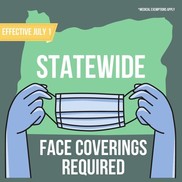
DHS has a responsibility to protect the health of our workforce, partners and the Oregonians who depend on us. DHS is now requiring all staff to wear face coverings while interacting with the public and while in the public spaces of DHS buildings. We also have new face covering requirements for visitors to DHS offices. Please read the full DHS guidance here.
The change took effect on July 1, 2020 when the Governor began requiring Oregonians statewide to wear face coverings in indoor public spaces to reduce the transmission of COVID-19.
|
The DHS face covering guidance means:
- Staff are required to wear face coverings when interacting with the public and when they are in the public spaces of DHS buildings. Examples of public spaces in DHS buildings are lobbies, conference rooms, break rooms or hallways.
- Staff can bring their own face covering or use one provided by the Department.
- Staff do not need to wear a face covering while at their workstation if physical distancing is in place and they are not interacting with anyone.
- Staff with medical conditions or disabilities that prevent them from wearing a face covering are exempt from the requirement. DHS also will exempt staff and visitors who experience emotional distress related to face coverings.
 Get the facts on face coverings and tell a friend
We all know that people spread respiratory droplets by coughing and sneezing. But did you know that we also spread respiratory droplets by talking, laughing and singing?
These respiratory droplets are why the Oregon Health Authority (OHA) strongly recommends that Oregonians wear cloth face coverings and why face coverings are required in public settings. See the OHA Face Covering fact sheet.
“Wearing a face covering is a simple, common sense way to protect yourself and others. It’s an easy way to help reduce the spread of COVID-19 and save lives,” said Governor Kate Brown.
The Governor today launched a statewide public awareness campaign to inform Oregonians about the urgent importance of wearing face coverings when out in the public. You can check out the ad here.
A social media toolkit with 70 different graphics in English and Spanish also is available for Oregonians to help spread the message that face coverings can reduce the transmission of COVID-19.
|

Do your part to keep Oregon safe this weekend
Over the past five weeks, Oregon has seen the number of people with COVID-19 quickly growing. More younger people are getting COVID-19, and the virus is spreading more widely in both our rural and urban communities.
With cases surging at an alarming rate, Governor Kate Brown extended her declaration of a state of emergency regarding COVID-19 for another 60 days, until September 4.
Health experts advise us that Oregon is at a crossroads and stress the importance of staying vigilant when it comes to health and safety precautions. If we don’t, we could see an exponential growth in cases, and newly reopened communities and businesses could close again.
We know people are tired of being cooped up and are eager to get out. Every Oregonian still has a role to play in reducing the spread of COVID-19. Please follow these tips from our friends at OHA to have a safe Fourth of July holiday and keep Oregon on its path to reopening.
|
Tips for a safe Fourth of July
The safest choice this holiday is to celebrate at home. If you choose to celebrate in other ways, activities that take place outdoors, allow for enough room to maintain physical distancing and involve fewer people are lower risk than activities that take place indoors, don’t allow for physical distancing and involve more people. Below are some extra tips for enjoying the holiday safely:
-
Stay home if you’re sick or if you have an underlying medical condition that puts you at higher risk of severe illness from COVID-19.
-
If you host a gathering, provide hand sanitizer or give people easy access to places where they can frequently wash their hands.
-
Adjust your food offerings to avoid sharing utensils and offer individual servings. Don’t share drinks.
-
During and afterward thoroughly clean all frequently touched areas your guests have access to.
-
Wear a mask if you cannot maintain 6 feet of physical distance.
Tech tips on Skype for Business

The Office of Information Services (OIS) provides weekly tips on the top issues reported by staff and partners through the Skype for Business after-meeting online survey. This week OIS shares audio tips.
|
Other participants can’t hear me
Possible reasons
- You may not have an audio source selected or an incorrect audio source selected (headset model, speaker model, etc.).
- Your headset may be disabled or just not set up properly.
- You may be muted – check in the Skype application and/or on the headset controls.
To resolve the issue (refer to documents below for instructions)
- Check to see if the audio source on your desktop, laptop, or mobile device is enabled and set to default.
- Check to see if the correct audio source is selected while using Skype.
- Check to ensure the Skype application microphone is “on,” and/or the headset mute control button is “off.”
For instructions and more information
 |
|
Human Resources notifies staff as soon as possible when there is potential exposure to COVID-19 in an office. Human Resources also makes that information available to everyone through real-time updates on a webpage. The webpage includes a master list of notifications and individual notification letters. |
New notifications since our last edition:
- July 2, 2020: D12 Hermiston Office
- July 1, 2020: D4 CW Albany Office
- July 1, 2020: D5 McKenzie Center
- July 1, 2020: D14 CW Ontario Branch
- July 1, 2020: D12 Pendleton CW
- June 30, 2020: SACU Oak Island
- June 30, 2020: APD Central Office
- June 30, 2020: SACU Alder Island Portland, OR
- June 30, 2020: D12 Pendleton SSP & CW
- June 30, 2020: D10 Redmond Office
- June 30, 2020: D4 CW Newport
- June 30, 2020: D6 Roseburg Office
- June 30, 2020: D14 Ontario Branch
- June 30, 2020: VR
- June 29, 2020: D12 APD
- June 26, 2020: SACU Elm Island
|



