
Updated Parent/Child Visitation Guidelines during COVID-19
Oregon Department of Human Services sent this bulletin at 06/03/2020 09:13 AM PDTTo: Foster Parents and Relative Caregivers Certified through Oregon DHS Child Welfare
From: Oregon DHS Child Welfare Leadership Team
Dear Foster Parents and Relative Caregivers,
Oregon’s planned re-opening phases under the Governor’s Stay Home, Save Lives Order allow for the Oregon Department of Human Services Child Welfare to provide supervised in-person visits for the children in our care and their parents. In-person parent/child visitation is essential. We are regularly reassessing our guidance around in person visitation to mitigate risk and ensure that everyone can remain as safe as possible.
As we know, visitation between children and parents is key to developing and maintaining a parent-child relationship, reducing the anxiety children experience when separated from their parents, and working towards reunification and concurrent permanency plans. Frequent visitation has consistently been found not only to benefit children emotionally and reduce the impacts of trauma, but also to contribute to the achievement of reunification.
In-person visits will be conducted following the most current guidance from the Center for Disease Control (CDC) and local health authorities. The guidance that follows has been reviewed and approved by a child psychiatrist who is a Senior Health Advisor on the COVID-19 Incident Response Team.
Unsupervised visits will continue to occur with the plan developed for each family given their specific circumstances, and in compliance with any active court orders regarding visitation. In addition, visitation plans will be developed in consultation with the child (when age/developmentally appropriate), parent, foster family, and, if applicable, tribe.
Visits supervised by DHS staff, foster parents, or Safety Service Providers (SSPs) will continue to be provided and may occur in DHS offices or other community locations. DHS staff should continue to work with parents and others to explore and evaluate other possible resources to supervise visits where appropriate. Due to possible limitations on the number of in-person parent/child visits that can be provided by DHS staff while following additional screening, disinfecting and social distancing protocols, the guidance for virtual visits will remain in effect to enhance the frequency of visits for children and their parents. Virtual visits are intended to supplement, but not substitute for, in-person visitation.
WHAT YOU CAN EXPECT FROM ALL DHS STAFF AND DHS CONTRACTED PROVIDERS:
- Any DHS Staff or DHS Contracted Provider that has symptoms or a positive test for COVID-19 in the last 10 days will NOT be conducting child visitation.
- ALL DHS Staff and DHS Contracted Providers will contact caregivers and parents in advance to establish expectations on how the in-person visit will be conducted (i.e. in an area outside, in the home, at a DHS office or predetermined location, arrival time, etc.).
- DHS staff will contact the parent(s) and the child’s foster parent to screen for exposure to COVID-19 the day prior to the scheduled in-person visit.
- ALL DHS Staff and DHS Contracted Providers will practice good hygiene according to CDC guidelines AND will be wearing a facial covering.
- All DHS Staff and DHS Contracted Providers will follow the comprehensive guidelines set forth in the Guidance for In-Person Family Contact During Covid-19.
- DHS will provide diapers, wipes, water and snacks for visits in offices.
WHAT DHS EXPECTS FROM PARENTS:
-
Tell your caseworker if you’ve been sick with symptoms (listed below) or you’ve been around someone who has tested positive for COVID-19. If so, your in-person visit will be rescheduled. Virtual visitation should continue.
-
Symptoms may appear 2-14 days after exposure to the virus. People with these symptoms or combinations of symptoms may have COVID-19:
- Cough
- Shortness of breath or difficulty breathing
-
Or at least two of these symptoms:
- Fever
- Chills
- Repeated shaking with chills
- Muscle pain
- Headache
- Sore Throat
- Recent loss of taste or smell
-
Symptoms may appear 2-14 days after exposure to the virus. People with these symptoms or combinations of symptoms may have COVID-19:
- If you have symptoms, a positive test for COVID-19 or have been around someone with a positive test for COVID- 19, virtual visits should be held until at least 10 days since symptoms first appeared AND 3 days have passed without symptoms (without the use of fever-reducing medications), or after you have received a negative test result.
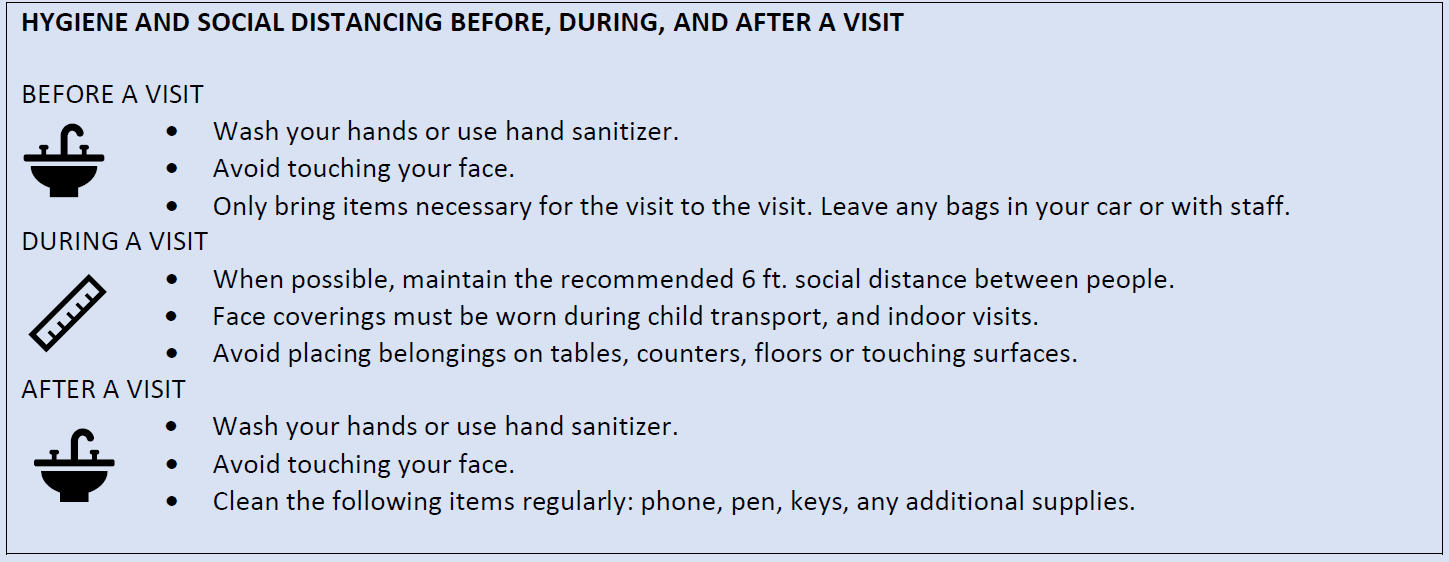
- Please arrive 15 minutes prior to the scheduled visit and wait in their car or parking lot maintaining social distancing of 6 feet from others. Let DHS staff know when you have arrived.
- Please leave personal items that will not be needed in a car or put them in a plastic bag provided by DHS staff. This includes jackets, purses, bags, and backpacks.
- You must wear a face covering for your visit, unless it needs to be removed to address your child(ren)’s fears. If you do not have a face covering, one will be provided to you.
- Please do not bring food or drinks to visits. Water and small snacks can be provided by DHS staff for visits in the office.
- You may hug your children and have physical contact. Please avoid touching of faces when possible.
- DHS has developed additional guidelines to help protect the health and safety of you and your children with in- person visits. Your caseworker will talk to you about those guidelines. If you have any questions, you can talk to your caseworker.
WHAT DHS EXPECTS FROM CAREGIVERS:
- DHS staff will contact you ahead of the scheduled visit to plan for that visit. During that planning call, you will be asked if any member of your household has tested positive for COVID-19 in the last 10 days, has symptoms of COVID-19 (see above) or has been exposed to someone who tested positive for COVID-19. If no, the visit will proceed with appropriate safety precautions. If yes, or if the child has been determined to be immune compromised and/or medically fragile, a team meeting may be scheduled to discuss the visitation plan.
- If age-appropriate, teach the children in your care proper hygiene techniques as outlined by the CDC and inform them that adults may be wearing facial coverings, so they are not surprised. Facial coverings are not recommended for children under 2 years of age, nor for individuals who cannot safely manage their own face coverings.
- You may provide transportation for children to visits whenever safely possible and based on your availability.
- Please engage with parents at a safe social distance of six (6) feet. This is an opportunity to share information, updates, and build a relationship.
- Ensure that children are fed and well-hydrated prior to the visit to prevent the need for bringing snacks into the visitation room.
- For infants who are bottle fed, send a bottle and enough formula for the time the child will be with DHS staff and parents.
- DHS has developed additional guidelines for transportation and preparation of children for visits. The caseworker will go over the guidelines with you prior to the visit(s).
We thank you for all that you are doing to care for children and young adults in foster care!
Child Welfare Leadership Team

You can view or update your subscriptions, password or email address at any time on your User Profile Page. All you will need are your email address and your password (if you have selected one).
This service is provided to you at no charge by the Oregon Health Authority and the Department of Human Services.
If you have any questions about this service, please visit the GovDelivery user support website.