|
Until recently, China has been the world’s largest importer of
recycled paper and plastics – including most of Oregon’s mixed paper and
plastics. In March, China imposed severe restrictions on imports in part due to
high levels of contamination and in July, announced total bans on some
materials by January 2018.
China’s
abrupt actions have created uncertainty and disruptions in Oregon’s recycling
markets. Our recycling systems have been structured to produce mixed paper and
plastic for China’s markets, and it will take time to re-structure those
systems to meet the new standards or find new markets if China further limits
or stops accepting our materials. Recycling processors are slowing sort
lines to remove more contaminants and meet tighter standards. This has reduced
processing capacity, and with Oregon’s strong recycling ethic, the flow of
incoming material is not slowing down.
Oregon DEQ is working closely with
local governments, collectors, recycling processors and industry
representatives on short term
solutions to problems caused by China’s abrupt actions – and planning longer
term changes to update our recycling systems to recycle effectively in new
market conditions.
Oregonians can help now by knowing what their recycling programs
accept and putting only clean, accepted materials in recycling bins.
More information about China’s proposed ban is available
on our website.
To receive updates on Recycling Markets, sign up
for email or text updates.
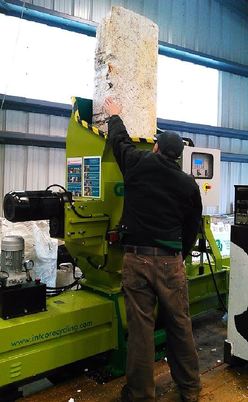 Recycling Expanded Polystyrene foam (EPS),
such as Styrofoam, is rarely economical, since 98 percent of the space taken up
in a truck used to transport it is simply air. In areas like Tillamook, the distance
to market it is at least 60 miles away, and oftentimes landfilling EPS is the
best solution.
To address this challenge, Tillamook County
applied for a DEQ grant to purchase an EPS compactor/densifier for use in
Tillamook and neighboring counties. With the funding, the county purchased a mobile densifier, a trailer and diesel generator. The purchases allow the county to bring the mobile
densifier to collection sites, compact the material, and haul the compacted
material back to the central storage location – all in one day independent of
power availability.
So far they have established four regular
collection locations in Tillamook County, where they have compacted more than
650 cubic yards of EPS into about four pallets of material since January. According
to David McCall, Solid Waste Program Manager at Tillamook County Solid Waste
Department, if a transfer station operator were able to use this additional volume in his
trailers, five trips to Coffin Butte Landfill would be avoided – saving about 200 gallons of diesel fuel.
“This project has enabled us to provide
recycling for Styrofoam to rural residents in an economically viable manner,”
McCall said. “In an area where we don’t have commingled curbside recycling, it
is a great feeling to be able to offer this convenient service to our residents
and local businesses, who are very appreciative of the opportunity. Life on the
Oregon Coast has its advantages, and projects like this make the Tillamook
Coast extra special. I hope that other rural communities will duplicate efforts
such as these, and bring innovative solutions to the residents they serve.”
More information about DEQ Materials Management grants can be
found here.
|
What are the environmental impacts of growing field-grown tomatoes verses
hot-house tomatoes? Does the type of fish feed used in land-based aquaculture systems really make a difference? And is it better for the environment to buy wine from a store or directly from a vineyard? These questions are just a small sampling of what’s reviewed in nine new literature summaries developed by DEQ, University of Michigan and Oregon
Sustainability Board.
By
focusing on the life cycle of food products, the literature summaries identify
the relative contribution of different life cycle stages (growing, processing,
distribution, consumption and disposal), the relative benefits of different
practices, and limitations in existing research. These summaries are designed
to help growers, producers, retailers, and large purchasers make informed
choices about the environmental impacts of foods. The reviews cover land-based
aquaculture, beer, citrus, coffee, pork, tomatoes, wine, transportation and
packaging.
Read full reports here.

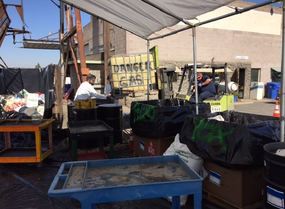 While most Oregon residents have household hazardous waste
facilities or collection events in their communities at which they can dispose
of unwanted products, some who live in small, rural towns do not. To give these
residents, as well as businesses that generate small amounts of hazardous waste
(commercially exempt generators), access to a safe way to properly reduce,
recover or dispose of these materials, DEQ’s Materials Management program
coordinates collection events in their communities.
Upcoming events include Klamath Falls on Oct. 13-14 and Canby on
Nov. 3-4. The Friday dates are for commercially exempt generators and Saturdays
are reserved for household waste. A
full schedule of upcoming events is available here.
In addition, DEQ is providing 22 Metro area middle and high schools an
opportunity to clean out old, expired and dangerous science lab chemicals. Many of these date back to the 1960s or
earlier, and some have become very unstable and potentially explosive. The program not only removes these hazards
from schools, it also provides training for teachers and staff on how to prevent
problems in the future. This program began in 2008, and has been
offered to every school district, and most private schools, in the state.
|
 This month DEQ announced its first reuse and repair workforce
development micro-grant recipients. A total of $48,596 is being awarded to five
recipients. Grant funds will be used to purchase equipment and train employees
to support long-term business expansion.
Grant recipients include The Renewal Workshop (Cascade Locks),
Garten Services (Salem), JD’s Shoe Repair (Portland), The Toolbox Project
(Eugene) and Salvage Works (Portland). Grants will support clothing and shoe
repair, diverting high-grade electronics from recycling to reuse, tool sharing,
and the salvage of reclaimed lumber. Additional details can be found at http://www.oregon.gov/newsroom/Pages/NewsDetail.aspx?newsid=2348.
The purpose of this grants program, one of DEQ’s first steps in
implementing the recently-completed Strategic Plan for Reuse, Repair and Extending the
Lifespan of Products in Oregon, is to reduce the
environmental impacts of material production and disposal through growing reuse
and repair enterprises. The selected projects focus on making reuse and repair
options more accessible, as well as normalizing the concept of repairing goods,
as opposed to disposing of them. Both small businesses and non-profits were
eligible for funding under the micro grants. This is the first year for the
Reuse and Repair Workforce Development micro grants, and is also the first time
DEQ’s Materials Management program has awarded grants directly to businesses,
using new authority provided in SB 245 (2015).
|
An estimated 30 to 40 percent of all food produced and imported
for consumption in the United States is never eaten. In Oregon, as part of a
statewide strategy to prevent the wasting of food, DEQ has partnered with
Portland State University’s Community Environmental Services to conduct a
five-part study on wasted food generation. In July, DEQ completed the first
part of this research project, a qualitative study to understand the
informational, psychological, socio-economic and structural drivers that contribute
to the generation of preventable wasted food in households.
The findings illuminate major themes on wasted food and related
behaviors in households and provide insights into major categories of beliefs,
values, attitudes and behaviors that are relevant to understanding why people
waste food in Oregon. Results are informing subsequent research tasks, and with
this understanding, DEQ is poised to identify the types of interventions most
likely to succeed in preventing the wasting of food.
The study was recently published in a BioCycle article
and can also be found on the DEQ website
here.
|




 Follow us on Twitter
  Find us on Facebook or
  Visit Oregon Department of Environmental Quality (DEQ)