|
 This is a photo of a streambank surrounded by fall foliage
|
|
|
The National Flood Insurance Program (NFIP) expired at midnight on September 30, the end of the fiscal year, leaving homeowners largely unable to secure new flood insurance or renew existing policies. As a follow-up to last month’s member alert, below are answers to some common questions you might have.
What happens during a lapse?
- The NFIP cannot issue new or renew existing flood insurance policies until the program is reauthorized. Consumers who had a pending flood policy application or renewal should confirm with their agent that they have coverage.
- Homeowners with active NFIP policies will still be covered until their expiration date, including a 30-day grace period.
- The NFIP will continue to adjust and pay claims for its policyholders, as long as funds are available. If those funds are depleted, claims payments would be delayed until additional funds become available as the NFIP collects premiums or Congress provides for additional borrowing authority.
- Private flood insurance is not affected.
What does the lapse mean for homebuyers?
- In some cases, homebuyers may be able to assume the seller’s existing NFIP policy.
- Lenders may continue making loans during an NFIP lapse, but must still conduct flood determinations, provide accurate borrower notices, and follow all other flood insurance regulations. They are also expected to manage safety, soundness, and legal risks, and consider private flood insurance options.
- Private flood insurance remains an option and should be strongly considered.
Are floodplain regulations on hold during the lapse?
- Communities must continue enforcing their local floodplain management regulations. Local ordinances are adopted as a condition of a community's participation in the NFIP. They are legally adopted local land use standards and FEMA will expect communities to continue administering and enforcing their regulations, even when the NFIP is lapsed.
|
|
 This is a photo of cracked soil
Flooding after a drought is dangerous because dry, compacted soil becomes hydrophobic, or water-repellent, reducing its ability to absorb water and causing rapid surface runoff, leading to more intense and potentially flash floods. Prolonged dryness also kills vegetation, further reducing the soil's capacity to hold water and increasing erosion, which can contribute to landslides and debris flows after heavy rainfall. How drought leads to flooding:
Hardened Soil:
Extended periods of drought cause soil to become hard, compacted, and dry.
Hydrophobic Properties:
This dryness makes the soil hydrophobic, meaning it repels water like a waterproof surface instead of soaking it up.
Increased Runoff:
When rain finally falls, the water runs off the surface into streams and rivers instead of infiltrating the ground, leading to faster accumulation and higher flood risk.
Loss of Vegetation:
Droughts kill plants, leaving the soil bare and its natural ability to absorb and hold water significantly diminished.
Why the flooding is dangerous:
Intense Rain Bursts:
Droughts can be followed by short, high-intensity rainfall events, often from thunderstorms, that can overwhelm the land's ability to absorb water.
Flash Flooding:
The combination of hydrophobic soil and increased runoff can lead to flash floods, where water levels rise very quickly.
Erosion and Debris Flows:
The lack of vegetation leaves the land vulnerable to erosion, and heavy rainfall can wash away soil, leading to landslides and dangerous debris flows.
Vicious Cycle:
Drought-induced fires can further damage the landscape and increase the risk of flash flooding and landslides, creating a destructive cycl
|
|
|
This summer has been one of the most flood-impacted on record, with states such as Illinois, Texas, New Mexico, New York, North Carolina, Tennessee, and Wisconsin all experiencing extreme rainfall that overwhelmed communities. In a thoughtful analysis, AccuWeather found a 70% increase in reports of flash flooding through mid-July compared to the 10-year historic average.
The most consequential of this summer’s flood events is the Texas flash flood on the Guadalupe River that devastated Camp Mystic and resulted in over 138 deaths and at least $18 billion in damages. In the aftermath of this terrible flash flooding, ASFPM fielded more than two dozen media inquiries on topics ranging from flood mapping and pre-disaster mitigation to warning systems and steps parents can take to ensure their kiddos’ safety.
In reflecting on those interviews, along with reviewing numerous media reports and data about the event itself, five key lessons emerged:
1. Regulatory gaps leave camps and campgrounds vulnerable
2. Advanced warnings only work when paired with an action plan
3. EAPs for flash flooding in camps/campgrounds are non-existent or insufficient
4. Plans must be practiced to be effective
5. Parents need awareness and must ask the right questions
As a floodplain manager and as a parent of an 8-year-old daughter who attended her first Girl Scout day camp the Monday after the Texas tragedy, I am embarrassed to admit that I failed in doing my own due diligence on the camp she was attending when it comes to flood risk. However, in examining the lessons that are to be learned from the Texas tragedy, I argue that we have the know-how, technology, and approaches to significantly reduce the deaths and injuries related to flash floods. Let’s honor those who lost their lives by committing to closing the gaps in oversight, preparedness, and communication to make our nation’s camps safer.
|
|
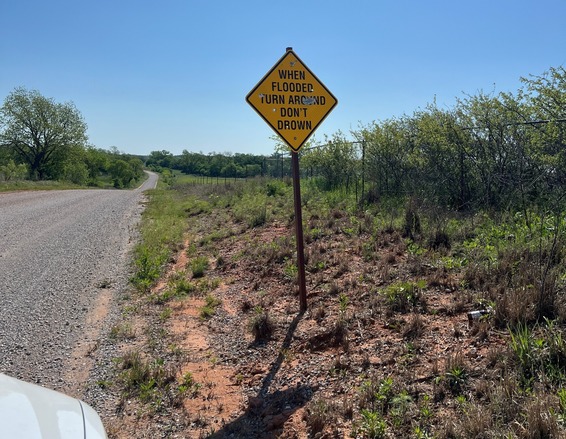 The is a photo of a Turn Around, Don't Drown sign in front of a scenic road
-
Protecting Lives and Property:
Floodplain regulations help prevent increased flood risk from development, safeguarding citizens, homes, and businesses from future flood losses.
-
Reducing Economic Impact:
Effective floodplain management minimizes flood-related damages, which reduces repair costs and business disruptions, leading to greater community financial health.
-
Enhancing Community Resilience:
By adopting and enforcing higher standards of floodplain management, communities become more resilient, able to withstand and recover more swiftly from floods.
-
Well-managed floodplains act as natural flood buffers, slow floodwaters, and offer benefits such as improved groundwater recharge, water quality, and valuable wildlife habitat.
-
FPAs ensure their communities meet minimum floodplain management standards to qualify for federally backed flood insurance and disaster assistance.
|
|
|
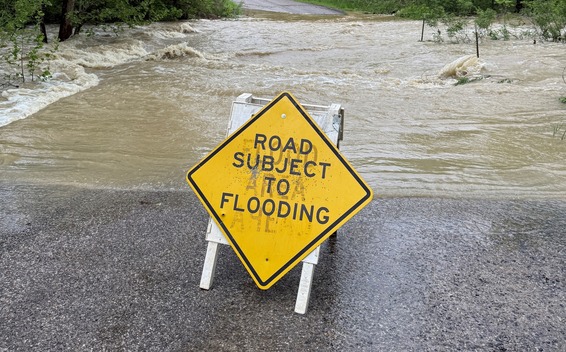
This is a photo of a sign that says "Road Subject to Flooding" and behind it is a flooded road
It is important to remember that when your community receives new FEMA floodplain maps, you are required, by law to adopt the new maps into your communities Flood Damage Prevention Ordinance.
The Oklahoma Floodplain Mangement Act Title 82. Waters and Water Rights Chapter 23 - Section 1610 - Adoption of Floodplain Regulations - Procedure Cite as:
- Floodplain management rules enacted pursuant to the Oklahoma Floodplain Management Act shall only be promulgated by the Oklahoma Water Resources Board in accordance with the Administrative Procedures Act.
- Floodplain management regulations adopted pursuant to the Oklahoma Floodplain Management Act and any amendments to the regulations shall go into effect thirty (30) days after adoption unless the regulation or amendment specifies a later date; provided, that no floodplain management regulation or amendment thereto shall be in force unless published in a newspaper of general circulation regularly published nearest the area of jurisdiction within fifteen (15) days after adoption.
- At least thirty (30) days prior to the date of adoption of a regulation or amendment thereto, written notice shall be furnished to the Oklahoma Water Resources Board, accompanied by a copy of each proposed regulation or amendment.
- A certified copy of any regulation or amendment thereto adopted by a floodplain board pursuant to the Oklahoma Floodplain Management Act shall be filed with the Oklahoma Water Resources Board within fifteen (15) days after adoption.
|
|
FEMA Region 6 has developed a suite of monthly trainings to help communities become more flood-resilient by using flood risk data for future development, emergency planning, and risk communications. Our "Virtual Brown Bag" sessions include:
-Using Base Level Engineering (BLE) at the Local Level - Trainings available for Local Officials, Local Planners, Engineering Practitioners, Floodplain Administrators and Insurance Stakeholders
-Live tutorials on pairing local data with FEMA data to develop flood risk assessments;
-Letters of Map Change (LOMCs) for Local Officials
-Base Leve Engineering (BLE) and the Community Rating System (CRS)
-Using the Estimated Base Flood Elevation (BFE) Viewer
Join us each month for these free interactive, live demonstrations! CECs are available for CFMs. In cases where the attendee would like to use the Virtual Brown Bag towards their Professional Engineering or Surveyor’s License renewals, please be aware that the CEC provided by the Virtual Brown Bag is not equivalent to a Professional Development Hour. This CEC/CEU is equivalent to 0.1 PDH. Instructions on how to receive a certificate of participation provided at each webinar.
Register at FEMA Region 6 Virtual Brown Bag
|
|
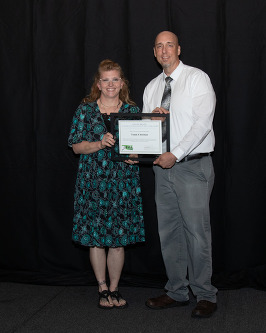 From left to right is Tonde Christian and Jesse Beck
Tonde Christian, Texas County EM/FPA, has not only dealt with historic 1000-year flooding in her community, she advocates for and assists the non-participating communities in her county as well. She is in contact with OWRB on a regular basis seeking guidance and to further her understanding of floodplain management. She is training for and hopes to sit for the CFM exam soon.
|
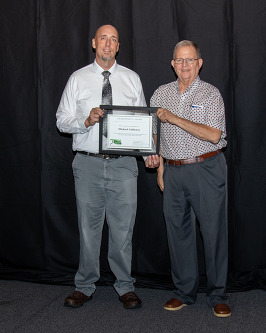 From left to right is Jesse Beck and Mike Galloway
Mike Galloway, Custer County, EM/FPA, has been an excellent, diligent floodplain administrator for many years, through several disasters. He has been a friend of OWRB and an advocate for public floodplain education and outreach. For years he donated his program funds to provide training facilities in Clinton, OK for both OWRB and OFMA classes. We’ll miss him a great deal.
|
|
|
|
|