|
FOR IMMEDIATE RELEASE
April 26, 2018
Governor Mary Fallin Signs Criminal Justice Reform Bills
OKLAHOMA CITY – Governor Mary Fallin today signed seven criminal justice reform bills that will reduce the flow of nonviolent offenders into prison; establish a more efficient
and streamlined parole process; and facilitate successful reentry that reduces
recidivism.
“Studies have shown that with our current laws Oklahoma's prison population will grow 25 percent by 2026 and cost the state an additional $1.9 billion,” said Fallin. “Criminal justice
reform has been an incredibly important issue for our state. We can be smart on crime and tough on violent violent offenders.
“Over a year
ago I charged the Oklahoma Justice Reform Task Force with examining our state’s
justice system to make efficient use of our limited state resources. Task force
members developed these recommendations that were the framework for these
bills. I appreciate lawmakers for their bipartisan approval of these vital
measures.
“Our state
prisons are filled to well over capacity so it is crucial that we make some
changes to our criminal justice system,” Fallin said. “These bills will not
jeopardize public safety while addressing Oklahoma’s prison population. Too few
Oklahomans are getting the treatment they need for substance abuse and mental
health issues, and are instead winding up in our criminal justice system. As I
said in my State of the State address at the beginning of this legislative
session, we need to stop warehousing moms and dads, son and daughters in prison
when many just need substance abuse treatment.”
“Oklahoma cannot afford the status quo,” said Senate Majority Floor Leader Greg Treat. “Our prison population is
currently at 113 percent of capacity, and is projected to grow 25 percent
by 2026. That is an unacceptable trajectory for our state and its
people. These reforms will slow the growth in the prison population
long-term. The savings Oklahoma will see from reduced corrections’ costs
will be substantial, and will allow further investment in areas like
education, health care, and mental health services that will further
reduce crime and the prison population. The Legislature, criminal
justice reform advocates, and law enforcement are in agreement on these
reforms after years of work. This is a balanced, smart approach to keep
our communities safe, keep more people as productive, taxpaying members
of society, and keep more families together.”
“It was an honor to be part of the governor’s Oklahoma Justice Reform
Task Force, and I believe we have taken some incredible steps as a state
during the last 18 months,” said House Majority Whip Terry O'Donnell. “Nearly all Oklahomans agree that their tax
dollars are better spent on core services like education, health care, and
roads and bridges than incarcerating too many people for too long.
Today marks a new direction for Oklahoma on criminal justice and
incarceration. These measures are based upon data-driven, proven
solutions that will safely reduce our prison population, save taxpayers
millions of dollars each year, and help keep families together.”
The governor signed
the following measures:
-
Senate Bill (SB) 650,
which authorizes no more than one nonviolent felony to apply for expungement if
they have no new convictions or pending charges within the last seven years.
-
SB 786, which eliminates the mandatory minimum
and allow a judge to sentence up to the current maximum sentence of seven years
in prison for burglary in the second degree, and would create a new felony
offense, burglary in the third degree (defined as breaking into a vehicle),
punishable by up to five years in prison.
-
SB 649, which reduces enhanced
sentences for certain repeat nonviolent felonies.
-
SB 689, which creates
risk and needs assessment as a tool for sentencing.
-
SB 793, which changes the
penalties for commercial drug offenses, and distinguishes conduct by possession
with intent to distribute, distribution, and manufacturing.
-
House Bill (HB) 2281,
which adjusts
penalties for numerous low-level property offenses, including larceny, forgery
and other “paper crimes.”
-
HB
2286, which creates an administrative parole process for nonviolent offenders
who comply with case plans in prison so that the Pardon and Parole Board can
focus on more serious offenders, and would establish a geriatric parole release
process for inmates who are 60 and older and who have been determined to not be
a public safety risk.
###
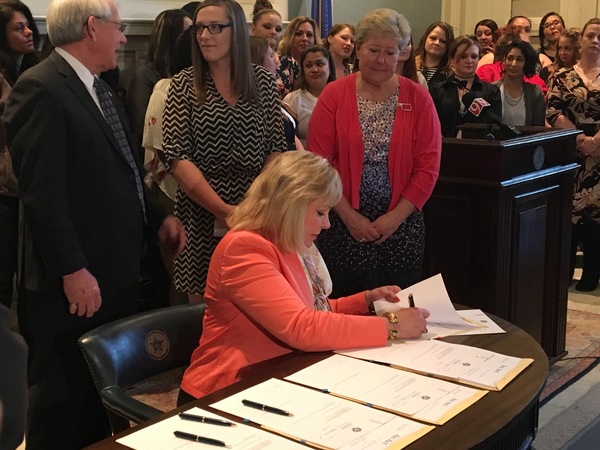 Governor Mary Fallin signs seven criminal justice reform bills Thursday that will reduce the flow of nonviolent offenders into prison; establish a more efficient and streamlined parole process; and facilitate successful reentry that reduces recidivism.
Web: www.governor.ok.gov
Facebook: www.facebook.com/GovernorMaryFallin
Twitter: www.twitter.com/GovMaryFallin
|