|
|
Please note the corrected date in the Upcoming Events section
Welcome to the quarterly newsletter for the Public Water Supply (PWS) Water Quality Division (WQD). This newsletter will keep you up to date on the latest in the world of water and will also help you ensure your systems are running smoothly by providing information and links to upcoming trainings, events, and funding opportunities.
|
|
 |

|
35th EFO Annual Meeting/Trade Show
Norman, OK
Oct 19-21, 2026
More info here
|
OMAG Sanitary
Sewer Expo
Enid, OK
Oct 12-14, 2026
More info here
|
Governor’s Water Conference
Norman, OK
Dec 2-3, 2026
More info here
|
The Area-Wide Optimization Program (AWOP) sets goals for going above and beyond regulatory requirements and focuses on maximizing water quality through operational measures and strategies. Optimization of a water system is achieved through enhanced process monitoring and control as well as using existing staff and infrastructure. Implementation of AWOP concepts increases public health protection, maximizes cost benefits, and results in providing the absolute best water possible to customers. The following systems received an AWOP Award. Awards are determined by how many points each system received.
|
|
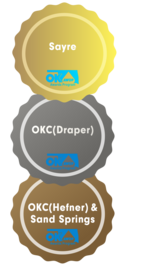 |
Points are determined by examining data of various measurements like IFE, MCL Violations, CT, etc. The total number of points a system has correlates to a 'tier' of either Bronze, Silver, Gold or Platinum. Further, each system is categorized as either a Surface Water/GUDI, Ground Water - Chlorinated, or Ground Water - NON-chlorinated system. Additionally, bonus points are given is a system hosts a CPE or workshop or participated in a water loss audit.
Click here to learn about AWOP.
Cybersecurity Advisory Update!
 |
|
Stay informed and cyber-ready with the latest security updates, alerts, and resources from the Cybersecurity and Infrastructure Security Agency (CISA) to help protect Oklahoma’s public water systems from emerging threats. Click here. |
Oklahoma DEQ’s new Operator Certification Portal makes it easier for water and wastewater operators to access certification information and manage their credentials. |
|
 |
|
|
Seasonal System Shutdown Procedures
- Inspect entire system and look for problems and damage that need attention or repairs
- Turn off the power to water supply pump
- If there is potential for pressure tank or storage tank to freeze, drain it
- If there is no potential for tanks to freeze, you may choose to leave them full
- Drain all the water from internal plumbing
- Protect distribution system by not leaving taps open during the off-season
- Turn the power off to all systems
Line Leaks and Line Disinfection
Once a leak or break is suspected, isolate the affected section as soon as possible and assess the extent of the damage. Contact your district engineer in DEQ's public water supply Engineering & Enforcement Section(PWSES), or DEQ's 24-Hour Emergency Response/Environmental Complaints Hotline at 1-800-522-0206. Be ready to report on the location and size of the break, whether pressure was lost, any signs of contamination, and your planned repair and disinfection steps.
If the size of the break is significant or areas of service have been lost, talk to DEQ about whether to issue a precautionary boil advisory. It is a voluntary notice telling customers to boil their water before use while a repair is underway, even before any contamination is confirmed. Issuing one gives your customers an added layer of protection in case contamination did enter the line.
Before returning a repaired main to service, it must be flushed and disinfected in accordance with ANSI/AWWA C651, Disinfecting Water Mains, including adequate chlorination, contact time, and satisfactory bacteriological samples before the line goes back into service.
For questions on reporting a leak or line break, contact your District Engineer through the PWSES District Map or DEQ's Water Quality contact page.
|
LCRI Update
As part of the Lead and Copper Rule Improvements(LCRI) all Community Water Systems(CWSs) must conduct lead (Pb) sampling and public education at schools and childcare facilities they serve. CWSs must first submit a list of eligible schools and childcare facilities by November 1, 2027 and update the list every five years. DEQ recommends to start creating a list of all known schools and childcare facilities that your CWS serves. Include the full name of the school, location and type (middle school, daycare, k-12 etc.). If you have any questions regarding this requirement, reach out to DWLC@deq.ok.gov. If you are interested in DEQ's Lead Testing in Schools Program, please reach out to LWSC@deq.ok.gov.
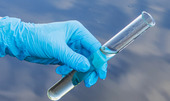
For sample collection instructions,
click here.
|
|
- Find your PWS sampling schedules here.
- Find your PWS district compliance coordinator here.
- Find your PWS district engineer here.
 |
|
EPA Launches PFAS OUT Initiative |
EPA’s PFAS OUTreach initiative—or PFAS OUT is a new outreach initiative that will proactively and systematically engage with water systems that face potential challenges with PFAS, with a focus on preparing drinking water systems for future compliance with federal drinking water standards for PFOA and PFOS.
PFAS OUT will host a nation-wide webinar series that will provide support to all water systems addressing PFAS concerns. EPA will proactively reach out to water systems with levels of PFOA and PFOS above the Maximum Contaminant Level (MCL). To identify these systems, EPA will actively review drinking water monitoring data submitted to EPA through the Unregulated Contaminant Monitoring Rule (UCMR) 5, as well as state, tribal, and territorial data sources as available. Drinking water systems with additional local PFAS concerns should reach out to EPA for technical assistance and support. For more information, click here.
See the PFAS OUT fact sheet here.
Watch this video to learn how to collect PFAs samples.
 A sanitary survey is a proactive public health measure and a key requirement of the Safe Drinking Water Act, evaluating eight areas: source, treatment, distribution system, finished water storage, pumps, monitoring and reporting, management and operation, and operator compliance.
Before your survey, gather key records:
- system population and number of service connections
- water use records (design, seasonal average, and max plant output)
- plans and specs for your Water Treatment Plant (WTP) and facilities
- current permits for your system
- updated monitoring plans, including sample siting and lead/copper plans
- finished water storage inspection reports
- chemical feed information
- your list of certified operators with certification levels
- well logs
- your lab journal documenting sample results and analyses
- Monthly Operating Reports (MORs) for the past year
- SOPs covering routine operations, cross-connection control, and maintenance
- and a copy of your Emergency Response Plan.
Next, walk your system ahead of time. Confirm that all facilities are accessible, safe, clean, and operational. Check that wells have intact sanitary seals, tank vents are properly screened, hatches have gaskets and locking devices, and any leaks are addressed. Have keys to every gate, well house, and pumping facility ready.
Operators, owners, and administrative contacts should all plan to attend and be ready to discuss general operations, management, security, and system-specific technical questions. For more on what DEQ reviews, visit DEQ's Sanitary Surveys page.
 A Notice Of Violation (NOV) is the first formal step DEQ takes when a violation is confirmed. Every NOV requires a written response. A strong written response identifies the deficiency, explains the root cause, lays out the specific steps being taken to fix it, and includes realistic target dates for completion. Your written response needs to include a few things, depending on where you are fixing the problem:
- If the violation has already been corrected: describe what caused it, explain what you did to fix it, and explain why that fix will prevent it from happening again.
- If the cause is known but not yet corrected: describe the cause, lay out a detailed corrective action plan, and include a proposed schedule for completing it.
- If the cause is still unknown: explain why you haven't identified the cause, and provide a proposed schedule for determination.
Print the response on the PWS system’s letterhead, have a responsible official sign it, and mail it to DEQ at the address provided in the NOV.
Questions about a specific finding, an NOV, or your survey report should go to your district's Public Water Supply Engineering & Enforcement Section contact. Find your district contact on the PWSES District Map, or reach the section directly through DEQ's Water Quality contact page.
|
|
Needs Survey Update:
System Selected
The Drinking Water Infrastructure Needs Survey and Assessment (DWINSA or "Needs Survey") is a national survey to assess the cost to maintain and/or bring public water supplies into compliance with the Safe Drinking Water Act (SDWA). The results of the Needs Survey is presented to the United States Congress, and money is then allocated by congress proportionally among each states' Drinking Water State Revolving Fund (DWSRF) program. The Needs Survey is completed every four years, for which a statistically significant portion of water systems are selected to participate in the Needs Survey to represent the need and cost for each state.
If you are contacted by DEQ regarding the survey, it is important to provide accurate information.
Capacity Development Annual Report
Compliance Monitoring Annual Report
|
Funding & Assistance Corner
There are a number of funding resources available. Follow these links for more information, and reach out to us with any questions.
|
|
Oklahoma State University Industrial Training and Assessment Center (ITAC) is offering its energy efficiency assessment services at no-cost to water and wastewater systems that produce or treat between three to ten million gallons per day. Get your comprehensive energy assessment, along with implementation support by visiting ceat.okstate.edu/det/itac/assessment-application.html
|
|
|
The Emerging Contaminants (EC) in Small and Disadvantaged Communities (SDC) Grant
The Emerging Contaminants (EC) in Small and Disadvantaged Communities (SDC) Grant program is dedicated to helping eligible systems manage PFAS and other emerging contaminants (including manganese). As part of this dedication, the program is offering reimbursement grants to qualifying water systems that are in the beginning stages of remediation projects. Grants can cover costs for engineering/design work, pilot studies (including sample costs), and environmental review. To be eligible systems must:
- Be tackling problems with emerging contaminants and/or PFAS
- Serve a population less than 10,000 individuals (systems serving under 3,300 will have higher priority)
- Meet the criteria of disadvantaged. Final determination made by DEQ
- Be working toward receipt of Drinking Water State Revolving Funds
Funds are also available in partnership with DWSRF funds for construction projects. All interested systems can reach out to Kamren Lambdin at Kamren.Lambdin@deq.ok.gov or Lisa Stewart at Lisa.Stewart@deq.ok.gov.
|
|
|
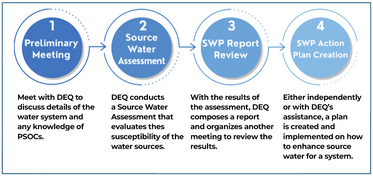
Are you interested in keeping treatment costs low, deferring complex treatment, protecting the availability of water supplies, and simultaneously protecting water quality for wildlife and recreation? Oklahoma’s Source Water Protection (SWP) Program is just the thing for you! This program assists public water systems in identifying Source Water Protection Areas (SWPAs) and surrounding Potential Sources of Contamination (PSOCs) so they can better protect their drinking water sources.
Source water protection simply refers to the proactive protection of water sources that provide for public drinking water supplies. This can include both surface water bodies such as streams, rivers, lakes, and reservoirs as well as groundwater. Less than one percent of the earth’s water is drinkable, so it is imperative that we protect the quality and presence of these sources to ensure the continued safe use of these waters.
DEQ Source Water Protection Plan Process
In the assessment completed by DEQ (at no cost!), the following will be provided:
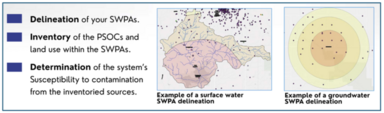 In addition, the report provided to you from DEQ will detail and discuss the results of the assessment, provide personalized suggestions on practices, projects ideas, funding sources, and community engagement, AND provide informational flyers on relevant topics to your system.
|
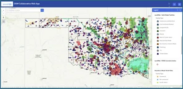
 Oklahoma has a Source Water Collaborative with active involvement from numerous state and federal agencies! This group meets quarterly to identify the SWP needs of the state, as well as to facilitate collaboration across the agencies involved. This past year, the collaborative created an online map that displays SWP. If you’re curious about your watershed, click the image below.
 Sign up to participate in the FREE program today by reaching out to the Capacity Development Section via email at DEQ.CapDev@deq.ok.gov, by phone at (405) 702-8141, or by visiting the DEQ website at oklahoma.gov/water-quality/public-water-supply/capacity-development.
|
|
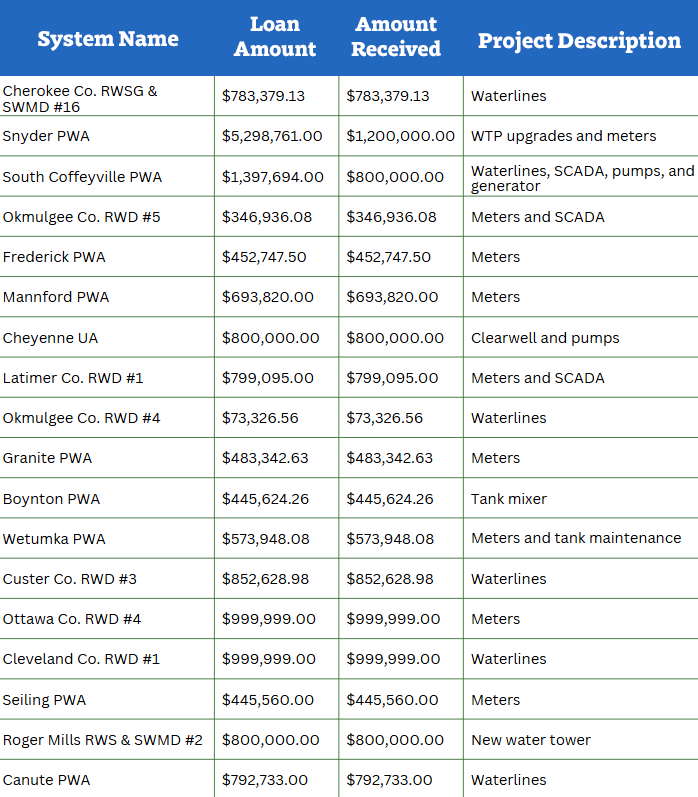
 The following projects were approved since the last quarterly newsletter to receive funding from DWSRF in conjunction with OWRB. Learn more about funding categories here.
|
|
|
|
|