|
|
to the quarterly newsletter for the Public Water Supply (PWS) Water Quality Division (WQD). This newsletter will keep you up to date on the latest in the world of water and will also help you ensure your systems are running smoothly by providing information and links to upcoming trainings, events, and funding opportunities. So dive in! The water’s fine.
 Summer conditions can pose a variety of challenges for public water systems in Oklahoma. Many systems often need to manage an increase in demand for finished water, driven by lawn irrigation and pool filling, while simultaneously facing a decline in raw water supply due to lack of precipitation.
To navigate these challenges, storage optimization can be an effective strategy. For example, utilizing SCADA data to assess whether filling storage tanks during low-demand nighttime hours can provide a buffer when daytime demand peaks.
 |
|
Find your PWS district engineer here. |
Find your PWS district compliance coordinator here.
Find your PWS district engineer here.
|
IN THIS ISSUE:
• Summer Topic
• Impacts of Drought
• Well Inspection Checklist
• DWSRF SFY2027
• Rules Updates
• Cybersecurity Advisory
• Cybersecurity Funding
• System Spotlight
UPCOMING TRAINING
AND EVENTS
DEQ Operator Renewal Training July 21
Muskogee
More info here.
ORWA Fall Conference
Sep 30 - Oct 2
Sequoyah State Lodge
More info here.
AWWA Water Infrastructure
Conference
Aug 30 - Sep 2
Indianapolis
More info here.
AWWA WaterSmart
Innovations Conference
Oct 21 - 23
Portland, OR
More info here.
RCAP SRF Workshop
Aug 18 - 20
Denver, CO
More info here.
Subscribe to
the newsletter here.
Contact: DEQ Water Quality
Division
Public Water Supply
405-702-8100
Website
|
|
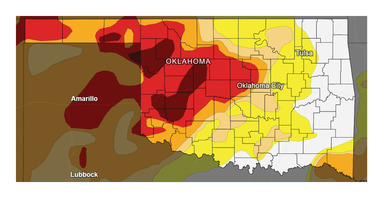
 Drought conditions may have a number of impacts on the ability of a water system to operate. Most obviously, droughts may threaten your ability to supply water by reduced levels for both surface water and groundwater, which may require conservation efforts to reduce usage. However, a drought can have a variety of impacts on a source beyond just capacity.
In surface water, drought conditions may lead to water quality deterioration such as increased turbidity and total organic carbon which can impact operations at the water treatment plant and increase formation of disinfection byproducts. These conditions may also increase algae growth, which can potentially cause harmful blooms. Monitoring of source water during drought conditions may be important to ensure operations at the plant and protection of public health.
  Groundwater is a critical resource for many communities, so making sure wells are in good condition is important to keep customers supplied. Some ways to ensure a well continues to operate safely and efficiently are below:
- Ensure the sanitary seal is intact and all openings in the wellhead casing are sealed to prevent contamination.
- Check mesh on air reliefs to ensure they are intact.
- Verify pressure gauges and flow meters are operational and reading accurately.
- Exercise valves for sample taps and pump to waste.
- Ensure the building is in good condition and incompatible materials such as mercury based meters are not present.
- Track well levels and yields to diagnose potential issues such as plugging of the well screen or pump failure.
|
Approved Projects
The following projects were approved since the last quarterly newsletter to receive funding from DWSRF in conjunction with OWRB. Learn more about funding categories here.
System Name: LeFlore Co. RWD #18
Loan Amount: $670,450.00
Amount Received: $670,450.00
Project Description: New AMR meters.
System Name: Erick PWA
Loan Amount: $772,065.62
Amount Received: $772,065.62
Project Description: 2 new wells, generators, and transmission main.
System Name: Logan Co. RWS&SWMD #1
Loan Amount: $1,140,518.00
Amount Received:
$1,140,518.00
Project Description: Water lines and meters.
System Name: Seminole MA
Loan Amount: $1,738,518.00
Amount Received:
$1,000,000.00
Project Description: New AMI system.
|
|
 Base Program Subsidy Rate
-
Severely disadvantaged communities
- 75% of the DWSRF loan as subsidy with a max of $1,000,000 in subsidy
-
Disadvantaged communities
- 50% of the DWSRF loan as subsidy with a max of $1,000,000 in subsidy
-
Non-disadvantaged communities
- $100,000 of subsidy for projects over $1,000,000
-
Additional subsidy for regionalization/consolidation
- Additional subsidy of 10% of the DWSRF loan with a max of $500,000 in subsidy
|
Funding & Assistance Corner
There are a number of funding resources available. Follow these links for more information and reach out to us with any questions.
Oklahoma Water Resources Board (OWRB)
|
|
Lead Service Line (LSL) Replacement Funding
-
Disadvantaged or severely disadvantaged communities
- 0% interest rate
- 0% administrative fee
- 75% subsidy for small (10,000 or under pop.)
communities
- 50% subsidy for large (over 10,000 pop.) communities
-
Non-disadvantaged communities
- 0% interest
- 0% administrative fee
- Subsidy available if LSL project serves area of low
income
Emerging Contaminants Subsidy Rate
-
100% subsidy for applicable project costs
- Eligible costs must contribute to addressing emerging contaminants in the drinking water
- Costs which do not contribute to addressing emerging contaminants may be funded through the DWSRF base program, including subsidy
|

Oklahoma State University Industrial Training and Assessment Center (ITAC) is offering their energy efficiency assessment services at no-cost to water, and wastewater systems that produce or treat between 3 to 10 million gallons per day. Get your comprehensive energy assessment, along with implementation support by clicking this link
.
|
|
Definitions and Other Information
- Subsidy is provided as principal loan forgiveness and is a percent of the DWSRF loan amount
- Disadvantaged Community – Median Household Income (MHI) less than 90% of the National MHI and is not a Severely Disadvantaged Community
- Severely Disadvantaged Community – MHI is less than 60% of the National MHI
- MHI is based on the 5-year estimates from the ACS, U.S. Census Bureau
|
|
 EPA’s PFAS OUTreach initiative—or PFAS OUT is a new outreach initiative that will proactively and systematically engage with water systems that face potential challenges with PFAS, with a focus on preparing drinking water systems for future compliance with federal drinking water standards for PFOA and PFOS.
PFAS OUT will host a nation-wide webinar series that will provide support to all water systems addressing PFAS concerns. EPA will proactively reach out to water systems with levels of PFOA and PFOS above the MCL. To identify these systems, EPA will actively review drinking water monitoring data submitted to EPA through the Unregulated Contaminant Monitoring Rule (UCMR) 5, as well as state, Tribal, and territorial data sources as available. Drinking water systems with additional local PFAS concerns should reach out to EPA for technical assistance and support. For more information click here.
See the PFAS OUT fact sheet here.
Watch this video to learn how to collect PFAs samples.
|
 The Federal Bureau of Investigation (FBI), Cybersecurity and Infrastructure Security Agency (CISA), National Security Agency (NSA), and Environmental Protection Agency (EPA) are urgently warning U.S. organizations of ongoing cyber exploitation of internet-connected operational technology (OT) devices, including Rockwell Automation/Allen-Bradley-manufactured programmable logic controllers (PLCs), across multiple U.S. critical infrastructure sectors.
If you have questions about any of the information in this alert, including assistance with the mitigation steps, submit a request to EPA’s Cybersecurity Technical Assistance Program for the Water Sector.
 The Drinking Water State Revolving Fund includes financing to eligible systems for approved cybersecurity measures, that may include upgrading outdated computers and/or software, creating secure network backups, and install physical security such as doors, cabinet, and alarms. Projects must either facilitate the system’s compliance with national primacy drinking water regulations or significantly further the health protection objections of the Safe Drinking Water Act.
 LCRI Update
As part of the LCRI all CWSs must conduct lead (Pb) sampling and public education at schools and childcare facilities they serve at least once. CWSs must first submit a list of eligible schools and childcare facilities by November 1, 2027 and update the list every 5 years. DEQ recommends to begin investigating now and start creating a list of all known schools and childcare facilities that your CWS serves. Include the full name of the school, location and type (middle school, daycare, k-12 etc.). If you have any questions regarding this requirement reach out to DWLC@deq.ok.gov or are interested in DEQ's Lead Testing in Schools Program please reach out to LWSC@deq.ok.gov.
|
|
 Cherokee Co RWD #16 recently received a Letter of Proclamation from the Governor of Oklahoma recognizing the successful completion of the Long-Range Sustainability Program(LRSP).
The LRSP is a rigorous program consisting of 21 key components that ensure a water district is planning for the next 100 years of sustainable water service.
The proclamation was presented by the Oklahoma Rural Water Association (ORWA), Oklahoma Department of Environmental Quality (ODEQ), and the Oklahoma Water Resources Board (OWRB).
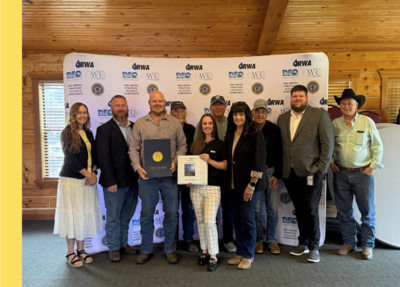 From Left to Right: Holly Cannon, Environmental Programs Specialist, ODEQ; Doug Hall, Federal Programs Director, ORWA; Daniel Napier, System Manager, Cherokee RWD 16; Terry Noble, Cherokee RWD 16; Karen Risley, Sustainability Specialist, ORWA; Walter Armstrong, Cherokee RWD 16; Cherlene Ferris, Cherokee RWD 16; Paul Laney, Cherokee RWD 16; Bill Wilcoxen, Cherokee RWD 16; Zachary Bradley, P.E. OWRB.
If your system is interested in completing a LRSP click here.
|
A few of the technical objectives of the Long Range Sustainability Plan are listed below:
- Asset Management
- AWIA VSAT/ERP (Risk / Vulnerability Assessment and Emergency Response Planning)
- Business / Financial Policy Development
- Capacity Development Assessment
- Capital Improvement Planning
- Training for System Personnel – Governing board, office/support staff, operators, and safety
- Leak Detection
- Mapping of Distribution / Collection System
- Mutual Aid / SoonerWARN
- Operations and Maintenance Plan Development
- Optimization of System
- Rate Analysis
- Sanitary Sewer Evaluation – Inflow / Infiltration Study (Smoke Testing)
- Source Water Protection Plan Development
- Water Loss Auditing / Meter Analysis
|
|
|
Subscribe to the newsletter here.
Contact: DEQ PWS WQD
405-702-8100
Website
|
|
|
|
|