|
|
Welcome to the quarterly newsletter for the Public Water Supply (PWS) Water Quality Division (WQD). This newsletter will keep you up to date on the latest in the world of water and will also help you ensure your systems are running smoothly by providing information and links to upcoming trainings, events, and funding opportunities. So dive in! The water’s fine.
 |
 Here is what you need to know from the May 2025 EPA press release regarding the recent PFAS Rule EPA announced the agency will keep the current National Primary Drinking Water Regulations (NPDWR) for perfluorooctanoic acid (PFOA) and perfluorooctane sulfonic acid (PFOS), which set nationwide limits for these “forever chemicals” in drinking water. EPA plans to issue a proposed, updated PFAS, rule this fall and finalize it in the spring of 2026, which will include a proposal to extend the compliance deadline to 2031. EPA has also announced its intent to rescind the regulations and reconsider the regulatory determinations for PFHxS, PFNA, HFPO-DA (commonly known as GenX) and the Hazard Index. They also encourage states seeking primacy to request additional time from EPA to develop their applications.
Through the launching of the initiative PFAS OUT, the EPA will connect with public water utilities by sharing resources, tools, funding and technical assistance to help them meet the federal drinking water standards including those EPA has identified as having PFOA and PFOS levels above EPA's MCL. PFAS factsheets and training along with state implementation guidance are coming down the pipeline. Stay tuned!
Source – EPA Announces It Will Keep Maximum Contaminant Levels for PFOA, PFOS | US EPA
|
Upcoming Training
& Events
Operator Renewal Training
- October 7th, 2025 Ardmore
- November 18th, 2025 Blackwell
-
2026 dates are in the works...
More info here.
34th EFO Annual Meeting and Trade Show
October 13-15, 2025
Tulsa, OK
More info here.
OMAG Sanitary Sewer Expo
October 27-29, 2025
Enid, OK
Register here.
AWWA Water Quality
Technology Conference
November 9-13, 2025
Tacoma, WA
Register here.
Oklahoma Governor’s Water Conference & Research Symposium
December 3-4, 2025
Norman OK
Register here.
|
|
 Critical infrastructure plays a vital role in our local communities, state and nation. It is important to strengthen our critical infrastructure to remain resilient, safe and secure.
One important step is identifying if your water system is using operational technology (OT).
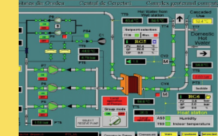
OT is technology that uses a combination of software and hardware to monitor and control specific devices and processes in an industrial setting. A system may use OT for one or more of the following operational processes: source water intake, treatment, distribution, water storage, pumps, and monitoring.
|
|
Lead Service Line Inventory Update From EPA
The Environmental Protection Agency (EPA) is in the process of issuing administrative orders for failure to submit an Initial Lead Service Line Inventory (LSLI). The Initial Lead Service Line Inventory was due October 16th, 2024. To see if your system has not submitted an approvable inventory, please visit Drinking Water Branch and look under the violations section. We are still accepting and reviewing inventories, so please submit if you have not done so. For any lead related questions, please contact the DEQ Lead and Copper Unit at DWLC@DEQ.OK.GOV.
|
|
|
Examples of OT include industrial control systems (ICS) such as Supervisory Control and Data Acquisition (SCADA) systems for drinking water treatment and distribution, building management systems, fire control systems, and physical access control mechanisms.
Any OT systems that are connected to the internet may be vulnerable to cyber incidents. A system with hardware-based OT that meets any of the conditions below may have a higher cybersecurity risk:
- Connected or occasionally connected to a computer (for any reason including alarm reporting), or
- Connected or occasionally connected to a network (local, wide area or internet), or
- Are remotely accessible or occasionally remotely accessible (either for control or monitoring)
If you are still unclear whether your system has OT, EPA’s Cybersecurity Technical Assistance Program for the Water Sector can help. Click on the link above to submit your questions or request to consult with a subject matter expert about cybersecurity.
 The Drinking Water Infrastructure Needs Survey and Assessment (DWINSA or "Needs Survey") is a national survey to assess the cost to maintain and/or bring public water supplies into compliance with the Safe Drinking Water Act (SDWA). The results of the Needs Survey is presented to the United States Congress, and money is then allocated by congress proportionally among each states' Drinking Water State Revolving Fund (DWSRF) program. The Needs Survey is completed every four years, for which a statistically significant portion of water systems are selected to participate in the Needs Survey to represent the need and cost for each state. If you are contacted regarding the survey, do your best to provide accurate information.
|
Iran Conflict is Increasing the Likelihood of Low-Level Cyberattacks Against US Networks
The U.S. EPA is issuing this alert to inform water and wastewater system owners and operators of the need for increased vigilance for potential cyber activity in the United States due to the current geopolitical environment. The U.S. Department of Homeland Security (DHS) published a National Terrorism Advisory System Bulletin, indicating that low-level cyberattacks against U.S. networks by pro-Iranian hacktivists are likely, and cyber actors affiliated with the Iranian Government may conduct attacks against U.S. networks. Additionally, the Cybersecurity and Infrastructure Security Agency (CISA) published a fact sheet warning that Iranian-affiliated cyber actors may target U.S. devices and networks for near-term cyber operations.
Iranian-affiliated cyber actors have demonstrated the ability to exploit operational technology (OT) devices at U.S. water and wastewater systems, forcing many systems to revert to manual operations and resulting in operational impacts.
Read the full alert here.
|
|
 The Area-Wide Optimization Program (AWOP) is a voluntary program that assists and awards Public Water Systems for optimizing their processes and increasing public health protection.
Oklahoma’s AWOP program consists of three teams – AWOP Awards, Workshops, and Voluntary Comprehensive Performance Evaluations (CPEs).
|
 Oklahoma State University Industrial Training and Assessment Center (ITAC) is offering their energy efficiency assessment services at no-cost to water, and wastewater systems that produce or treat between 3 to 10 million gallons per day. Get your comprehensive energy assessment, along with implementation support by clicking this link.
|
|
AWOP Awards
Get recognition for your Public Water System’s ability to meet the AWOP Optimization Goals, and earn physical awards based on your Optimization Tier!
Points are earned in the following areas:
· Capacity Development
· Compliance Sampling
· Turbidity
· Log inactivation
· Chlorine Residual
· Water Loss (for bonus points!)
· AWOP Workshop participation (for bonus points!)
· Voluntary CPE participation (for bonus points!)
The more points earned, the higher your system’s Optimization Tier!
Contact awopawards@deq.ok.gov to join the program!
|
AWOP Workshops
Optimize a specific area of your system’s processes or treatment with our workshops designed to specifically target your needs!
A variety of workshop topics are available for your system, such as:
·Data Integrity
·Turbidity
·Disinfection By-Products
·Manganese
·AND MORE…
Workshops generally entail a day of data collection at the plant, with a brief overview of the findings provided the same day. Following the workshop, a detailed report of the work completed during the workshop will be sent to the system.
If you are interested in optimizing something specific, contact andrew.shaw@deq.ok.gov to discuss your workshop options!
|
|
If you want your system to be the most optimized that it can be, a Voluntary CPE may be for you!
A Voluntary CPE is a 5-day evaluation of your water system’s processes in order to identify the areas in which your water system can become more optimized. At the end of the week, AWOP staff will present their findings, and a report will be sent to the water system detailing the work completed during the CPE and including a ranked priority list of areas limiting optimization.
If you are interested in optimizing your water system to the best that it can be, contact tara.bussing@deq.ok.gov to discuss a future voluntary CPE!
*Operator Certification hours may be available for participation in Workshops and Voluntary CPEs
|
Approved Projects
The following project was approved since the last quarterly newsletter to receive funding from DWSRF in conjunction with OWRB. Learn more about funding categories here.
System Name: Chelsea Economic Development Authority
Loan Amount: $1,076,497
Amount Received: $800,000 BIL GS (2024)
Project Description: Solids contact clarifier
|
|

Working in the water sector is a vital job that ensures communities have access to clean, safe drinking water. It is a job that comes with a unique set of safety challenges. Some key safety considerations could include:
- Personal Protective Equipment (PPE) - Always wear the appropriate gear for the situation.
- Material Safety Data Sheets (MSDS) - MSDSs contain valuable information on hazards, safe handling, storage, and emergency procedures.
- Spill Kits - Know the location and proper use of spill kits for different chemicals.
- Wash Stations - Know the location of safety showers and eyewash stations
- Permit-Required Confined Spaces - Identify and evaluate if any spaces are permit-required. Follow proper procedures for those areas.
- Atmospheric Monitoring - Before entry, and then continuously monitor the air for oxygen levels, flammable gases and toxic vapors.
- Ventilation - Ensure proper ventilation to remove any hazardous gases.
- Buddy System - Ensure another person is outside the confined space and continuously monitoring the process.
- De-energize - Before starting work, ensure all energy sources are de-energized.
- Locks and Tags-Appling locks and tags can prevent accidental re-energization.
- Test and Verify - Use equipment such as a multimeter to ensure it is de-energized.
- Wet Conditions - Prevent slips and falls by immediately cleaning up spills or use anti-slip mats in unavoidable wet areas.
- Watch Your Step - Keep workspaces clear of unnecessary clutter and be mindful of uneven surfaces.

 |
|
Jennifer Sides is the agency’s Complaints, Spills, and Emergency Response Manager located in the Environmental Complaints and Local Services (ECLS) Division of DEQ. She serves as the agency liaison to the Oklahoma Department of Emergency Management and Homeland Security and is the state representative to the EPA Region 6 Regional Response Team. |
Additionally, she serves as the agency representative for the FEMA Region 6 Regional Interagency Steering Committee and is one of the agency representatives for the Oklahoma Flood and Drought Task Force. Most importantly, she facilitates interagency communication and coordination during emergency response events.
Since field staff in the ECLS Division respond to a variety of potentially hazardous situations, what kind of training is required?
ECLS field staff are required to complete FEMA Incident Command System 100, 200, 300, 700, and 800 courses and obtain and maintain Hazardous Materials Technician certification. Additionally, they are required to become Registered Professional Environmental Specialists, obtain a minimum C level DEQ Water and Wastewater Operator’s License, and attend EPA Method 9 Certification – Visible Emissions Training as well. There are many other training programs and certifications that aren’t specifically related to hazardous situations, but ECLS field staff are well-trained and consistently do a great job responding to incidents and emergencies across the state.
|
What do you see as the biggest safety challenges in a water treatment plant environment?
Mr. Walker,
Safety Director:
In regard to frequency, confined space entry can prove challenging from a regulatory standpoint. As they occur often, complacency can increase the potential for an employee circumventing safety measure because of the redundancy and relatively routine environment.
In regard to dangerous activity, by far it is the handling and use of chlorine gas and other dry chemicals.
How do you stay current on safety regulations, best practices, and new technologies?
Mr. Roberts,
Chief Operator:
The city has a very knowledgeable and thorough Safety Director who works well with all departments on the development and implementation of Midwest City's Safety Program. Input from all departments was used to develop programs like our Lock out / Tag out program and determine the PPE required to perform various tasks in each department. We can always depend on the Safety Director to answer any concerns we may have on any safety related items.
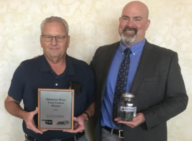
Picture of Mark Roberts and Paul Streets accepting the award for the 2022 Oklahoma Water Taste Contest on behalf of the Midwest City Water Treatment Plant
 |
 |
|
|
|
|
|