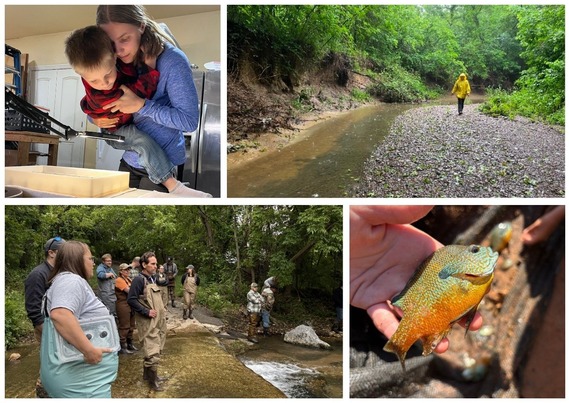


 The Central Irregular Plains (CIP) Ecoregion is in northeastern Oklahoma and parts of Kansas, Missouri, and Iowa. This unique area of rolling hills separates the Ozark Highlands from the Cross Timbers. The primary habitat type is tallgrass prairie, but there are smaller areas of dry upland forest and moister floodplain forest. Streams in this ecoregion are typically slow-moving, low-gradient, and meander in wide valleys. They drain to the Arkansas, Verdigris, or Grand Rivers. Fishes found in the CIP include redfin shiners, suckermouth minnows, river carpsuckers, and black and golden redhorses. The Blue Thumb Program began in Tulsa in 1992 and continues to have a strong presence in and around Tulsa. Many of our monitored streams are in the CIP. Monitored streams in this ecoregion include Crow Creek, Coal Creek, Mill Creek, Fred Creek, Haikey Creek, Mingo Creek, and Joe Creek.
 |
Hi everyone! My name is Haley Amicarelli and I will be Blue Thumb's Intern this summer. I’m a student at Oklahoma State University studying Fisheries and Aquatic Ecology. After I graduate, I’d love to work in water conservation or as a fisheries biologist. I love being outside whether it’s hiking, kayaking, bird walks, or fishing.
I interned with Blue Thumb last summer and I learned so much. I gained a lot of valuable hands-on experience, but I know I have so much more to learn. It was a great experience, and I am so grateful they let me help out again!
I am excited to meet everyone and help out with the fish collections again this summer. I can't wait to learn even more and help out this incredible team!
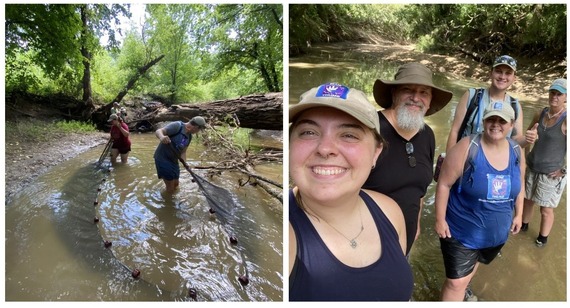 Haley Amicarelli
Blue Thumb Summer Intern
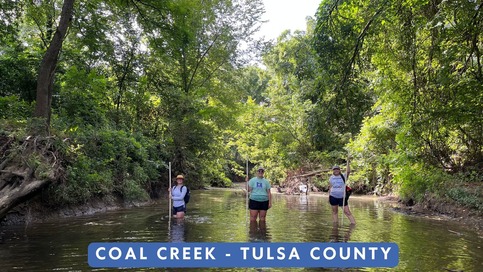
For the first time in a while, during May stream monitoring, I visited Coal Creek with my monitoring partner, Emily (who is an employee of the City of Glenpool), in the rain. Volunteers are encouraged to set aside a time for monitoring, like 8:30 a.m. on the final Thursday of the month (just as an example). When we stick to a date and time, this means we will be at the stream in a combination of conditions. This is what we want in order to get to know the stream through chemical monitoring.
Coal Creek in Morris Park north of Glenpool is allowed a little more riparian area than some urban streams. On the day of monitoring, Emily and I found Coal Creek to be of elevated flow and rising. We made our observations, collected our DO sample, then proceeded to the City of Glenpool’s Public Works facility to run the chemical tests.
There were no remarkable readings from any of the tests, but I have been observing that Coal Creek seems to be trending toward phosphorus readings more consistently. We had a five on the color wheel which equates to .033 mg/l orthophosphate. This is a low reading, but still, where is the phosphorus coming from?
It is the nature of nonpoint source pollution to be of an unknown origin. This is why this is the type of pollution that is best combatted through EDUCATION. Still, it makes sense for us to wonder why we see a fluctuation in our test results, and for me on this particular day, I loaded my data into my noggin to consider my stream. What was going on during my May monitoring?
It was raining. My stream was elevated. A tiny tributary, or maybe just a wet weather drainage was flowing into Coal Creek, and it was murky with sediment. I know from investigating what is going on in my watershed that there is a new disk golf course on the west banks of Coal Creek. Some land clearing has been done to build the course and create trails through the riparian zone. My Secchi disk reading was .3 m NOT resting on the bottom. There were tree roots exposed at the monitoring site that were orange, an indicator of fresh stream bank erosion.
I figure that the phosphorus existing in Coal Creek at the time of the May 2026 monitoring is a result of added sediment in the stream. Phosphorus is often a result of the erosion of rock and soil, thus the more sediment a stream carries, the higher goes the phosphorus level, at least in the case of Coal Creek on this day.
I will be paying attention to my monitoring results. If when the stream is at base flow the phosphorus reading is still above detection, I might consider other sources. For volunteers who struggle to make it to their stream every month, I provide this thought: Monthly chemical data can pick up trends, and stream observations on at least a monthly basis offer insight that can be important. Happy monitoring!
Three Cheers for Insects!
Senate Bill 2065, also known as the Lucile Morehouse Pollinator Act, was signed into law on May 5. This Act draws attention to a few of our insect friends by designating Oklahoma “state” insects. Beginning November 1, 2026, the European honeybee (Apis mellefera) is the state agricultural pollinator; the American bumble bee (Bombus pensylvanicus) is the state native insect; the Carolina mantis (Stagmomantis carolina) is the state predatory insect; and the rainbow scarab (Phanaeus vintex) is the state soil conservation insect.
Watch From the Water’s Edge for profiles of these hard-working invertebrates in upcoming issues.
Cheryl Cheadle
Blue Thumb Volunteer Coordinator
|