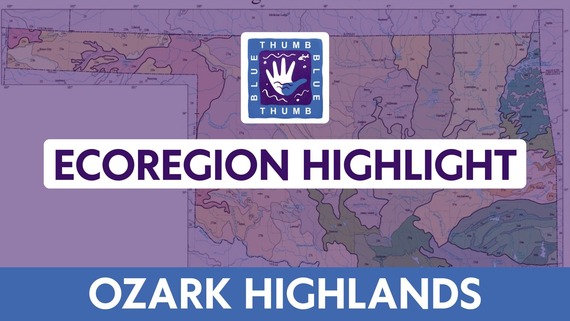
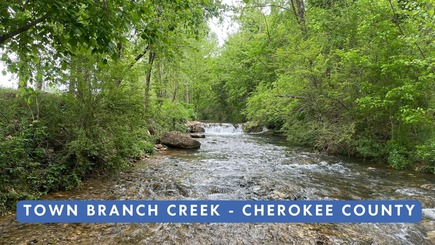
The Ozark Highlands (OH) Ecoregion is located in northeastern Oklahoma, southern Missouri, and northern Arkansas. This ecoregion receives about 42' of rain per year, and topography includes rugged hills and low mountains. The underlying limestone geology is conducive to springs, caves, and sinkholes. Habitats in this ecoregion include dry oak-hickory forests, taller and moister forests in protected ravines, dry, rocky ridge tops, and bottomland hardwood forests. Streams in this area are cool, clear, and have rocky substrates. The OH contain three of Oklahoma's scenic rivers: the Upper Illinois River, the Baron Fork, and Flint Creek. The OH also contain the headwaters of Little Lee Creek, the only scenic river split between two ecoregions. The ecoregion has high fish diversity and is home to white suckers, redspot chubs, banded sculpins, and slender madtoms. Blue Thumb streams in the OH include Town Branch, Ross Branch, and three sites on Spring Creek.
The Mayflies of Oklahoma Webinar!
Join Blue Thumb for a specialty webinar on Thursday, April 23rd, at 6:30pm in celebration of Earth Day 2026! During this free webinar, Dr. Peter Grant, Friends of Blue Thumb board member and Professor Emeritus from Southwestern Oklahoma State University, will share with us his lifetime of research on mayflies. Dr. Grant will share interesting information not only on the mayfly life cycle and natural history, but also about the creature culturally. Even though this will be a wealth of information, the presentation is expected to take no more than an hour. Use the link below to join on April 23rd.
It is easy for time to fly by…I was unable to make it to my stream (Coal Creek in Tulsa County) this month, but I am happy that my monitoring partners got the job done. That is part of the value of monitoring with a dedicated team – one person can miss and the show goes on.
The Blue Thumb staff is in the middle of education activities right now, and I think most of us would agree that April is our busiest month for working with young people, although the last week of March and the first week of May are right in there as well. Volunteers very often are right in there beside us, adding their voices to the call for all of us to love and care for our entire earth.
In the March newsletter I encouraged readers to go to the Blue Thumb website to look at the newly posted reports on volunteer data projects. I just finished reviewing those again. New reports have been posted for Chisholm Creek, Sugar Creek, Tributary to Arkansas River, and Salt Fork of the Arkansas River. In addition, there are a number of trainings and workshops listed to help adults become Project WET and Project WILD facilitators, and some workshops that will prepare us to train other environmental educators!
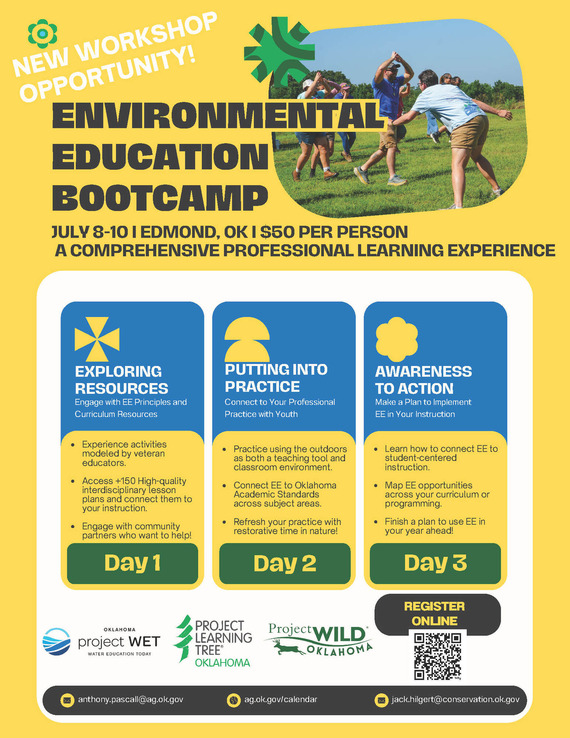
Now is a great time to sign up for upcoming events. The Blue Thumb team has never done a better job of planning ahead – so there are offerings for volunteers, teachers, nonformal educators, etc. Click here to see what is coming up!
Phenology
Phenology is the study of natural processes happening in their time. Another definition could be the scientific study of recurring events in nature. I bring up phenology for a couple of reasons, one being I saw my first scissortail flycatcher on March 30.
Because of well-studied natural phenomena, both by professional researchers and citizen scientists, watching when things happen has added to the data that tells us that an increasingly warming world is having negative impacts on our planet.
It is not as simple as we just have a longer growing season. To better understand long-term shifts in global weather patterns, please click on the link below.
For many years of my life I noticed that scissortails arrived in Oklahoma on April 15. That was the day I typically saw my first scissortail. Maybe they were here a little earlier, but I noticed them on April 15.
Arm yourself with knowledge and encourage your family, neighbors, and elected officials to be aware of increasing environmental stress and how to best cope with a warming world.
Cheryl Cheadle Blue Thumb Volunteer Coordinator
From the QA Officer
Here Fishy Fishy…
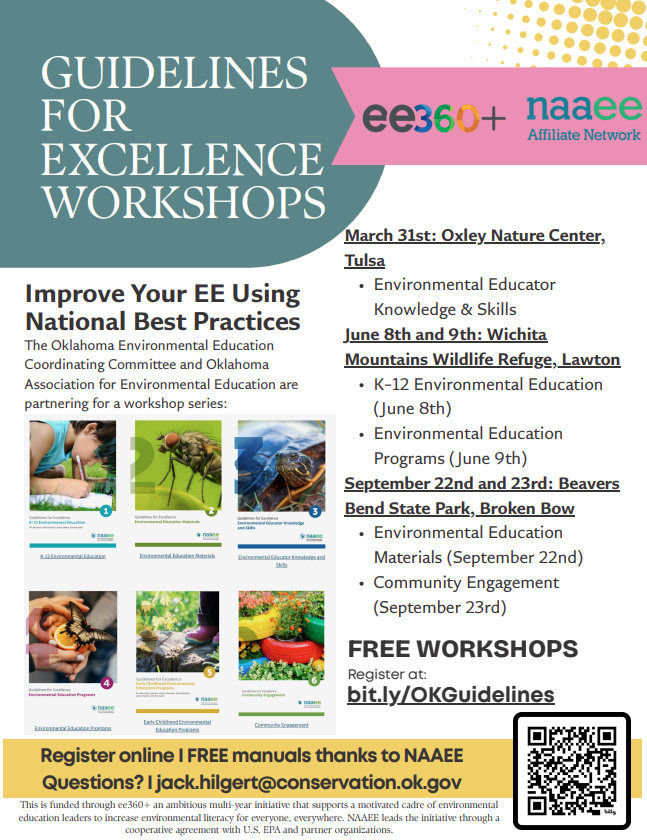
That is right, it is nearing time to conduct Blue Thumb fish collections!!! This summer we will be in the Ozark Highland Ecoregion, one site down in the Arkansas Valley Ecoregion and pick up three sites in the Central Irregular Plains Ecoregion that we couldn’t get last year for various reasons. These are not scheduled yet. We plan to fish in June, July and first half of August. If you’d like to join us on a fish collection, please contact me and I’ll keep you in the loop once I get these scheduled.
Site Name
County
Haikey Trib: Houston
Tulsa
Mill Creek: McClure Park
Tulsa
Coal Ck: Morris Park
Tulsa
Fourche Maline: Blackloop
Latimer
Beaty Creek
Delaware
Brush Ck: 460 Rd
Delaware
Spring Creek: Three Spring Farm
Cherokee
Spring Creek: Rocky Ford
Cherokee
Spring Ck: Evans
Cherokee
Tahlequah Ross Branch
Cherokee
Tahlequah: Basin St
Cherokee
Tahlequah: Spring St
Cherokee
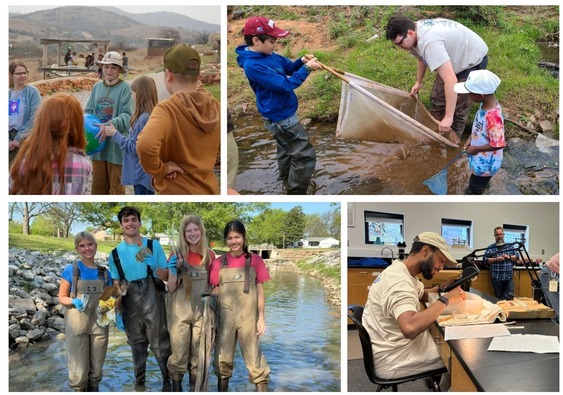
A little summary of what a fish collection day is like: We usually start around 8:30am with the habitat assessment. We begin where the person/team does their monthly monitoring and either go upstream OR downstream 400m (about ¼ mile) and stop every 20m to assess physical characteristics of the stream (width and depth, substrate, banks, canopy, etc.). This takes about 2-3hrs. Then we will go back to our vehicles for a water break, eat a snack/lunch and change out equipment. Then we seine the same 400m stretch of creek for fish. This can take anywhere from 2-6hrs. A fish collection is a full day's work, but also fun exploring and learning! We hope you’ll join us on a fish collection this summer.
FBT is a small nonprofit organization that was formed primarily for the benefit of helping Blue Thumb volunteers effectively monitor and educate the public about protecting streams, rivers, and lakes. FBT does this primarily by providing small grants. If you would like more information, please reach out to Board president, Terrie Becerra.
April showers are in the forecast! Check out the Oklahoma Mesonet to see how much rain fell where you are.
Did you know that there is a whole association for Citizen Scientists? You can become a member and learn more about it here!