|
Soil Health and Biomass Management for Winter and Spring Planting into Bermuda Grass
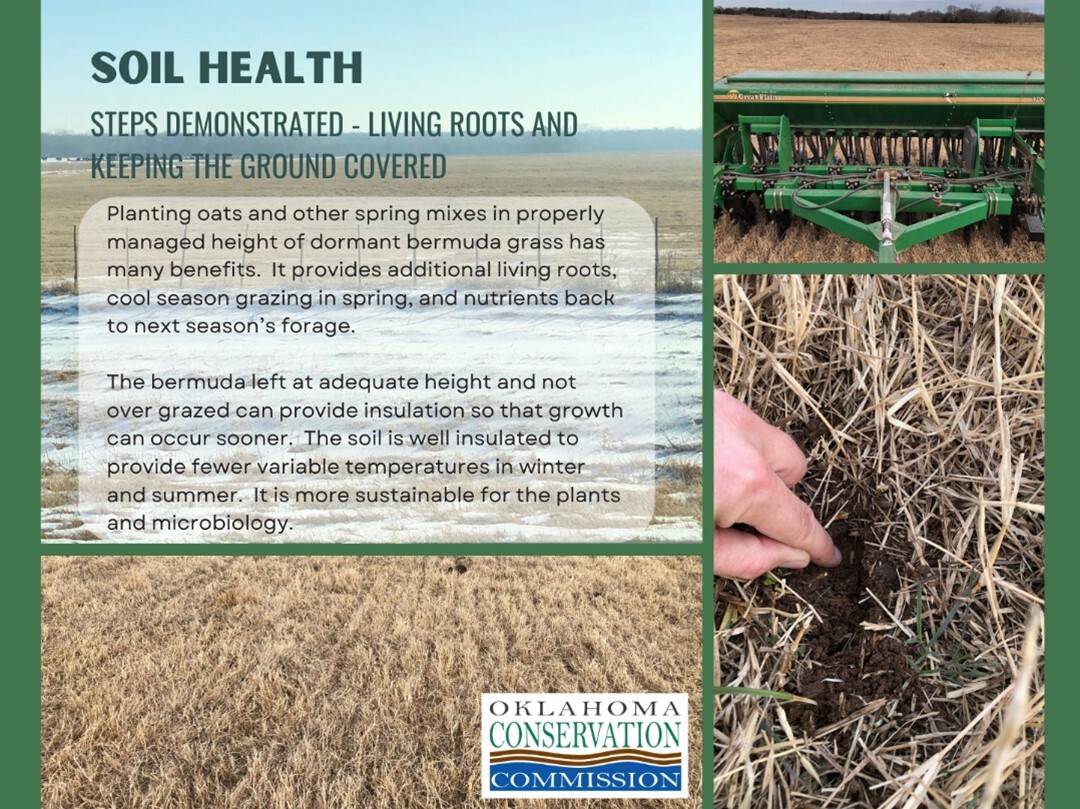
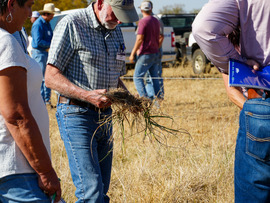
Bermuda grass (Cynodon dactylon) is one of the most resilient and productive warm-season perennial grasses used in pastures and hay systems and has been used for conservation management throughout the southern United States. However, Bermuda grass is an introduced species that requires significant attention and maintenance. Those who planted Bermuda years ago are now looking to incorporate soil health principles on their property. This can provide some challenges, but adaptations are being used to meet soil health principles throughout Oklahoma.
Soil health refers to the soil’s ability to function as a living ecosystem that sustains plants, animals, and environmental balance. Soil health and ecosystem function can be accomplished in Bermuda grass systems, but may provide some challenges. Earth’s systems have a natural function within the local ecosystem, with native plants and animals forming a symbiotic relationship for thousands of years. When introducing non-native plants to the area (like Bermuda), they can become invasive and unlikely to provide an ecosystem function. Bermuda grass was initially planted many years ago, before the larger impact on the local ecosystem was assessed. Bermuda was initially used to prevent erosion on sites and adapted easily to most landscapes; however, it provides little additional ecosystem function.
Today, many farmers are trying to reverse the impacts of Berumuda on local ecosystems. Some are trying to convert Bermuda pastures to native rangeland, but the practice can be costly. Others are gradually introducing soil health principles to the Bermuda grass system.
Continue reading for advice for improving the soil health in Bermuda grass systems.
|
|
UPCOMING EVENTS
Blue Thumb Training | Tulsa | March 28-29
Do you love science and being outdoors? Help protect Oklahoma streams by becoming a certified Blue Thumb stream monitor!
Register & Learn More
|
|
|
H2Oklahoma | Stillwater
March 11 | Couch Park
Learn More
|
|
Propagation Principles for Productive Farms | Tishomingo
March 12 | Tishomingo
Learn More
|
|
The Nature of Science: Educator Monthly Virtual Learning Series | Virtual
March 23 | Webinar
Learn More
|
|
|
H2Oklahoma | Norman
March 24 | Ruby Grant Park
Learn More
|
|
Cimarron County Outreach Day – Bird Houses & Succulent Planting | Boise City
March 26 | Cimarron County Fairgrounds
Call 580-544-3048 to RSVP and learn more.
|
|
2026 Earth Day Festival | Norman
April 26 | Reaves Park
Learn More
|
|
 OCC In the News
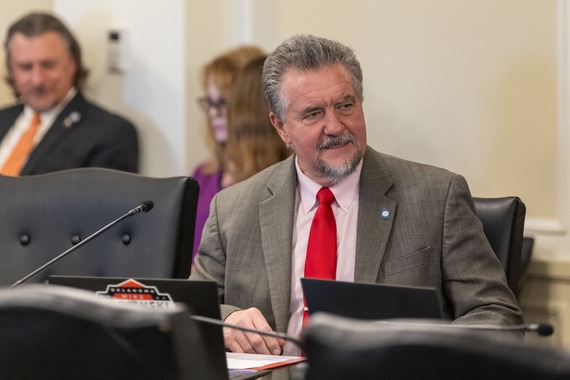
Dobrinski Urges Governor, Legislature to Fund Wildfire Reduction Effort
OKLAHOMA CITY – Rep. Mike Dobrinski, R-Okeene, today urged action by the governor in concert with the Legislature to expand funding for eradicating invasive species as the state faces early wildfires.
Dobrinski is the author of legislation that created the Terry Peach North Canadian Watershed Restoration Act and the House author of legislation that requires the Oklahoma Conservation Commission to implement a statewide plan targeting harmful woody species on state lands. Both are efforts to reduce materials that consume massive amounts of water and lead to fire threats.
This year, Dobrinski is running House Bill 2988, which currently recommends a tax credit for those who remove harmful woody species through qualified practices as defined by the Conservation Commission. The bill passed in the Appropriations and Budget Natural Resources Subcommittee. Dobrinski said the legislation will be amended before it reaches the House full A&B Committee to instead expand the Terry Peach Act.
Read the Full Press Release Here
|
|
PROGRAM UPDATES
Emergency Drought #4 - The Emergency Drought Committee met and approved a new Emergency Drought Program. The application period opens March 9 and runs through June 30, 2026. Full details and applications will be available on March 9 at this webpage. Applications will also be available at your local conservation district office.
Locally Led Cost-Share - Cost Share Program Year 28 will begin on March 9, 2026, through your local conservation district. Each conservation district operates its own sign-up period and eligibility requirements. Learn more here.
|
|
P.S - Quick Question
As we plan out our next newsletter, we want to cover what matters most to you!
Want to help influence what ends up in your inbox? Take our one question survey (Only takes 10 seconds to complete!)
|
|
|
|