
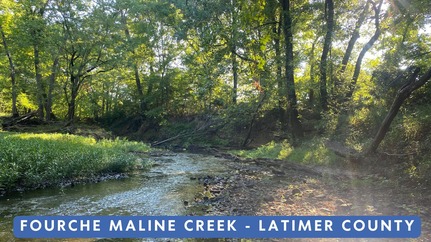
 This ecoregion is named for the valley of the Arkansas River and runs from east-central Oklahoma to central Arkansas. Most of the land in this ecoregion is flat and poorly drained. The highest elevation in this ecoregion lies in the San Bois Mountains. Habitat types include dry oak-hickory forests, shortleaf pine savannas, mixed pine-hardwood forests, tallgrass prairies, and riparian forests of oak, elm, and hackberry. The rich water resources of the Arkansas Valley have supported communities for thousands of years. The area was inhabited by the Spiro mound-builders from about 850 to 1450 CE. The people who built Spiro Mounds were part of a larger Caddoan Mississippian culture that traveled and traded widely up and down the Mississippi River. You can learn more about Spiro Mounds by listening to this podcast from the Oklahoma Historical Society:
 |
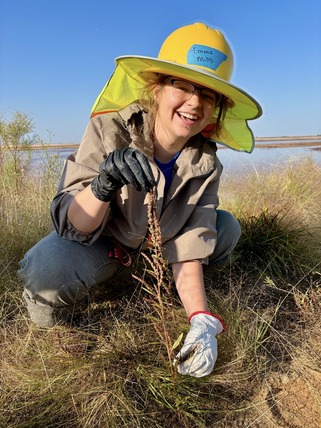 |
Hello everyone, I am Emma Mills, and I am overjoyed to be joining the Blue Thumb family as a Field Education Coordinator of the Northeastern Quadrant of Oklahoma (excluding Tulsa County). Environmental education has been a life-long career goal of mine, as I believe everyone should be involved in science. Prior to starting with Blue Thumb, I focused on research and conservation: from salt cedar eradication and erosion control to ancient DNA extraction. Last fall I experienced being a crew leader in a Conservation and Disaster Relief Team through the Oklahoma Conservation Corps, traveling from the Salt Plains of Oklahoma to Fayetteville, Arkansas and Austin, Texas. Previously, I spent time studying harmful algal blooms through sediment cores from Grand Lake with Oklahoma State University, and monitoring litter levels on the Illinois River and its social impact with Northeastern State University and the Grand River Dam Authority. Between these varying grant funded positions, I have enjoyed substitute teaching middle school science with Broken Arrow Public Schools. I am looking forward to furthering my experience and impacts made within our watersheds.
Emma Mills
Blue Thumb Field Education Coordinator
After a classic Oklahoma downpour, rainwater rushes across roads, driveways, and parking lots before flowing into nearby creeks and lakes. But it’s not just carrying leaves and dirt, it’s also sweeping up tiny pieces of plastic called microplastics.
Microplastics are plastic particles smaller than five millimeters, forming when larger plastics break down. They can be ingested by aquatic organisms, move through food webs, and carry attached pollutants on their surfaces, raising growing concerns about long-term environmental and human health impacts. And while we often hear about ocean plastic, these particles are also showing up much closer to home: in freshwater lakes, rivers, and reservoirs across the state. In Oklahoma, common sources include tire wear from daily driving, synthetic fibers shed in the laundry, plastic litter that slowly fragments, and even agricultural plastics. When heavy rain hits, stormwater acts like a conveyor belt, carrying these particles straight into our waterways.
Here’s the tricky part: once microplastics enter water, they’re difficult and costly to remove. That’s why prevention matters most. The good news? Small changes add up! Use reusable bags and water bottles. Wash synthetic clothes in full loads and consider using a microfiber-catching laundry bag. Keep plastic litter secured and dispose of fishing line properly. Even reducing unnecessary car trips can help cut down tire particles on roads. Communities can help too; regularly cleaning storm drains, installing sustainable filtration systems, and local cleanups all reduce microplastic pollution before it reaches our streams.
Microplastics may be tiny, but protecting Oklahoma’s freshwater doesn’t require tiny effort. It starts with everyday choices, and every drop counts!
Click the button below to view 'A Community Guide to Preventing Microplastic Pollution' created by Sophia!
Sophia Zhao
Student Researcher
This is your reminder that Blue Thumb will loan you educational tools if you want to jump in and be a part of conservation education this spring! Items that tend to be frequently requested are 1) EnviroScape Watershed Model; 2) Fish print kits; and 3) Incredible Journey water cycle set. Get in touch with usual Blue Thumb contact person or even send an email to me. Don’t wait until the last minute!
Have you visited the Blue Thumb website lately? This is a good time to drop in and see what is new! Documentation for four projects from 2025 will be posted this week for you to view! These Data Projects include:
- Chisholm Creek (Monitoring site in Oklahoma County)
- Salt Fork of the Arkansas River (Monitoring site in Woods County)
- Tributary to Arkansas River (Monitoring site in Osage County)
- Sugar Creek (aka Tributary to Mingo Creek, monitoring site in Tulsa County)
Review these projects and consider what you would like to do to protect the streams in your area.
Cheryl Cheadle
Blue Thumb Volunteer Coordinator
Hello Blue Thumbers,
Sorry I didn’t get an article in last month. It has been a pretty crazy start to 2026.
While looking over data that has been entered by Blue Thumb creek monitoring volunteers, I’m seeing a common occurrence that the comments section is not being used enough. Please remember to mention in the comments if it has rained/snowed recently (about how much), if there has been no precipitation in many months, why ‘dead animal’ was selected, why ‘flow alteration’ was selected, why ‘habitat alteration’ was selected, etc. No need to write a book about it but a short a description will suffice. You can also submit photos of these observations along with your site photos.
Winter onsite QA’s are still going on as I’m writing this, but something I’ve noticed is not everyone is rinsing their sample water bottle and lid. Rinse procedures are important at the creek as well as indoors. The rinsing cleans out whatever was in the bottle. Please empty each rinse downstream of where you are filling. Rinsing also coats the inside of the bottle and lid with the water that you're going to be testing. This is good science and good technique. This is one reason why we have quarterly QA’s, just to check on technique, reagents, equipment, procedures, and prevent bad habits from continuing on or becoming a big problem.
As always, thanks for monitoring!!!
Kim Shaw
Blue Thumb QA Officer
|