
 If you’ve ever driven across Oklahoma, you’ve likely noticed how dramatically the landscape changes from one region to the next. That’s because Oklahoma is home to 12 distinct Level III ecoregions! You can check them out here. In 2026, FTWE will spotlight a different ecoregion each month, exploring the unique landscapes, plants, and wildlife that make our state so diverse. If you have a Blue Thumb calendar, these articles may look a little familiar (wink).
We would like to begin our journey through Oklahoma's ecoregions by extending our thanks to the Oklahoma Department of Wildlife Conservation (ODWC) whose "Oklahoma Biodiversity Plan" was the source of much of the ecoregion information provided. You can access the full document here.
The South Central Plains Ecoregion occurs in southwestern Arkansas, northwestern Louisiana, northeastern Texas, and the most southeastern corner of Oklahoma. This ecoregion is warm and humid, receiving about 45" per year of rain. The area is characterized by gently rolling plains. Streams are low-gradient and drain to the Red River. Habitats include moist upland forests, drier oak and pine forests, swamps, and small patches of tallgrass prairie. This ecoregion has high fish diversity and is home to redspotted sunfish, dollar sunfish, and fliers. If you have the opportunity to explore this part of Oklahoma, check out the interesting history at the Mount Olivet Cemetery in Hugo and arrange for a tour at the Endangered Ark Foundation, home to retired circus elephants.
 |
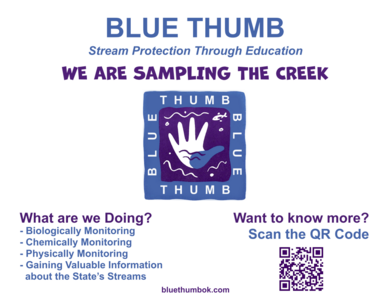
Volunteers John and Sara Harrington came up with a great idea while monitoring their creek! Along with their monitoring partner, Gretchen, they regularly monitor Spring Creek at I-35 in Edmond. This site sits alongside a busy bike trail, so they see a lot of foot and bike traffic. They’re often asked what they’re doing—or notice curious passersby watching from afar, wondering why people are down in the creek.
To solve this, John and Sara created an informational sign and attached it to the wagon they use to transport their monitoring equipment to the stream. Now, anyone passing by can immediately see what’s going on, without having to guess or ask.
You can view and download the sign below to use for your own monitoring site. Thanks for sharing this great idea, Sara and John!
Hunter Hodson
Blue Thumb Field Education Coordinator
Happy New Year, 2026, to everyone!! A new calendar year means a new start. Perhaps you’d like to strive towards monitoring your creek every month. I put this challenge out there last year and we had more sites monitored monthly last year then the year before! Good on ya!
It has been a strange winter thus far; feeling more like spring or even early summer. From looking at my creek site and taking walks near some other creeks, I’ve noticed some creek sites are pretty low, and some have no flow. Algae blooms are running crazy due to nutrients and the warm/hot temps. This has gotta be stressful on the creek bugs and fish. Come on rain and more ‘normal’ temperatures.
QA Reminder
When you select Habitat and or Flow Alteration in the site observations, please write a short explanation in the comments. Was it due to lack of water? Has the creek has shifted in its banks and is flowing more on the left bank side? Is there a new dam/obstruction or is the dam/obstruction now gone? Has a new riffle formed? This information could certainly be helpful in the future.
Kim Shaw
Blue Thumb QA Officer
 Scholarships are still available through OKAEE thanks to a Kirkpatrick Foundation Grant to help you get there and fully participate in Oklahoma’s premier environmental education gathering—where many of our Blue Thumb staff (Jack, Cheryl, Hunter, and Candice) will be presenting!! Explore the program schedule here.
Scholarships may cover one- or two-day registration and offer travel support, including hotel assistance, mileage reimbursement, travel stipends, and substitute reimbursement for classroom teachers—so you can focus on learning, connecting, and bringing real-world quality education back to your students and community.
Deadline extended: Applications are now open through midnight on Sunday, January 19, 2026 thanks to generous funding support!
Who should apply: Oklahoma educators working in formal and nonformal settings are encouraged to apply. Priority will be given to educators serving marginalized and rural communities, strengthening a statewide community of practice around environmental literacy.
We would love to see a few of our Blue Thumb teacher friends take advantage of this opportunity!
Timeline
Application deadline: Monday, January 19, 2026 (midnight CT)
Notifications sent: Shortly after the deadline
Sign up to assist with the Project WET, Project WILD, Project WILD, and Project Learning Tree booths during the eeExpo!
Volunteers! The work you do is important! Other Blue Thumb volunteers want to hear what you have to say. Blue Thumb is offering the chance to provide a webinar in which you tell other Blue Thumb volunteers about your monitoring experiences and your stream, or if you work or a conservation topic that is especially important to you. This is another way to use your voice for GOOD! If this is something that interests you, please email Cheryl.
The beginning of the new year has found me a bit philosophical, as it always does. I am going to take a break from discussing the fish kill on Coal Creek, and I will get back to that next month. It is just too important not to revisit. Plus I expect that by then I will have more information from the report generated by the Oklahoma Department of Environmental Quality. I do not yet have that report.
I am now a part-time employee with Blue Thumb. Taking this route will allow me to “ease” into this important phase of my life. I am excited about the job duties that I will retain, and the bulk of these are with volunteers who are ready to dive into education about their streams. If you are an avid reader of From the Water’s Edge, you will continue to hear from me monthly. I realize that many of you are out there doing great work for streams and helping to generate data, and we have not met. Email me anytime and ask “Okay, just what are you all about?” We’ll have a conversation.
A number of volunteers have done a beautiful job creating data projects that use their data and experiences with their streams to get the word out about protecting their streams. While we have volunteers who have done exceptional work to educate about their streams, in 2023 we began capturing these efforts (as best we could) in little reports that are proudly displayed on the Blue Thumb website. Take a look at these!
Be careful with your winter monitoring. The last few days have been in the 70s, but that can turn on a dime. Safety first. Thank you for taking care of the business of your stream!
Cheryl Cheadle
Blue Thumb Volunteer Coordinator
|