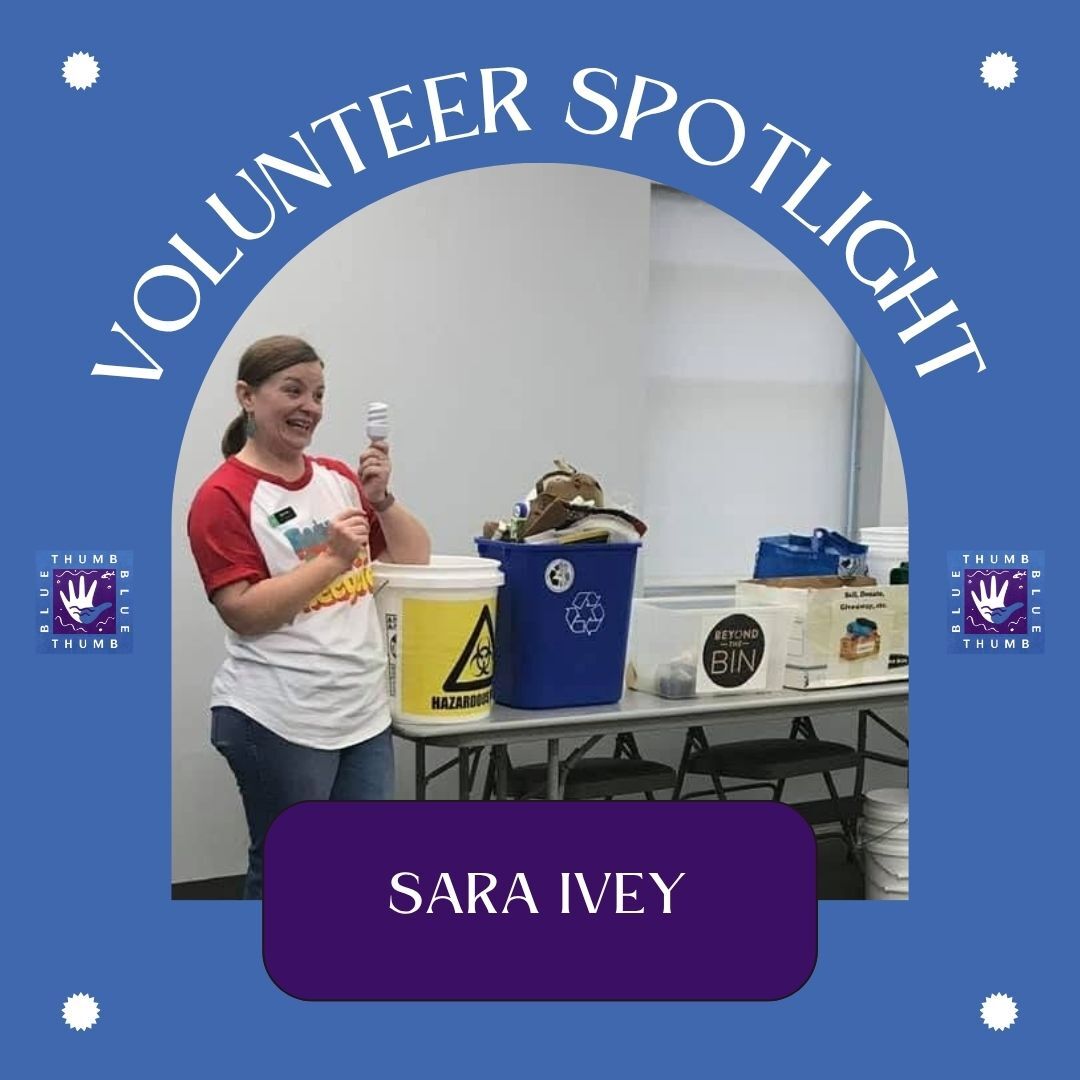
 What inspired you to get involved with Blue Thumb?
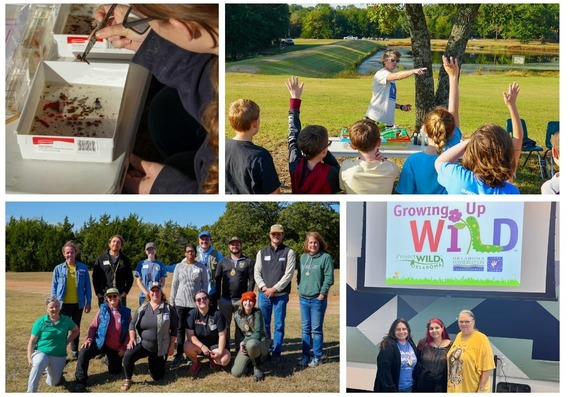
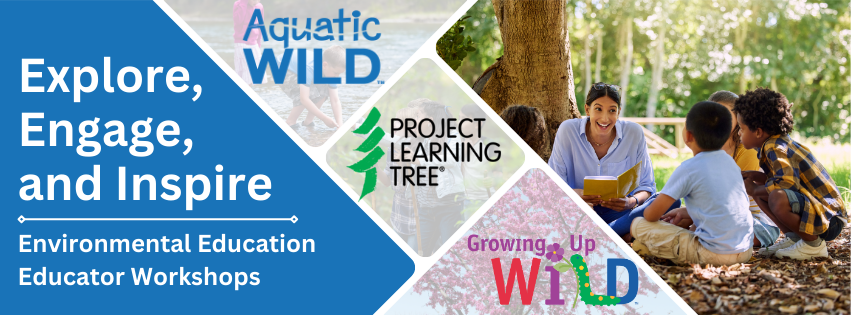
I’ve been passionate about environmental education since undergrad. I wasn’t drawn to a traditional classroom role, but when I discovered non-formal education—and programs like Blue Thumb and Project WET—it clicked. They let me connect students to real-world water issues and stewardship, and I’ve loved watching those “light-bulb” moments ever since.
What do you enjoy most about volunteering with Blue Thumb?
Introducing students to science through Project WET’s fun, hands-on activities. I love helping them investigate, question, and reason through complex issues—instead of memorizing facts—so they leave feeling curious, capable, and empowered.
How long have you been with the program?
I completed my Project WET training in 2007 and became a facilitator soon after. Over the years I’ve used a wide range of Project WET activities—some exactly as written, others adapted for Oklahoma’s context—and sometimes as quick “hooks” that open the door to deeper conversations.
Is there a memorable moment or lesson from your time with Blue Thumb that stands out?
The annual H2Oklahoma Festivals are my favorite. Getting students outside, learning all day in a natural space, is powerful. I’ve seen so many of those light-bulb moments at these events—experiences that stick with students long after the field trip ends.
Sara Ivey
ODEQ Education Programs and Services Coordinator & Blue Thumb Volunteer
This year marks 30 years since the publication of the original Project WET Curriculum and Activity Guide 1.0 (otherwise known as the white guide). We will celebrate through this a series of stories and a $30 for 30 fundraising campaign at the end of the year.
Right now, we are looking for pictures of people with a Guide 1.0 OR the first guide you were trained in. We also want to hear from you about how Project WET has impacted your career and life. We have a short 3-question form to collect your answers and submit a photo.
Thank you for helping us celebrate this milestone and fund the next 30 years of greatness in water education!
Give us your quick thoughts and upload your photos here.
National Project WET Foundation
In October, I had the opportunity to join the Oklahoma Aquatic Connectivity Team (OK ACT), along with several Blue Thumb and Oklahoma Conservation Commission colleagues, for their annual meeting and a hands-on stream survey blitz in the Illinois River Watershed. The group is part of the Southeast Aquatic Resources Partnership (SARP) and brings together people from across the state who share a common goal: reconnecting our streams so fish and other aquatic life can move freely again.
The first day of the event was spent learning about the methods used to conduct aquatic connectivity surveys — from assessing road crossings and culverts to understanding how to collect consistent, accurate data in the field. This training helped us prepare for the next day’s efforts and ensured that everyone on the team was ready to identify and document barriers effectively.
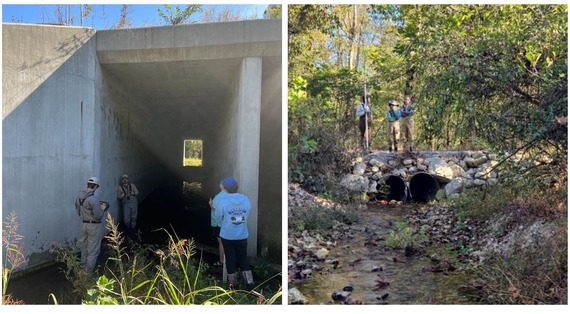
On the second day, we put those methods into action during the blitz itself, visiting several stream crossings throughout the watershed to see firsthand how these structures affect water flow and aquatic passage. Across Oklahoma, thousands of road crossings, culverts, and small dams block fish from reaching the habitats they need to survive and spawn. These barriers can also cause flooding, erosion, and road damage — showing that what’s bad for fish is often bad for people too.
One crossing that stood out in particular was an old vented ford. Water was actually flowing beneath the concrete, and its drainpipes were perched above the stream — impossible for fish to pass through. Standing there, it was easy to see how such barriers fragment habitat and disrupt the natural rhythm of the creek.
The blitz was a valuable reminder of how much insight can come from time in the field. Each survey brings Oklahoma one step closer to restoring healthy, connected waterways.
Click here to learn more about the Aquatic Connectivity Program!
 Hunter Hodson
Blue Thumb Education Coordinator
Book Review – Cherokee County Birds, George W. Fulk
For almost 30 years George Fulk has been a volunteer for Blue Thumb in Cherokee County. He, his wife Mary, and close friends Don and Joyce Varner attended an early Blue Thumb training in Tahlequah. These are special people who were all dedicated to caring for the environment. As a team they monitored Baron Fork Creek for over 25 years.
George has been an interesting study over the years. He retired from Northeastern State University in Tahlequah and took to painting like a fish to water. He has also authored four books with another book on birds nearly ready to go to print. The book I am reviewing is Cherokee County Birds, Illustrations and Information for 70 Species of Birds from Northeastern Oklahoma. George credits two additional Blue Thumb volunteers (Spring Creek) for being helpful with the effort, Cathy and Newell McCarty. Some of the illustrations are done by Cathy, and Newell wrote some of the bird profiles.
I was already familiar with George’s artwork, so I wanted the book primarily because I am so fond of George’s painting. I now admire Cathy's artwork as much as I do George’s. The book is full of beautiful paintings and brief, very interesting descriptions of the 70 birds.
The book is NOT a field guide – it is better. It is the bird portraits and wonderful tidbits about them. George doesn’t pull any punches either. Along with the descriptions and habits of the birds, he talks about the drastic decrease in bird species and numbers that we are experiencing and encourages the readers to get to know birds and then help their friends and families to get to know birds. Probably most important of all is helping children to learn to look for and enjoy bird life. Children and the outdoors are a natural mix, but we have to help make it happen.
This book offers great reading. If you know nothing about birds, you will know something after investing a few hours in this book. If you are already a birder or a biologist you will enjoy viewing the birds from the author’s perspective. You can purchase one of George’s books for $33 by contacting him via email at fulkgeorge401@gmail.com.
 |
|
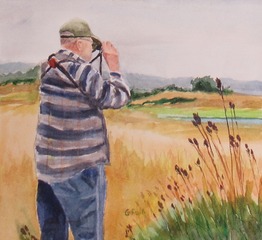
Illustration by George Fulk found on the cover of the book.
|
Fish Kill Series Part II
Part I of this series appeared in the October issue of From the Water’s Edge. That article covered what caused the fish kill, why sewage is a deadly pollutant, my trek up the stream, and the Oklahoma Department of Environmental Quality's role as the investigating agency.
This article will cover the month after the fish kill. Tulsa County has been dry until about ten days ago. Coal Creek (my stream and the one that suffered the fish kill) was in a no-flow situation, but the high volume of raw sewage coursing down the stream caused a fish kill all the way to where Coal Creek enters Polecat Creek, which appears to be about three miles of stream impacted. For about three weeks, the water in the stream's pools remained very cloudy.
Jeffrey Jenkins, my monitoring partner, and I monitor the stream in Morris Park, a city park. I was concerned that with no rain to push the water on through the park and into Polecat Creek, a much larger body of water, that people should not be in the water or near the water’s edge. Sadly, public signage is rarely part of the process when there is a fish kill, even if it is due to sewage. Public signage for surface water that is contaminated with bacteria is only required at swimming beaches. Nonetheless, it was easy to imagine a child splashing in Coal Creek or reaching into the contaminated water to retrieve a rock or stick, then touching their mouth or eating before thoroughly washing their hands. This scenario could easily expose a child (or adult) to a dangerous bacterium or virus. It was a concerning situation.
Blue Thumb testing on the water five days after the fish kill found a dissolved oxygen reading of 0.6 mg/L — the lowest DO I have ever tested. One week later the oxygen level was 1.6 mg/L, an improvement, but still not enough to keep fish alive. On both dates ammonia nitrogen levels were too high to be measured accurately using the Blue Thumb test kit because the levels were above the measurement range. The rains that arrived on October 24 and continued over the weekend brought the stream into high-flow conditions. I expect dissolved oxygen to be in the normal range the next time I test.
Advocating for your stream is an important part of being a Blue Thumb volunteer. Before the fish kill, I requested the opportunity to talk with City Council about a recent fish collection at Coal Creek. After the fish kill, I notified the city and let them know that my presentation would include a discussion of the fish kill. I was allowed to talk to the City Council on November 3.
I couldn’t really “read the crowd” after my presentation. No questions were asked. I gave every member of the Council a copy of the presentation, which included extensive notes on the dead fish observed and the monitoring results. I hope that the Council members and additional City staff will read all those notes, as they contain information I did not actually say at the meeting. There will be a Part III in this series, where I will cover the findings from recent fish collections and the continued monitoring of the water. Stay tuned!
Cheryl Cheadle
Blue Thumb Volunteer Coordinator
|