
 What inspired you to get involved with Blue Thumb?
Mike: Water monitoring is a requirement of The City of Lawton Stormwater Management Program. Working with Blue Thumb has expanded that part of the program.
Cam: I had to because water quality monitoring is one of our BMPs for the Stormwater Program and the City was already working with Blue Thumb. However, even if monitoring was not required and the City was not already working with Blue Thumb, I feel like it is something we would have added once we heard about y’all because protecting resources and preserving them for future generations is something that has always been important to me.
What do you enjoy most about volunteering with Blue Thumb?
Mike: I enjoy working with Blue Thumb to meet new people and learn more about our creeks.
Cam: The fish collections! Until the last hour or so of the 2nd day.
How long have you been with the program?
Mike: I have worked with the Blue Thumb Program for about 15 years.
Cam: Two years this time around and three years previously.
Is there a memorable moment or lesson from your time with Blue Thumb that stands out?
Mike: The most memorable moments are the creek evaluations and fishing.
Cam: My first fish collection! Even though I grew up fishing and majored in Zoology, it was my first time doing something like that.
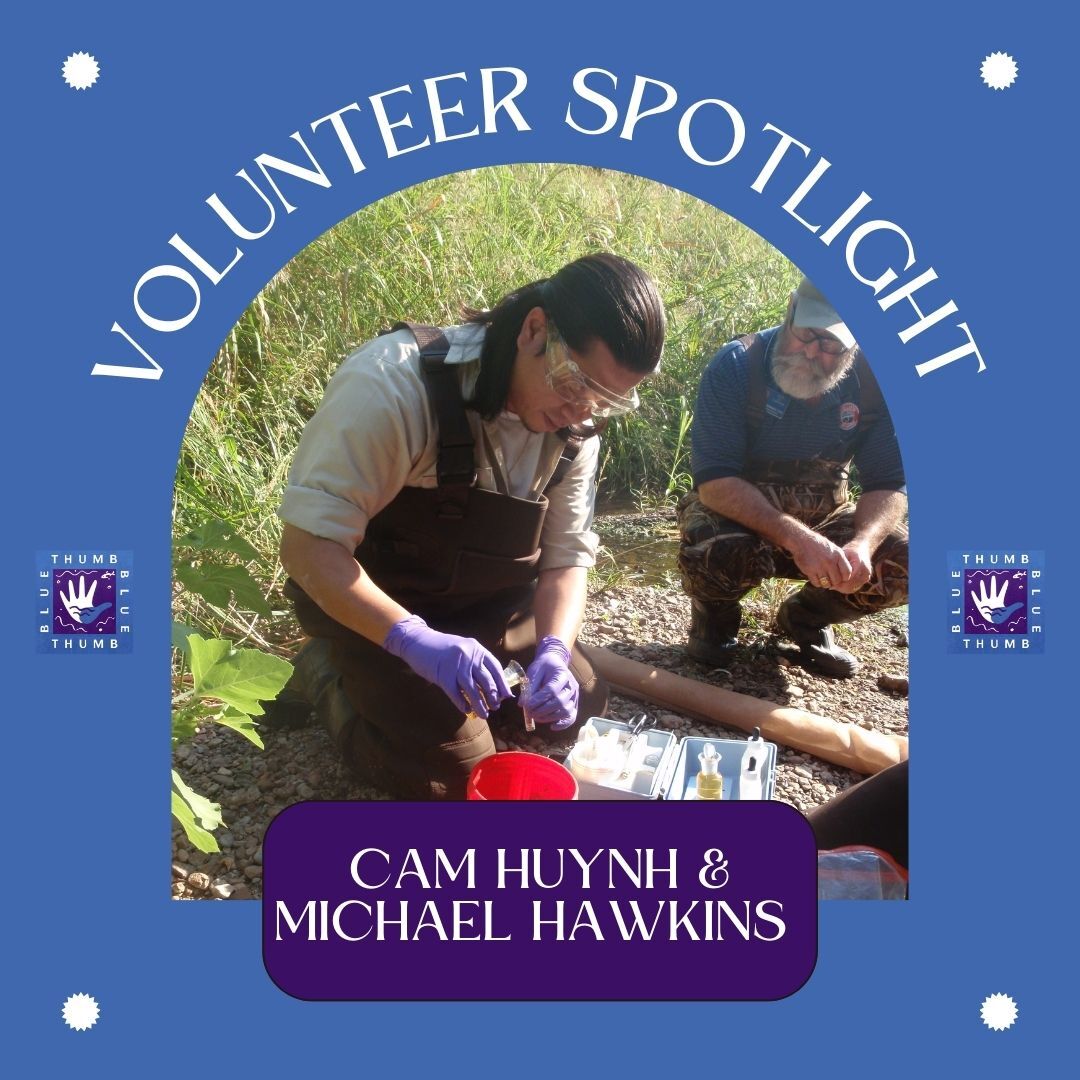
Cam Huynh & Michael Hawkins
Blue Thumb Volunteers
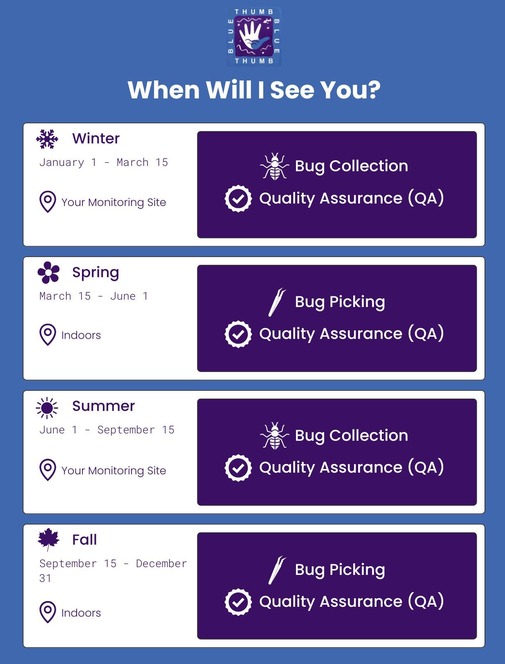
When Will I See You?
I’ve noticed that some new volunteers have had questions about when they’ll hear from their Blue Thumb staffperson, so I wanted to share a quick overview of what to expect throughout the year.
Winter (Jan 1 – Mar 15):
Your staffperson will reach out to schedule your winter bug collection and outdoor quality assurance (QA). Both will take place at your monitoring site during a single site visit.
Spring (Mar 15 – June 1):
You'll be scheduled for spring bug picking and indoor QA, where you’ll sort through the sample collected during winter. These activities happen at a designated indoor location.
Summer (June 1 – Sept 15):
Your staffperson will schedule your summer bug collection and outdoor QA—both at your monitoring site during a single site visit.
Fall (Sept 15 – Dec 31):
Time for fall bug picking, using the sample collected in summer, and indoor QA. These events take place at an arranged indoor location.
This cycle repeats every year, and your staffperson will be in touch each season to help keep things running smoothly.
Thanks so much for being part of the Blue Thumb team—we’re glad to have you on board!
Oklahoma Celebrates First-Ever Water Stewardship Day with Major River Cleanup
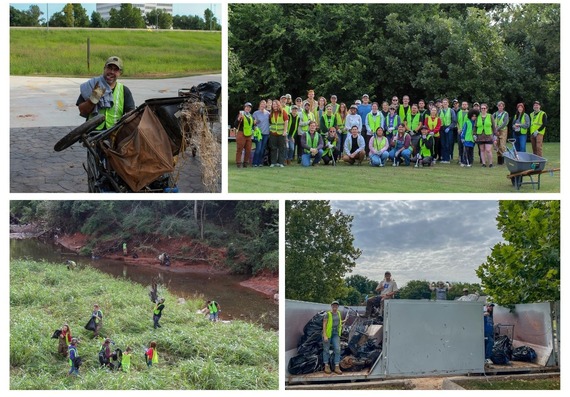
On September 6, 2025, we marked a milestone with Oklahoma's inaugural Water Stewardship Day — a statewide initiative dedicated to protecting and preserving the state’s vital water resources. To honor the occasion, Blue Thumb partnered with OKC Beautiful to organize a large-scale cleanup of a stretch of the Deep Fork River in Oklahoma City.
In just two hours, 42 dedicated volunteers rolled up their sleeves and removed an astonishing 3,839.2 pounds (almost 2 tons!) of trash from the river and its banks. The debris included everything from shopping carts and plastic waste to abandoned clothes — all of which had been polluting the waterway and threatening local wildlife.
The event not only improved the health of the Deep Fork River but also raised awareness about the importance of community-driven environmental stewardship. By joining forces, volunteers demonstrated how much can be accomplished in a short time when people unite with a shared purpose: protecting Oklahoma’s water for future generations.
 Hunter Hodson
Blue Thumb Field Education Coordinator
Impervious Surfaces In Your Watershed
Impervious surfaces are those that contribute to runoff – think sidewalks, roofs, streets, parking lots. Water (raindrops or water from hoses and irrigation systems) hit such surfaces and head to the nearest storm drain or ditch, then on to a waterbody, possibly picking up nonpoint source pollutants along the way. Highly manicured properties where the grass is kept very short contribute much more runoff than does a forest or prairie, or even a lawn with grass that is allowed to grow a little taller.
A few of the problems associated with impervious surfaces are:
- Greater risk of flooding (less areas of infiltration means more runoff)
- Threats to water quality (oil, pesticides, other chemicals, sediment, pathogens, and additional debris can be picked up in runoff and taken to streams)
- Heat Island effect (vegetated surfaces are much cooler than concrete, cement, and other paved areas)
- Stream temperature increased (runoff flowing over impervious surfaces on a hot day can take high temperature water into streams, thus contributing to lower dissolved oxygen)
A city cannot be a city without streets and parking lots. This is why it is very important for cities and citizens to:
- See the value of managing parks, right of ways, and business grounds by employing some urban conservation practices like increasing mowing height and using native plants that contribute to infiltration
- Reconsider areas that need to be kept short – maybe some stretches of mowed areas can benefit from a tiered approach, with short grass next to streets and sidewalks and medium length grass next, then following up areas further back with mowing only a few times a year
- Select areas of parks to be natural – while it sounds like a no-brainer, many communities keep all areas of parkland mowed very short. Some areas could become wildlife habitat with native species and much less mowing
- Citizens can adopt Yard by Yard Community Resiliency Project urban conservation practices for a healthier, pollinator friendly community
Cheryl Cheadle
Blue Thumb Volunteer Coordinator
|