 What inspired you to get involved with Blue Thumb?
J: I was coming to the end of my master's program in social work, and I was deeply interested in combining social values and ethics with environmental education and conservation. I took a webinar focusing on Environmental Justice (a key part of our ethics) and the host recommended looking into Blue Thumb. I was already involved with Save Our Streams Tulsa, so it was a natural fit to start monitoring that same creek. I am so glad I did!
K: I became aware of Blue Thumb in March of 2024 when my friend Jerry invited me to come to his stream to help monitor it. I was in my junior year of undergrad at the University of Tulsa and trying to figure out what I should focus on doing as a career at the time. Going to the creek and learning about water quality monitoring and projects really caught on with me, and I am so glad I went when he invited me.
What do you enjoy most about volunteering with Blue Thumb?
J: I have grown quite fond of our little creek. It's an urban creek so it's not as pretty as some, but I have grown to know and appreciate this small area of water that is a tributary to Mingo Creek and is home to all sorts of bugs, small fish, and one large turtle we have named Yurtle. Ducks and geese regularly use this area as a waypoint too. It's nestled in between a neighborhood and a shopping center with a small park and playground nearby. It experiences a lot of trash being blown in and can also be a source of shelter for those experiencing homelessness. As an urban creek in a low-income area, it holds immense opportunities to build people's relationship and stewardship of water and their natural surroundings. It's very important to me to combine conservation efforts that also meet the needs of those who use the area. One of my driving forces is a quote from Justice Ruth Bader Ginsburg: "Fight for the things that you care about. But do it in a way that will lead others to join you." That is what I hope to do here.
K: I really enjoy the sense of community and purpose I’ve found in water protection in general, which started from my involvement with Blue Thumb. I have really taken off with water conservation topics in my school projects and senior project that I just finished up. It also inspired me to begin working toward a career in water planning, conservation, and stewardship. I am also excited to contribute more to Joanna’s projects she has planned for our creek! We want to foster community involvement in our watershed, especially since East Tulsa neighborhoods are underserved.
How long have you been with the program?
J: I've been monitoring since 2023, starting shortly after completing the training.
K: I started coming along to monitor monthly in May of 2024 and continued with Jerry and Joanna until Jerry left to go back to graduate school. I became a certified volunteer in October of 2024.
Is there a memorable moment or lesson from your time with Blue Thumb that stands out?
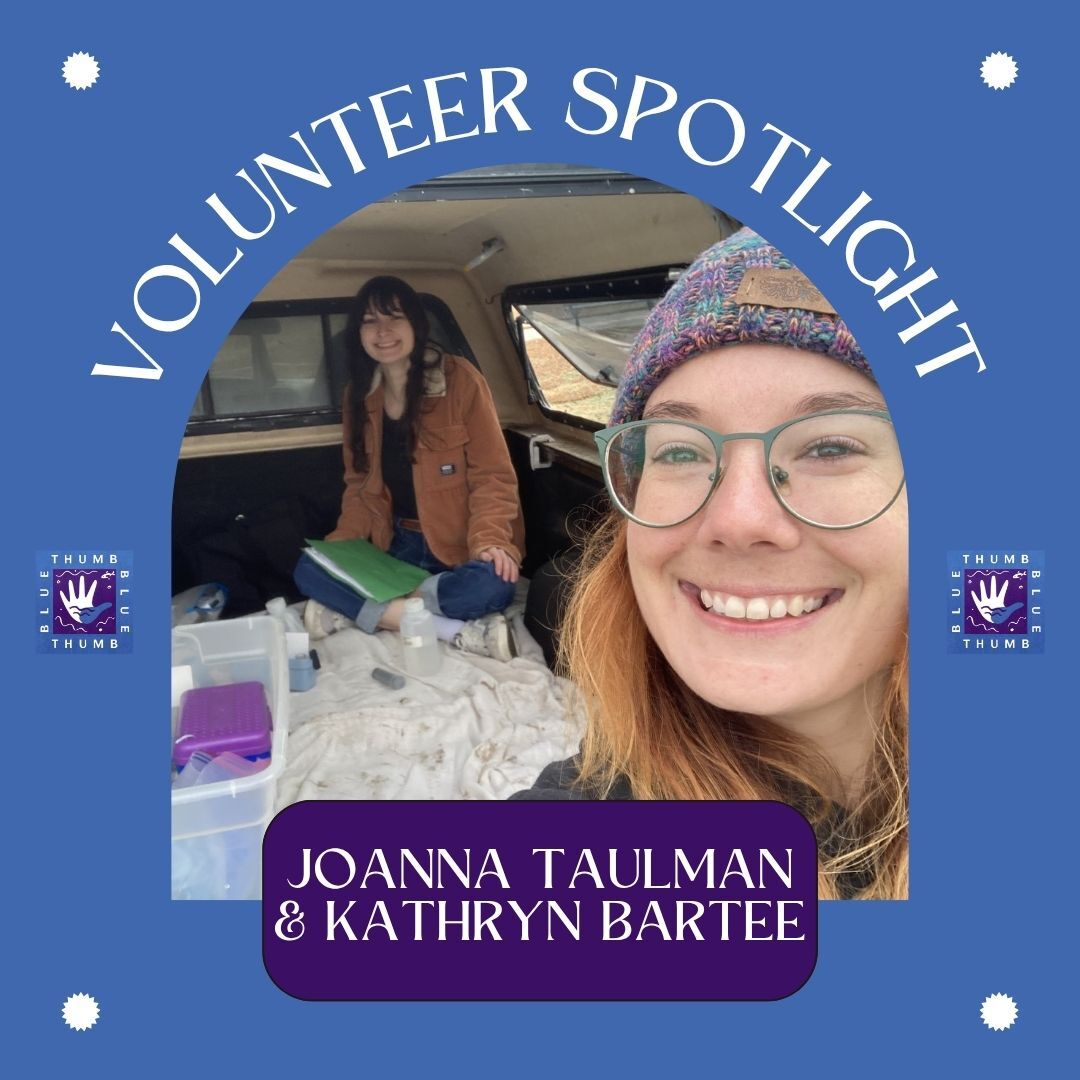
J: I would say this year in general. Hosting successful community cleans, receiving a Friends of Blue Thumb grant (!!), and working more closely with Cheryl and my monitoring partner Kathryn (they are both a wealth of information and I really appreciate their passion). I also really enjoyed the time Kathryn and I had to pile in the back of my truck to monitor because it was a blistery cold morning outside, but we prevailed! We're basically postmen; we monitor rain, sleet, snow or shine!
K: Anytime Cheryl comes to our creek to help with community events or stream cleanups is wonderful. She met with us to plan our activities after the work day, which really meant a lot to me. I also love finding animals in the creek and seeing them flourish!
Joanna Taulman & Kathryn Bartee
Blue Thumb Volunteers
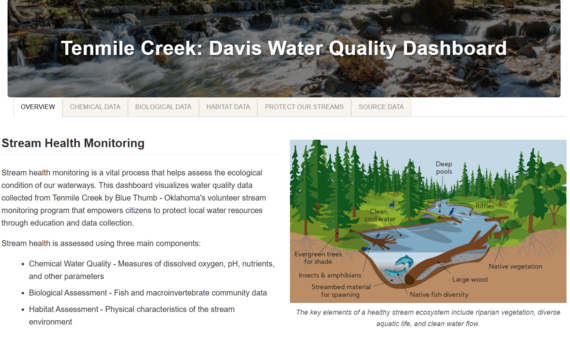 I grew up in Oklahoma and then went off to university and spent some time working in Texas as a water resources engineer for 3 years. I was back home for several months in-between jobs and looking for ways to get involved with the community. I stumbled upon Blue Thumb and read more about the work they did. Given my background, it seemed like the perfect fit to match my skill set with impact. I reached out to Kim, she gave me a sample data packet for Tenmile Creek, and then I was off on my own trying to come up with a unique way to communicate the data and the importance of stream health to the public.
During my free time, I have been teaching myself the programming language Python and also web development. I knew that I wanted to incorporate these new skills into the project. What initially started out as showing a couple of graphs and a location map for Tenmile Creek on a web page, has now evolved into incorporating the entire history of Blue Thumb data into an interactive dashboard that allows users to learn the context of stream health and explore data trends in their local streams. It has been an incredible learning process and I am thankful to Kim for allowing me the flexibility to explore unique ways to communicate Blue Thumb Data. I am also thankful to all of the current and previous Blue Thumb volunteers that have created such a robust dataset to work with. I consider myself a conservationist, and the work that Blue Thumb does is vital to maintaining the quality of our most natural resource.
I am currently putting the finishing touches on the website and will soon be able to share it with the public. It has been such a pleasure to work with Blue Thumb and I hope that you all get a lot of use out of what I have created!
Jacob Askey
Blue Thumb Volunteer
In July, Jacob will be leaving for the Philippines to do some work for the Peace Corps. The data project Jacob created for Tenmile Creek can be found on our website or by clicking the button below. Go check it out, it is REALLY neat!!!
Your Stream is Part of a System!
June 21 my monitoring partner, Jeffrey Jenkins, and I completed a small “creek walk” on Coal Creek, north of Glenpool. This is the stream that we monitor. We live in the watershed (although Jeffrey recently moved to OKC), therefore we see this stream often and we have this stream on our minds. Pretty much the whole community of Glenpool is in the Coal Creek watershed.
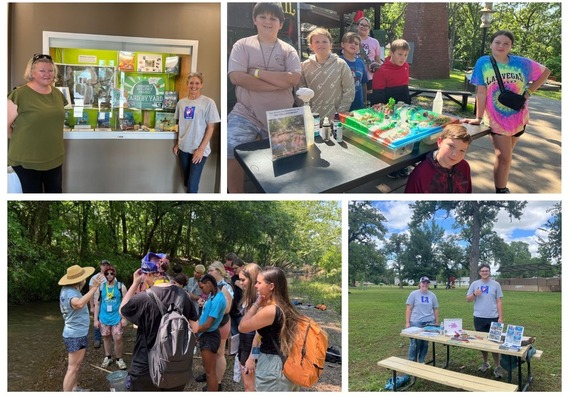
Our little creek walk garnered a small crowd, and we looked at bugs and fish and everyone there got a turn to pull the seine! When you can actually get people to the stream, they love seeing the fish and the creek bugs!
Not every Blue Thumb monitoring volunteer is interested in doing education activities. But every volunteer cares about the stream they monitor. When a stream becomes a Blue Thumb site, it goes on the Blue Thumb roster of actively monitored streams. So just by saying YES to becoming a monitor, a stream becomes part of the system. A BT staff member might be asked “What streams around here are monitored?” Your stream might be the answer.
When You Pick a Day….
When do you do your stream monitoring? At Blue Thumb training you were encouraged to pick a date and time, such as the last Friday of each month. When you pick your day EARLY in your monitoring endeavor, this will lead to a “randomness” that adds a variety of situations in which you are monitoring. If you are committed to monitoring on the last Friday of the month, you will monitor if it is hot, cold, clear, cloudy, or a light rain is falling. When you do not have a specific date, it might be easy to let conditions bias you.
Of course, you should change the date if conditions are unsafe. You might change the date because something important pops up. If you can know your changes early, you can still employ that randomness by saying “Okay, my team can monitor the third Friday this time, or maybe the day after.” See, randomness intact.
This is also a good time to offer this reminder – a high flow situation can be a good time to monitor. You might not be able to get to the exact place you typically monitor, so you just get as close as you safely can. If you monitor each month at an appointed time, you should get some high flow, low flow, base flow, hot days, cold days, windy days, etc. By “high flow,” we do not mean flooding events. Please do not monitor during flooding events. “High flow” means the water level is above normal, but you can still approach the creek safely. It is important to document your stream in all kinds of conditions, but only if it is safe to do so!
Cheryl Cheadle
Blue Thumb Volunteer Coordinator
|