|
A Deep Dive into Fish Collections
Part 2 – A Comparison Over Time
Blue Thumb was a young program in 1997 when a media specialist with Glenpool Public Middle School chose to become a volunteer monitor and expose students to outdoor experiences at Coal Creek in Morris Park. This media specialist, Carolyn Mathews, stayed with her monitoring and the following year, 1998, Coal Creek received a fish collection.
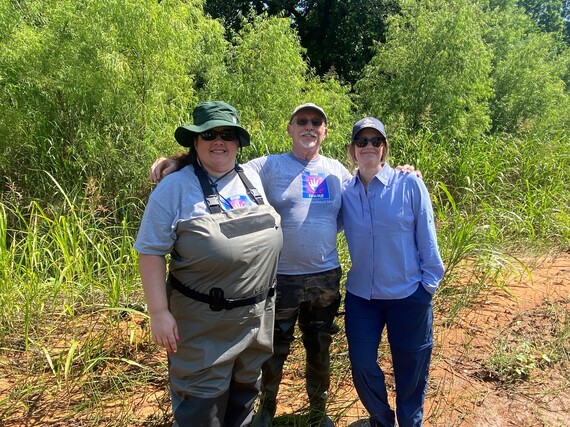
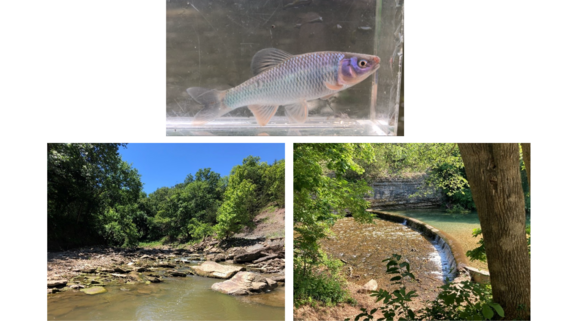
Carolyn monitored Coal Creek with various students for a few years, then moved to another stream, and Coal Creek went without data collected until 2016, when I began monitoring with college students Mark and Andrew. Once these two graduated, the monitoring faltered a bit, and during COVID monitoring faltered a bit, and in 2021 monitoring became more steady with the addition of team member, Kim. In 2021 another fish collection took place, and species found in both collections are below:
|
|
1998
|
2021
|
|
Present in Both Collections
|
Red Shiner, 218
|
Red Shiner, 12
|
|
Mosquitofish, 228
|
Mosquitofish, 62
|
|
Green Sunfish, 3
|
Green Sunfish, 17
|
|
Bluegill Sunfish, 3
|
Bluegill Sunfish, 46
|
|
Longear Sunfish, 47
|
Longear Sunfish, 223
|
|
Present in One Collection
|
Sand Shiner, 4
|
Brook Silverside, 159
|
|
Suckermouth Minnow, 2
|
Central Stoneroller, 53
|
|
Black Bullhead, 8
|
Redfin Darter, 9
|
|
True minnows, unidentified in field, 2
|
Gizzard Shad, 14
|
|
|
Bluntnose Minnow, 11
|
|
|
Yellow Bullhead, 10
|
|
|
Orangespotted Sunfish, 4
|
|
|
Redear Sunfish, 1
|
|
|
Largemouth Bass, 2
|
|
|
Spotted Gar, 1
|
|
|
Spotted Sucker, 1
|
|
|
Spotted Bass, 1
|
|
|
White Crappie, 1
|
There was twice the diversity in the more recent collection. Unquestionably, the Coal Creek watershed has gained population as the city of Glenpool has grown. The major change to the stream was the rerouting of Glenpool’s effluent from Coal Creek directly into the Arkansas River. The discharge was rerouted in 2010; this change paved the way for the return of species to Coal Creek.
The listing of fish from both collections, with the numbers caught, is the bulk of this “Deep Dive into Fish Collections, Part 2.” Tune in for the August “Deep Dive” because what you can expect in Part 3 will hold information such as:
- Are any of these fish sensitive to pollution?
- Why did some of the species from 1998 disappear even though the stream improved?
- What does it mean to catch very low numbers of several species?
- What is the best direction for the Coal Creek monitors to take to ensure the fish diversity in Coal Creek improves or at least stays the same?
Data Project Ideas
Blue Thumb staff members have pondered interesting ways that volunteers might present their data to those who live in their watersheds. Recently, El Reno students who have collected data on both Six Mile Creek and Four Mile Creek in Canadian County presented some findings via a poster presentation to other Blue Thumb volunteers. The students were encouraged to take this information into the City of El Reno, maybe the public library.
Volunteer Jeffrey Jenkins and I (Coal Creek, south Tulsa County) recently chose to invite city officials and members of the Glenpool area to Coal Creek to experience chemical monitoring and participate in an “education” fish collection. This is another way to share data and learn about stream protection. We are also going to set up a display at our local Farmer’s Market plus offer a creek walk. We want watershed residents to know that Coal Creek is in good condition and together we can keep it that way!
Do you have data project ideas? Let’s talk! E-mail me!
Cheryl Cheadle
Volunteer Coordinator
To our Monthly Monitors:
A couple of quick reminders to our creek monitors:
- Please store your reagents below 80°F. DO NOT leave them in a hot vehicle for any length of time. DO NOT leave them out in a garage, out building or storage building – if that is where you leave your test kit. We know accidents happen, so if you accidentally leave your reagents in conditions that are too hot, please let one of us know so we can get you new reagents. There is no point using compromised chemicals that will most likely give you wonky results. Storing chemicals at the right temps is necessary to ensure accurate data.
- Chloride blanks really should take only one drop of silver nitrate to see a change of color in the solution. I am seeing more and more of 3 drops. If you get a result of 3 drops for the blank, please let us know. Maybe you need new reagent(s) or perhaps you are going over the end point and need our assistance to show you what the actual end point color needs to be. You are after that slightest color change from yellow-yellow to a slight orange-yellow. And it might be that we need to advise you that you always back off a drop. During the Spring 2023 QA, we had you test a known standard solution of chloride. I don’t think all the results have been entered yet and/or I haven’t had time yet to analyze these results. But in the past QA’s with chloride, most of the volunteers are within the proper range but over-read the test by 2-3 drops.
If you’d like to help us with fish collections, please contact me. Here is our schedule thus far:
- July 10-14 – all week in Lawton
- July 17 - Crutcho Ck, S OKC
- July 27 – Salt Fork of the Arkansas River, Alva
- July 31 - Little River, Moore
- August 14 – Bishop Ck, Norman
- September 1 – Little Deep Ck, Weatherford
Still need to schedule:
- Bishop Ck, Norman
- Pepper Ck, Pawnee
- Spring Ck, Martin Park in OKC - August
- 1 site in Stillwater (Duck Creek)
Kim Shaw
Blue Thumb QA Officer
|