Nonpoint Source Pollution
Wetlands naturally provide a number of water quality improvement functions, making them an important part of resolving nonpoint source pollution, the leading cause of water quality impairments across the United States. Nonpoint source (NPS) pollution primarily results from water runoff during and after precipitation and snowmelt events. As water moves across the landscape, it often picks up and carries sediment particles, nutrients, and other pollutants (e.g., fertilizers, herbicides, pesticides, oil and grease, etc.), before being deposited into lakes, rivers, wetlands, and groundwater.
The Oklahoma Conservation Commission's (OCC) Water Quality Division is the lead technical agency for Oklahoma's NPS management program. The Water Quality Division is responsible for identifying, prioritizing, and managing waters in Oklahoma that are impacted by NPS pollution. Although OCC is the lead agency, addressing NPS issues across the state requires a collaborative effort from federal, state, and local agencies, environmental and landowner groups, and Indian tribes. Together these partners form the NPS Working Group. The NPS Working Group prioritizes where funds and technical assistance for water quality projects are directed. Water quality projects are also collaborative efforts often involving federal, state, and local agencies, conservation districts, tribes, and private citizens.
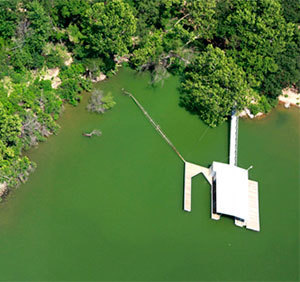
Aerial view of an extensive outbreak of blue-green algae in Grand Lake, a popular recreational lake in Oklahoma. Blue-green algae is primarily caused by excess nutrients from NPS runoff.
The Watershed Approach
NPS management programs generally address water quality issues at the watershed scale. Watersheds are defined as the drainage basin or catchment in which all of the surrounding water drains through to reach a stream, wetland, or the ocean. Watersheds can be assessed at multiple scales. For example, the watershed of an individual wetland may be several acres; whereas, the watershed of a stream may be thousands of acres.
By implementing a watershed-based approach, we can monitor water quality in individual streams, and identify potential causes of impairments within a particular drainage area. Once identified, best management practices can be implemented within the watershed to reduce future impacts. Finally, these practices can be evaluated for their success in improving water quality.
Oklahoma Success Story
With Grand Lake being one of Oklahoma's premier lakes, improving water quality within the upstream watershed became an important focus for OCC's NPS program, as well as for partners including, the Grand River Dam Authority. Honey Creek, a tributary of Grand Lake, was identified as a priority watershed for improvement based on potential NPS pollution within the watershed. Stakeholders convened to prioritize and implement best management practices (BMPs) in an effort to reduce NPS pollution impacts to Grand Lake. BMPs included riparian area protection, through livestock exclusion and limited grazing/haying, as well as poultry litter transport, septic system replacements, pasture planting, and other practices. Through effective collaboration and implementation of BMPs, monitoring results showed roughly a 28% reduction in phosphorus loading, a 35% reduction in nitrate loading, and significant reductions in bacteria concentrations. To learn more about Honey Creek and many other success stories in Oklahoma, visit: EPA: NPS Success Stories.
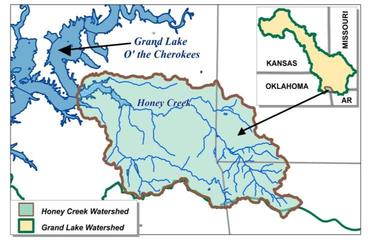 Map of the Honey Creek watershed
The Role of Wetlands
Wetlands have been widely recognized for their capacity to improve water quality. Specifically, wetlands function to recycle nutrients, including phosphorus and nitrogen, and filter out sediments and pollutants. Wetlands can also improve water quality by reducing peak flows and minimizing erosion impacts. Because wetlands naturally provide functions that are highly desirable for improving water quality, they have become an important component of many watershed management programs. Wetlands not only improve the water quality within their own watershed, but because they also exist within the larger watershed of a stream, there is an opportunity for wetlands to make a significant impact on the reduction of NPS pollution downstream.
The Oklahoma Wetlands Program is working to further integrate wetlands into OCC's NPS program, by including wetland management strategies in watershed level planning efforts. In fact, this goal has been specifically outlined in Oklahoma's Wetland Program Plan, the State's strategic planning document. Integrating wetlands into watershed planning includes strategies for voluntary wetland restoration, enhancement, creation, and protection projects in priority watersheds, where water quality improvements are needed. By focusing our efforts on restoring and protecting wetlands in these priority watersheds, we can further reduce NPS pollution, improve the quality of water we use for drinking and recreation, and increase wetland acreage across the state.
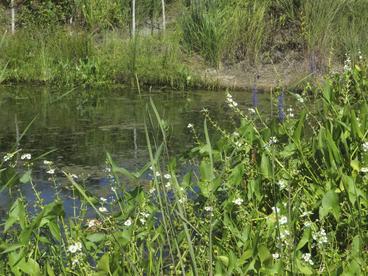 The Gathering Place, a newly constructed recreation area in Tulsa, incorporated areas of wetlands into their design. These wetlands not only offer aesthetically pleasing views for visitors, but constructed wetlands in urban areas can also minimize the negative impacts of accelerated runoff and increasing pollutant loads.
Photo credit: Elaine Warner, The Edmond Sun
|