Wetland Restoration
When protected wetlands are affected by unavoidable impacts (e.g., draining, filling, road construction, water pollution, etc.), mitigation may be required to compensate for the wetland loss (Section 404, Clean Water Act). Mitigation is often achieved through wetland restoration, which involves the reestablishment of wetlands where they previously existed. The goal of restoration is to replace the functions and services that are lost when wetlands are impacted or removed from the landscape.
Wetlands are primarily restored to meet mitigation needs; however, they can also be restored when wetland functions are needed or desired. For example, wetlands may be restored to increase stormwater retention, create wildlife habitat, recharge groundwater, and to improve water quality.
Restoration Process
Restoration plans should include objectives for restoring the three primary characteristics of wetlands: hydrology, hydric soils, and wetland vegetation. Examples of restoration objectives for each component are listed below.
Wetland Hydrology
Restoring a wetland's hydrology is critical for the wetland to function, because the timing, duration, and amount of water, as well as the water source, directly influence the soil and plant community. Restoring hydrology may require increasing or decreasing the amount of water being captured and stored in the wetland. On agricultural land, tile drains, which are usually made of clay or plastic, are buried in low areas to drain water off of the land. To restore hydrology, tile drains can be broken or removed to improve the wetland's capacity to hold water. Additionally, water control structures can be installed to control the amount of water input and output in wetlands.
 Flashboard risers (pictured) are one of the most common types of water control structures. Boards are removed from the inside of the structure to control the water level within a wetland. The cage on the outside is to discourage beaver activity.
Hydric Soils
Hydric soils are soils that have been flooded or saturated long enough during the growing season to develop anaerobic (oxygen-depleted) conditions. Restoring hydric soil may involve excavating and removing fill to expose the hydric soil underneath. While hydrology and wetland vegetation can be established soon after restoration, it may take many years of saturated conditions for hydric soil characteristics to form.
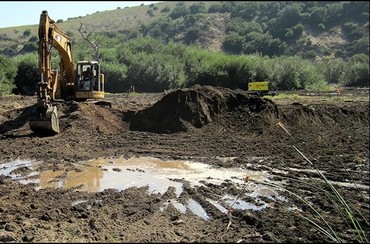 Equipment can be used to restore wetland topography. Recreating natural topography, including the addition of pools and mounds, can improve overall wetland functionality (e.g., diversify water regimes, increase habitat diversity, and increase benefits to wildlife).
Photo: National Park Service, Channel Islands National Park, California
Wetland Vegetation
Objectives for restoring native wetland vegetation include eliminating any disturbance, such as grazing or mowing and controlling for exotic and invasive species. Reestablishing native vegetation may involve relying on the native seedbank for colonization or planting the wetland. To achieve restoration objectives, wetlands need to be monitored to evaluate the survival and establishment of native plants.
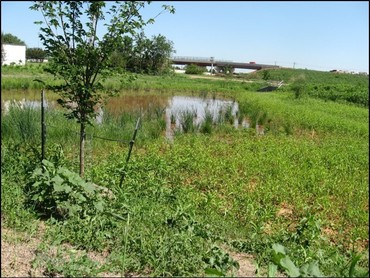 During wetland planting and seeding, a mix of species is typically used to promote a diverse plant community. Plant communities that are diverse in species composition and structure generally provide a greater variety of wetland functions, including habitat for a wider range of species.
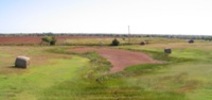
Photo: Wetland restoration in Norman, OK
Eufaula Wetland Project
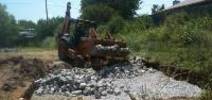
Team Up to Clean Up is an Oklahoma nonprofit that engages agencies, youth, and the community in projects to clean up neighborhoods. In collaboration with several partners, including the City of Eufaula, Oklahoma Conservation Commission, Oklahoma Water Resources Board, Oklahoma Water Survey, and BioxDesign, Team Up to Clean Up is currently working to convert a city park along the shore of Lake Eufaula into a wetland park. Their goal is to create a 2-acre wetland that will capture and treat a portion of the city's stormwater runoff, while also serving as an educational tool for the public.
Construction on this project began in June 2018. It is located at the intersection of Broadway Avenue and G Street in Eufaula, McIntosh County, OK.
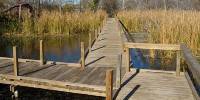
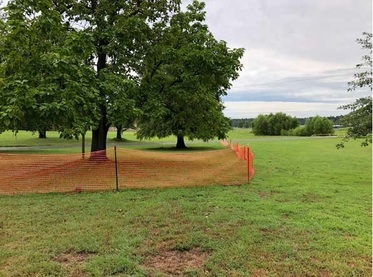 This project is currently in the early stages of construction. Temporary fencing has been placed around all existing trees for protection. Construction will include adjusting the grading on-site to allow the area to capture stormwater, as well as installing pathways, benches, and boardwalks for observation.
Photo credit: Team Up to Clean Up
Interested in Wetland Restoration?
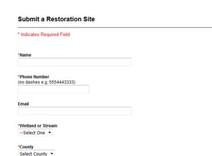
Citizens may submit requests to the Conservation Commission for their property to be included in the Wetland Registry, an online database of potential wetland restoration sites. The overall goal of the registry is to connect parties in need of restoration sites with landowners that are interested in restoration opportunities on their land. For more information, visit our website: www.ok.gov/wetlands.
Where are Wetlands in Oklahoma?
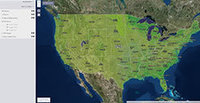
As part of a national effort to inventory all of the wetlands across the U.S., the Fish and Wildlife Service created maps of wetlands and riparian areas. These maps have been integrated into an online database and mapping tool, the National Wetlands Inventory Mapper. NWI is an excellent resource, providing information on the potential location of wetlands for preliminary planning. However, NWI data should not replace field verification of wetland locations. To access this tool and learn more about where wetlands are mapped in Oklahoma, see the NWI Mapper.
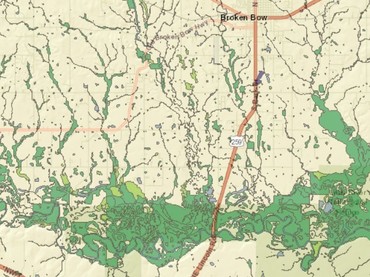 This image shows the locations of wetlands that were mapped in southeastern Oklahoma, near Broken Bow.
Source: NWI Mapper, U.S. Fish and Wildlife Service
|