Welcome to the new Oklahoma Wetlands Program bulletin! This monthly
publication will highlight many topics, including:
- The ecology, biology and management of wetlands in
Oklahoma.
- Plants and animals that rely on wetlands.
- Types of wetlands you might encounter across the state.
- Ongoing and completed projects designed to improve wetland
restoration and monitoring.
- Resources available to Oklahoma landowners on how
best to maximize ecological and financial benefit from wetlands on their
property.
The Oklahoma Wetlands Program provides Oklahomans assistance with wetland related issues. Led by the
Oklahoma Conservation Commission, the program is a collaborative effort between
state and federal agencies, tribal governments, local governments, academic
institutions, and non-governmental institutions. The program is a resource
of information about wetland science and current management activities,
and can guide you to the appropriate entity for technical, financial,
educational, and regulatory assistance.
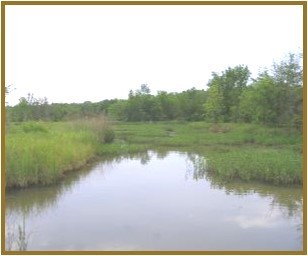
There are many types of wetlands and we will highlight them all in future bulletins. This is a beaver impounded wetland in Seminole County. Water enters this site due to a beaver impoundment
on an adjacent creek, which causes the creek to spill its banks and flood the riparian area.
What is a Wetland?
Wetlands are areas of land that are wet enough for long enough at the surface, or within the topsoil, to cause a change in the soil and plant community. This saturation with water is a dominant factor in determining soil development and the communities of plants and animals present.
In Oklahoma, wetlands are common in topographic “low-spots,” where surface water accumulates, or groundwater discharges to the surface for at least a portion of the growing season. Wetlands may also form where slopes intersect the groundwater table and groundwater discharges to the surface.
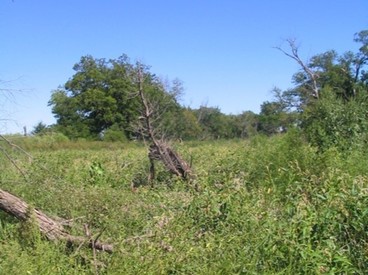 Wetland on the Hulah Wildlife Management Area in Osage County during a dry period in 2011.
Wetlands Can be Dry
When you hear the word “wetland,” you might immediately think “water.” However, to be considered a wetland an area really only needs to hold water at or near the surface for approximately 3 consecutive weeks every other year! In fact, it is the alternating wet and dry periods that make wetlands unique in their plant communities, soil development, and their ability to take in and remove excess nutrients from nearby land and waterbodies.
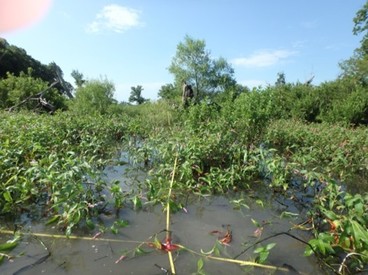 Wetland on the Hulah Wildlife Management Area in Osage County during a wet period in 2016 (same location as 2011).
Benefits of Wetlands
- Wetlands recharge underlying groundwater aquifers by holding the water and letting it slowly sink in.
- Because wetlands are often located adjacent to rivers, they can help reduce damaging floods by capturing or slowing floodwaters.
- Wetlands provide important habitat for wildlife, including waterfowl, therefore offering unique opportunities for recreation such as bird watching and hunting.
Oklahoma Wetlands Registry
The Oklahoma Wetlands Registry is a tool designed to connect wetland owners, developers and agencies with each other for wetland enhancement, restoration and creation opportunities.
If you have a wetland or stream on your property that you believe is suitable for restoration you can provide information about it on the registry. Listing a site in the wetlands registry is
completely voluntary.
Wetlands Registry
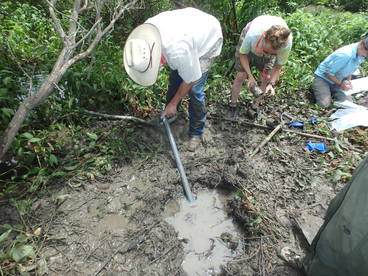 Completing soil sampling
during NWCA 2016 was sometimes challenging due to water-logged soil pits. Here we attempt to pump water out fast enough to collect accurate soil
samples. Soil samples tell us a lot about sources of degradation to
wetlands, including surface compaction, which can affect plant communities.
National Wetlands Condition Assessment
Oklahoma
Conservation Commission staff along with partners from Northeastern State
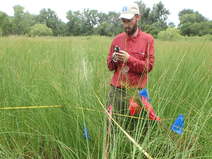
University spent the summer of 2016 participating in the National Wetlands Condition Assessment (NWCA). We
collected data on water quality, plant communities and soil profiles from 17
wetlands across the state. The goal of the NWCA is to determine trends in regional and national wetland health. With this data we can track the health of
Oklahoma wetlands and identify causes of wetland
degradation. The assessment is completed every 5
years across the United States.
See the results of the 2011 NWCA |