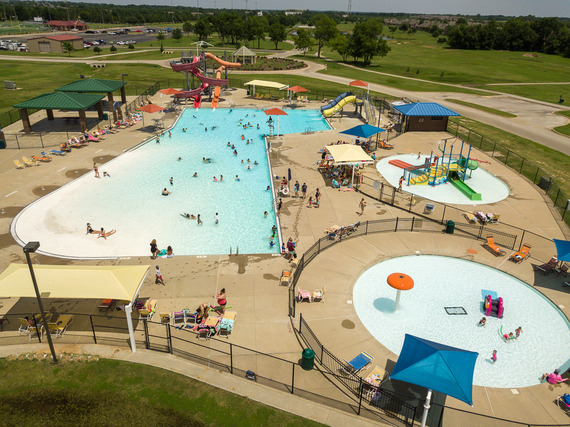
 Family Aquatic Center
If you want to learn to swim, you have to jump into the water! You'll have the chance to get wet beginning May 25, when all city pools and splash pads open for the summer.
Swim lessons are available for preschool and school age children. Find out more at BAParks.org.
Entrance to the pool is $5 per person, and we have a great deal for our frequent swimmers. You can purchase a 10-punch pass card at the community centers for just $40, saving you money on multiple visits. The punch cards may be purchased at any of the Community Centers. Proof of residence is required.
Hours of operation and locations are below:
Family Aquatic Center, 1400 S. Main St., will be open
- Monday, Wednesday, Thursday, Friday, and Saturday, 12 p.m.- 8 p.m.
- Tuesdays, 1:30 p.m. until 6 p.m. and
- Sundays, 12 p.m.-5 p.m.
Nienhuis Aquatic Facility, 3201 N. 9th St., will be open
- Monday: 12 p.m. - 8 p.m.,
- Tuesdays and Wednesdays 1:30 p.m.-8 p.m.,
- Thursdays 12 p.m.-6 p.m.,
- Friday and Saturday 12 p.m.- 8 p.m.,
- Sundays 12 p.m.-5 p.m.
Country Aire Pool, 100 N. Fir Ave.,
- Friday and Saturday, 12 p.m.-8 p.m. and
- Sunday, 12 p.m.- 5 p.m.
Splash Pads will be open daily from 8 a.m.-8 p.m. and there is no charge.
Splash Pads are located at the following locations:
- Jackson Park, 4800 W. Washington St.,
- Seiling Park, 525 W. Iola St.,
- Haskell Park, 601 E. Dallas St.,
- Preserve Park, 3000 N. 37th St.,
- Leisure Park, 800 W. Charleston St.
- Rockwood West Park, 1308 N Narcissus Ave, and
- Camino Villa Park, 2812 E. Madison Place.
The Rose District's Interactive Water Feature is open from 9 a.m. to 11 p.m. daily.
Are you looking for a summer job? We have a few spots available for lifeguards. Interested individuals are encouraged to apply on the City's website at BrokenArrowOK.gov.
Here's a look beyond the dirt and cones
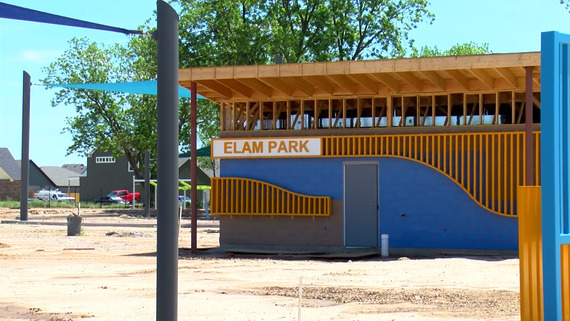 Elam Park is a brand-new park that is coming to southwest Broken Arrow. A grand opening will be announced in the summer of 2024.
Project updates for May 2024
-
Elam Park is taking shape with the playground equipment installation that is currently underway. The plants for the landscaping of the park will arrive soon and the finishing touches to the parking lot will begin shortly. A grand opening ceremony will take place this summer. Stay tuned!
- At Events Park. The Streets Department crew is nearing completion on the road that connects Events Park and the Challenger Sports Complex. They have hauled in fill and topsoil to shape the shoulder of the road. The sod crew has been laying the sod between the rainstorms and have been dealing with saturated ground. When the new black vinyl fence is installed south of the bridge, this project will be complete. Events Park will close to the public at the end of May as construction work is set to begin on the public infrastructure improvements within and around the park.
- The Oklahoma Department of Transportation is widening County Line Road (23rd St.) from Houston to Kenosha Streets to five lanes and building a new bridge over SH-51. The bridge approaches have been poured and crews have begun laying asphalt in the east lanes. They are continuing work on the curbs, gutters and pavement on Houston and County Line Road. The stormwater improvements at the intersection will continue for several weeks. This project is expected to be finished in the next couple of months.
- The City Council awarded a $4.1 million construction contract to Cherokee Pride Construction to widen 37th Street, also known as 209th East Avenue, to three lanes between Kenosha and Albany Streets. The project will include stormwater improvements, a new waterline, and a concrete sidewalk on the east side of the street. Construction is expected to begin this summer and will likely be completed this time next year.
For more on these projects, watch Broken Arrow in Motion with City Manager Michael Spurgeon.
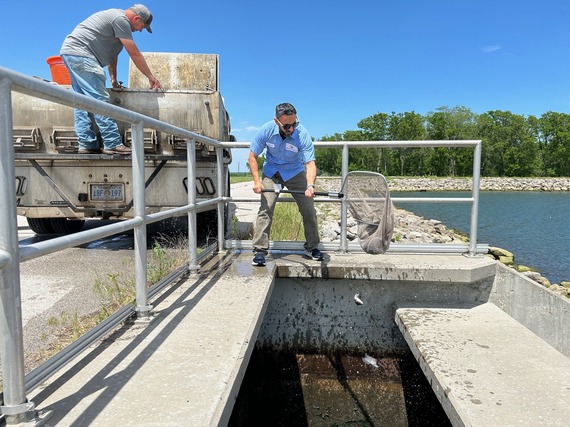
It's fishing season at the Verdigris River Water Treatment plant, but not in the way you may think.
As Bruce the Shark famously said in Disney’s Finding Nemo, these “Fish are friends, not food.” Bluegill and Tilapia fish are used at the water plant to help with the filtration process.
The City of Broken Arrow Utilities Department strives to provide residents with high-quality, safe drinking water that surpasses the U.S. Environmental Protection Agency and Oklahoma Department of Environmental Quality requirements.
"Providing the citizens with more environmentally friendly water treatment while minimizing chemical use is the goal," said Verdigris River Water Treatment Plant Manager Lou Ann Fisher. "We continue to look for sources and ways to treat the water that reflect our concern for the good health of our community."
One of the ways the City's highly trained and licensed operators accomplish that goal is by regularly stocking the pre-sedimentation water basins with Bluegill and Tilapia fish.
Operators added more than 600 pounds of Tilapia and 6,100 headcount of Bluegill to the basins on May 1. Each type of fish has a unique purpose in the water filtration process.
Warmer temperatures cause algae growth in surface water sources, such as the Verdigris River, which is the City’s primary source for drinking water. Algae blooms can affect the taste and smell of the drinking water.
"We're combating the algae in many different ways," Water Plant Operator Jed Beloncik said during the fish stocking process.
He tests the water from the river and both basins for taste and odor compounds. The samples are sent to a Texas laboratory for evaluation.
Algae is Tilapia's primary food source, and with this method, nature minimizes algae growth.
Broken Arrow has used Tilapia since 2014 as a secondary control for combating algae. However, with their recent success, Tilapia has become a primary source, and the operator’s re-stock the basins every year.
"Another situation of concern is water fleas (ceredaphnia dubia), microscopic translucent fleas that can make it past treatment processes and clog the strainers for the water plant's microfiltration process," Fisher said.
Bluegills feed primarily on water fleas and help control their population and minimize their harmful impact. They are an Oklahoma Native fish and are re-stocked every other year.
Fisher credits Senior Plant Operator Sam Burman, who made the Bluegill discovery a couple of years ago while researching how to get rid of water fleas.
"It was a game changer in the warmer months," Fisher said.
In case you’re wondering, the pre-sedimentation water basins are not open for public fishing, because after all, these fish are friends, not food!
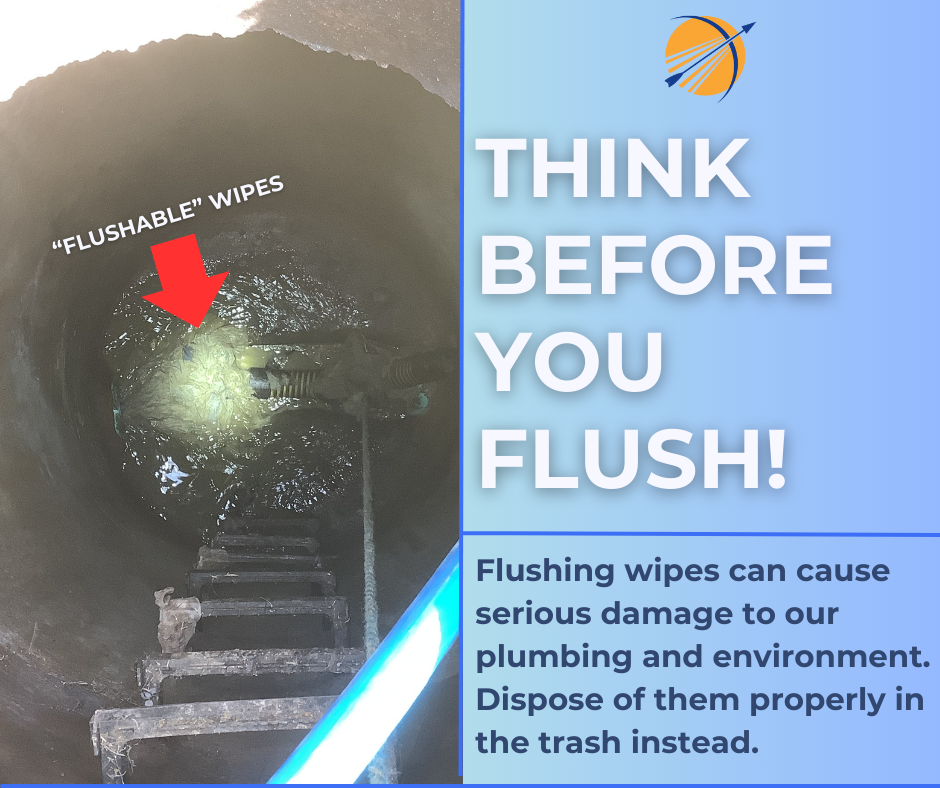 Flushable wipes are an oxymoron, a myth, they don't exist, no matter what the packaging says.
The City of Broken Arrow’s Utilities Department is asking residents to put wipes in the trash, not the toilet, even those marketed as "flushable wipes."
Considering the most significant challenges worldwide, you might think about war, famine, or the economy. Few of us would think of what New York Magazine called "Public Enemy No. 2"—the indestructible wet wipe!
Global cities are battling this familiar foe as wet wipe use rapidly increases in popularity. If you think about it, disposable wipes are everywhere these days. Baby wipes, Dude Wipes, makeup remover wipes, electronics wipes, furniture wipes—the list is endless.
While they are often marketed as "flushable" and may initially go down the toilet, they are not safe for your plumbing, septic tanks, or especially the City's sewer system.
Wipes are common culprits that clog and shut down city sewer lift stations that carry wastewater to the sewer plant. Large quantities of these materials are flowing weekly into the 30 sewer lift stations around the city. And as a result, they can clog the pumps in the sewer lift stations and shut them down. This happened recently on April 5, at the Adam’s Creek Lift Station, in the northeastern part of the city.
City Utilities workers must manually pull these wipes out of the pumps with their hands to get the pumps running again.
When the pump stations shut down, raw sewage can flow into manholes and wet wells and eventually into our rivers, streams, and ponds. Putting these wipes into the toilet instead of the trash can lead to illnesses in people and animals and harm plant life.
And, if the manholes back up far enough into residential sewer lines, raw sewage can come into your home sinks and bathtubs by entering a path of least resistance, costing you thousands in plumbing bills and home repairs.
So, remember no matter what the label says, toilet paper and human waste are the only things anyone should flush down the toilet, not flushable wipes, paper towels, or Kleenex.
Please help protect the environment and shared water systems by only flushing toilet paper and human waste. Remember, when in doubt, throw it out!
|