| |

2022 National Preparedness Month
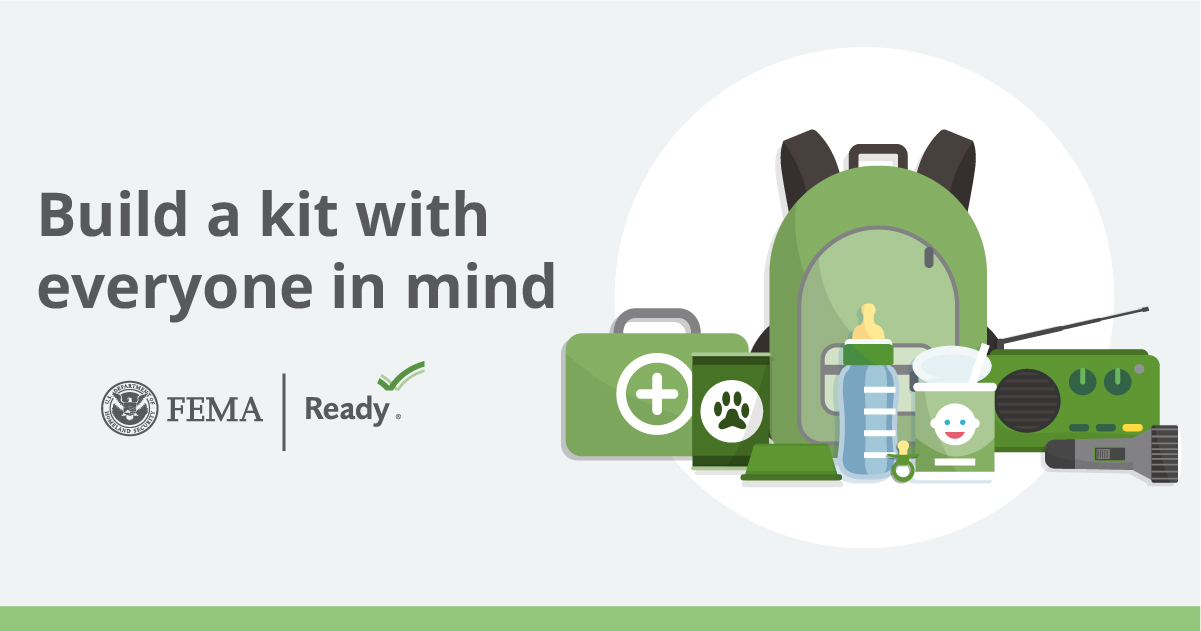
National Preparedness Month is observed each September to raise awareness about the importance of preparing for disasters and emergencies that could happen at any time. This year’s National Preparedness Month theme is A lasting Legacy: The life you’ve built is worth protecting.
To access this year’s national public service announcements and social media toolkits, please visit FEMA’s Ready Campaign website.
Ready Kids Prepares Youth for Disasters
Emergency managers, teachers, and others who work with children understand that children and youth are an important part of our communities and can be vulnerable during disasters.
Children and youth have unique abilities that allow them to prepare for, respond to, and recover from disasters. Knowing this, it’s important that schools put measures in place to help students understand their risks and how to protect themselves.
Today’s prepared children are tomorrow’s prepared adults! FEMA’s Ready Kids has free resources and curriculum available to help empower students.
Empowered youth can help involve their families, peers, and communities in disaster preparedness. To learn more about Ready Kids and what additional resources are available, click here.
Ohio Emergency Management Administrative Code Update
On Aug. 5, oversight for the Ohio Administrative Code rule about requirements for the emergency management plan and test changed from Ohio Department of Education to the Ohio Department of Public Safety. The new rule number is 4501:5-1-01.
Highlights include:
- Full Scale Exercise/Emergency Management Test: Individual school buildings can participate in a district-wide full-scale exercise in order to complete a full-scale exercise but they must submit their own after-action report.
- Emergency Management Tests will be a scheduled event at least two of the years; one actual emergency may be used during the three year plan cycle if an after action report is produced with the involvement of stakeholders pursuant to paragraph (E)(2)(e) of this rule.
- The test should include at least one representative from law enforcement, fire, EMA, EMS, and a mental health provider and public health official. For example the requirement means only one representative i.e. law enforcement. You don't need one from each stakeholder group.
To review the updated rule please click here.
After School Safety- OSSC Website
The OSSC has a new dedicated section of the website now to help schools plan for after school safety. This includes free training and resources.
Highlights include:
- Information on the Resilient Children/ Resilient Communities Initiative (RCRC) and the Emergency Planning Template and Assessment Tool for After School Programs that they designed. This template comes in Word document so that schools can use it to assist in developing an emergency or crisis plan for after school programs.
- Free online course from Texas A&M Engineers Extension Service (TEEX) AWR375 Risk Management for After School Activities and Interscholastic Athletics. The goal of this course is to enhance the safety and security awareness of individuals responsible for organizing, supervising, and supporting after school activities and interscholastic athletics.
To review the new after school safety webpage please click here.
 
Update OEDS Contact Information
 |
|
Remember to log into OH|ID and the Ohio Education Directory System (OEDS) to make sure your personnel and contact information are up-to-date. The OSSC uses the contact information in OEDS to disseminate time-sensitive information. As a reminder, only personnel who hold Superintendent, Assistant Superintendent, Principal, or Coordinator-Safety Plans roles in OEDS can access the School Safety Plans Portal.
It is also important to update your emergency contact sheet within your school safety plan to ensure first responders and OSSC staff can quickly contact you about threats related to your school or district.
|
Annual Emergency Management Test Due December 2022
Exercises are an important part of preparedness and a requirement under Ohio law. Exercising your emergency operations plan allows participants to practice their skills in a low-stress environment, exposes capability gaps, and highlights areas for improvement.
Schools have until Dec. 31 to conduct their annual EMT. Once completed, you have 30 days to submit an after-action report in the School Safety Plans Portal. For assistance with submitting your after-action report, click here.
To learn more about EMTs and what resources are available, please visit our webpage at Emergency Management Tests & Exercises.
Review Your School’s Emergency Contact Information Sheet
School is back in session! Whether your school is registered with the Ohio School Safety Tip Line or with a third-party provider, please ensure that your Emergency Contact Information Sheet (ECIS) is up-to-date. The OSSC uses the contact information listed on your school’s ECIS to disseminate time-sensitive information when tips are received via the anonymous tip line.
What to Check: Verify that the school administrator(s) is current and that you include at least two (2) alternates. If you have a School Resource Officer (SRO) or other security personnel, please list them on the ECIS. The backside of the ECIS lists all of your first responders. Verify that the appropriate law enforcement agency (within jurisdiction) is listed, as well as your contacts for fire and EMA.
Where is my ECIS? Log into the School Safety Plans Portal via OH|ID. Next, click on the blue button under the column that reads ‘Plan Management’. Find the ECIS document and click the ‘view’ button to open it. To replace the current ECIS, simply click on the ‘edit’ button and upload the new form.
|
|
|

Increase Your Knowledge!
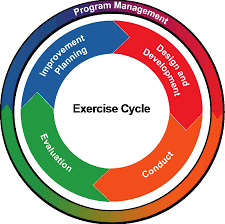
Exercises are an important part of preparedness and a requirement under Ohio law. Exercising your emergency operations plan allows participants to practice their skills in a lower-stress environment, exposes capability gaps, and highlights areas for improvement.
Invite local first responder agencies to participate in your school’s exercises. Working together during a simulated emergency builds stronger community relationships and fosters a realistic understanding of emergency response procedures.
|
|
|

Free Exercise Toolkits
The Ohio Emergency Management Agency (Ohio EMA) developed three tabletop (TTX) toolkits for K-12 schools.
View the available toolkits on Ohio EMA’s website. Choose from Severe Weather, Active Aggressor, or Hazardous Materials. Download the material, adapt it to your location, and schedule the exercise with the appropriate personnel.
New K-12 Tabletop Toolkits Available
To better assist K-12 schools, the OSSC has developed multiple scenario-based templates for K-12 schools to use. Each tabletop exercise features an easy-to-use format, and is designed to be completed in two (2) hours or less.
The most recently added tabletop toolkits include:
- Disruptive parent
- Hazmat incident
- Law enforcement activity near campus
- School gas leak
- Threat of violence
These toolkits and more can be found under the Tabletop Toolkits: Instructional Guides & Templates section of the Emergency Management Tests (EMT) & Exercises webpage.
CDC Prevention Resources
The Centers for Disease Control and Prevention (CDC) has several resources available on their website for emergency preparedness. This includes resources on topics including earthquakes, floods, lightning, tornadoes and winter weather just to name a few.
To view these resources please click here. Additionally, the CDC has a family emergency kit checklist and it can be downloaded here.
|
School Safety Update
The Ohio School Safety Center's website page on Emergency Management Tests & Exercise was recently redesigned.
It includes sample exercises, definitions, EMT data collection worksheet and other resources.
To review the EMT resources please click here.

Habitat for Humanity Preparedness Resources
Habitat for Humanity has a family preparedness plan resource available on their website.
This includes four steps including identify hazards, hold a family meeting, prepare and practice your plan.
To review these resources and others provided by Habitat for Humanity please click here.

Useful HSEEP tools
Looking for a blueprint to Improve your tabletop, functional and full-scale exercises?
Check out the Homeland Security Exercise and Evaluation Program's (HSEEP) Exercise Plan template. This document helps to identify goals, participants, logistics, and more.
HSEEP is a comprehensive approach to exercise design and development, conduct, evaluation, and improvement.
|

SchoolSafety.gov Provides Back to School Safety Resources
SchoolSafety.gov was created by the federal government to provide schools and districts with actionable recommendations to create a safe and supportive learning environment where students can thrive and grow.
With the start of a new school year, the safety of our students, teachers, and staff remains top of mind for schools and districts across the country.
Utilize SchoolSafety.gov's Back to School one-pager for information to help your community address a range of school safety threats and challenges this semester and all year long.
To download the one-page resource please click here.

School Safety Communications Center
Providing a safe and secure environment at school is imperative to helping students succeed academically, socially, and emotionally.
SchoolSafety.gov recently launched a Communications Center to help support your school or district’s safety efforts.
The Communications Center includes a comprehensive collection of one-pagers, presentations, newsletter bulletins, and materials available from SchoolSafety.gov.
To learn more, please visit the Communication Center’s webpage.
|
|
|
|
|