Administrator's Column
Greetings and welcome to our first Ohio Collaborative
newsletter. I’ve created this correspondence to provide our customers and
partners with updates on the Ohio Collaborative. I hope you find it useful and
informative. For our first newsletter I wanted to give you some background on
the Collaborative, some updates on what we’re doing, and introduce you to our
staff. I’ve provided you a photo and a little background on each of us, as well
as our contact information. We’re all committed to this process, our customers,
and our partners. We truly believe in doing everything we can to aid Ohio law
enforcement in service to their communities. We welcome your input into future newsletters.
Please contact us with anything you’d like to see in future newsletters. Thank
you for all you do to make this a Safer Ohio.
Origin
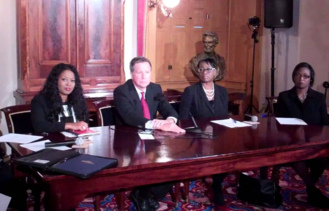 In December 2014, Governor John R. Kasich signed Executive
Order 2014-06K, creating the Ohio Task Force on Community-Police Relations
after a series of incidents in Ohio and around the nation highlighted
challenging situations that exist in too many places between some communities
and police.
The task force included 24 members representing the Governor, Legislature,
Attorney General, Chief Justice of the Supreme Court of Ohio, local law
enforcement, organized labor, local community leaders, the faith-based
community, business, municipalities and Prosecuting attorneys. On April 29,
2015, after a series of public forums, the task force delivered its final
report to the Governor, who in turn signed Executive Order 2015-04K,
establishing the Ohio Collaborative Community-Police Advisory Board to oversee
implementation of task force recommendations.
ABOUT THE COLLABORATIVE
The
Collaborative offers a certification process for police departments in Ohio.
Like other certification programs, the process consists of two major
components: 1. establishing professional standards for law enforcement to meet;
and 2. administering a voluntary assessment process by which law enforcement
departments can be recognized for meeting best practices.
|
 Karhlton Moore is the Executive Director of the Ohio
Office of Criminal Justice Services (OCJS) and is responsible for the
administration and evaluation of state and federal grants for law enforcement,
victim assistance, crime prevention courts, anti-trafficking efforts, re-entry,
corrections programs and traffic safety. Moore previously served as an Assistant Attorney General in
the Ohio Attorney General’s office, in the Court of Claims Defense section and
the Capital Crimes section.
He also works in continuing
partnership with law enforcement task forces, and provides the Governor and the
Director of the Department of Public Safety with current and projected criminal
justice strategies. Moore also oversees
the Motorcycle Ohio and Driver Training programs.
Karhlton is the President of the National
Criminal Justice Association and serves on their advisory council, board of
directors, and executive committee. Additionally, Moore recently served as the
facilitator for Governor Kasich’s Task Force on Community-Police Relations.
Originally from Springfield, Ohio, Moore received his
Bachelor of Arts degree from Wright State University and his law degree from
American University’s Washington College of Law.
Contact Karhlton at 614-728-4792 or kmoore@dps.ohio.gov
|
 Ed Burkhammer is a Deputy Director for the Office of
Criminal Justice Services. He is the Program Administrator for the Ohio
Collaborative, and the Law Enforcement Liaison for OCJS. Ed started his career
in the United States Army serving as a Military Police Officer and
Investigator. Ed is a proud retired Urbana, Ohio police officer with a combined
28 years of law enforcement experience. He spent years as a Trainer, OPOTA
instructor, FTO, Patrol officer, Patrol supervisor and Investigations
supervisor. Ed holds degrees in Criminal Justice and Administration/Organizational
Leadership, and is a graduate of the Northwestern School of Police Staff and
Command.
He continues his commitment
to public service by being a part of the OCJS and DPS mission, striving to
support and improve law enforcement throughout Ohio and the citizens they
serve.
Ed has various duties at OCJS. He is available to agencies
as an on-site Peer resource and also conducts trainings and presentations all
over the State on the Ohio Collaborative.
Contact Ed at 614-203-3555 or edbukhammer@dps.ohio.gov
|
 Stephanie Swindell is an Assessor for the Ohio
Collaborative. She is also our Intake Specialist. She is responsible for agency
data entry, downloading of agency documents, and Reviewer assignments. She has served the State
for 11 years working for the Ohio State Highway Patrol, the Bureau of Motor
Vehicles and now with the Office of Criminal Justice Services.
Contact
Stephanie at 614-728-4790 or saswindell@dps.ohio.gov
|
 Tom Lamb is an Assessor for the Ohio Collaborative. He also serves as a Peer resource for agencies.
Tom began
his career at Warren Correctional Institution in 2006. In 2013 he continued his career in Law
Enforcement, and began working for the Adult Parole Authority.
Understanding the
importance of a good relationship between the community and Law Enforcement, he
now works at the Office of Criminal Justice Services as a representative for
the Ohio Collaborative.
Contact Tom at 614-752-4569 or tclamb@dps.ohio.gov
|
 Carley Auddino is an Assessor for the Ohio Collaborative.
She began working for the Ohio Collaborative
in August 2017 as a college intern. She graduated from The Ohio State University
in December 2017 with a degree in
Criminology and Criminal Justice Studies, with an interest in Substance Abuse
and Misuse.
Contact Carley at 614-644-1259 or cmauddino@dps.ohio.gov
|
 Group
One - Standards 1 - 2
Number
of Agencies that have submitted applications (without compliance docs): 79
Number
of Agencies "In Process" (compliance documents submitted/in review):
20
Number
of Provisional Certifications: 4
Number
of Final Certifications: 406
Total:
509
Group
Two - Standards 3 - 5
Number
of Provisional Certifications in Group 2: 80
Number
of Final Certifications in Group 2: 57
Total
Number of Agencies Certified in all 5 Standards: 137
27663
out of 34807 officers involved in process (79%)
9,316,555
out of 11,536,504 population covered by agencies in the process (81%)
1
applications submitted 1/10/17 - 1/17/18 Doylestown PD
The 2018 Annual report-- OCJS staff will continue to accept submissions for review
until March 2, 2018. Any completed submissions received by our staff by this
date will appear in the 2018 Law Enforcement Certification Public Report. The
report will be released to the public no later than March 31, 2018. Our staff
will continue to review submissions received between March 2nd and the
release date, making every effort to have those submissions appear in the
report.
Board Meeting-- Community-Police Advisory board Meeting at 10AM March 26, 2018 at the ODPS Atrium.
Conference-- OCLEA Presentation for OH Crime Prevention Assoc. Annual
Conference is April 16, 2018 at 3PM at the Embassy Suites of Dublin. Karhlton
Moore and Ed Burkhammer will present updates on the Ohio Collaborative.
Bias
Free Policing-- The OCJS Ohio Collaborative team has been working on the
development of a Sample Policy for Bias Free Policing for the past several
months.
The policy sample is directly representative of the Standards provided
to us by the Ohio Collaborative Police Community Advisory Board. This sample
policy was created with the help of our partners at The Ohio Association of
Chiefs of Police and the Buckeye State Sheriff’s Association. OCJS is now
accepting this Standard for submission and review. The Standards and the Policy
Sample are available on our website. www.ocjs.ohio.gov/ohiocollaborative
Software Development--The OCJS staff has been working for months with the DPS IT
staff on the development of a software program for the Ohio Collaborative. The
first Phase of this launch took place on January 17, 2018 and is being used by
our staff. There were three primary goals of this effort:
1. to reduce
potential errors.
2. To increase efficiency.
3. Ease of use for our customer
agencies.
The target for Phase 2 release of the project will be
sometime in the spring or early summer of 2018. Phase 2 of the project will
provide customer agencies with the ability to directly upload their policies and
compliance documents to OCJS staff for review. Agencies will have access to
their documents at any time from their desktops. As with any new system, there
will be issues. We ask for your patience and input as we go through this
process.
Telecommunicator
Training--There has been some confusion about which agencies are required to
meet this standard. Hopefully this will provide some clarification.
This standard
and the training applies only to those Law Enforcement Agencies that operate a
telecommunications center or performs that function. Training shall meet and
support minimum standards as established by legislation for 911 call centers
and public-safety answering points (PSAPs). Acceptable training may include:
- Class room or equivalent
- Utilization of nationally recognized
dispatcher training
- Training developed by individual
agencies to meet the specific needs of their communities
To clarify
applicability, refer to ORC 4742.01 for the definition of Telecommunicator.
This refers to individuals “employed by emergency service providers whose
primary responsibility is to be an operator for the receipt of processing of
emergency calls”. If your agency has a 10-digit telephone number and your
emergency calls go to a 911 center, the new standard does not apply.
The Ohio
Collaborative still recommends to those agencies that do not meet this criteria
to consider implementing the standard as a best practice.
We would continue to ask agencies to highlight, or note on
their submitted forms the standard they are referring to. Also, the separation
of documents is of great importance. We often receive PDF files in the 50 to
150 pages range. These are extremely difficult to decipher, as you can imagine.
For the longevity of the program, our staff is separating the documents into
different files for future reference. For instance, agency policy is an
individual document. Compliance examples for each standard are also individual
documents.
This helps streamline the review process greatly, and will aid the
agency representative greatly when the user interface is launched later this
year.
For questions regarding how to break down your submission, please contact
our Intake Specialist, Stephanie Swindell at 614-752-4569 or
saswindell@dps.ohio.gov.
|