|
Today Ohio Department of Medicaid (ODM) launched the Next Generation managed care plans, new Electronic Data Interchange (EDI), and Fiscal Intermediary (FI). These initiatives emphasize a more personalized care experience and improve the provider experience by providing transparency and visibility for care and services.
The Next Generation managed care plan changes and EDI trading partner transactions do not apply to MyCare Ohio plans, which will continue to provide benefits to Ohioans who receive both Medicaid and Medicare, with enhanced coordination of medical, behavioral, and long-term care services.
What do I need to know about the February 1 launch?
We understand these changes affect you. In this article, you will find various resources and tips to navigate the changes.

ODM implemented the new EDI to be the new exchange point for trading partners on all claims-related activities. The FI will assist in routing managed care claims submitted to the EDI and adjudicate and pay fee-for-service (FFS) claims. Providers who have a trading partner should confirm their trading partner is authorized to work with Deloitte, the new EDI vendor. EDI claims – FFS and managed care – can be submitted by trading partners to the new EDI vendor. This does not include MyCare.
|
All FFS prior authorizations should continue to be submitted via direct data entry (DDE) to the Provider Network Management (PNM) module. All managed care prior authorizations should be entered directly into that specific plan's managed care portal. Providers who submit FFS claims by direct data entry should continue to submit to the PNM module. Providers who enter managed care claims by direct data entry should submit into that specific plan's managed care portal. All claim attachments for managed care, and FFS must be submitted via their respective portals. Trading partners will not submit attachments or prior authorizations on behalf of providers. Learn more about submitting claims and prior authorizations on the Next Generation website.

The Next Generation managed care plans began providing healthcare benefits to members and increased cooperation with providers. This includes updated managed care plan provider agreements to ensure consistency and minimize differences between how providers interact with the Next Generation managed care plans. Additionally, an external medical review is available for providers who are unsatisfied with a managed care plan’s decision to deny, limit, reduce, suspend, or terminate a covered service for lack of medical necessity.
|

Help desks are available. If you have questions related to Ohio Medicaid Enterprise System (OMES) submitted claims, prior authorizations, or other administrative processes, contact the ODM Integrated Helpdesk (IHD) at 800-686-1516 or IHD@medicaid.ohio.gov. Representatives are available during special hours February 1-24:
- 7 a.m.-7 p.m. Monday-Friday, except Monday, February 20, they are 8 a.m.-5 p.m.
- 8 a.m.-5 p.m. Saturdays and Sundays.
After February 24, regular hours of 8 a.m.-4:30 p.m. will resume Monday-Friday.
|
Return to Top
The Next Generation of Ohio Medicaid managed care launched today, February 1, providing members with benefits that will help them better address their individual healthcare needs. Ohio Medicaid’s Next Generation program brings many new changes to help providers do what they do best: providing care for members.
If members made a new plan selection during the open enrollment period, they will receive a new Next Generation ID card. If a member forgets their new card or brings an outdated card, do not refuse services. You can confirm eligibility using either the Provider Network Management (PNM) module or Single Pharmacy Benefit Manager (SPBM) and the member's Medicaid ID number. Please note that a Medicaid ID number is referred to as the Member ID number on Next Generation ID cards. This also applies to pharmacy benefits.
There are now seven unique managed care plans:
Contracting with the Next Generation Plans
While it isn’t required to contract with all seven managed care plans, providers should contact the plans with which they are interested in contracting. Review contracting information if needed. You will not be required to re-contract with managed care organizations you are currently contracted with as long as the plan has a current Medicaid addendum. If you are not contracted with a particular managed care plan, it is also possible to enter into a “single case agreement” with the MCO, to facilitate a transition of care or enable continuity of care for an individual you serve.
Lastly, we wanted to remind you of improvements to Ohio Medicaid’s information systems. On February 1, Ohio Medicaid launched the new Electronic Data Interchange (EDI) module as part of the Next Generation program. To learn more about the new EDI and how it impacts claims submission, prior authorization requests, and other payments related activities, see The new Electronic Data Interchange has launched!.
Return to Top
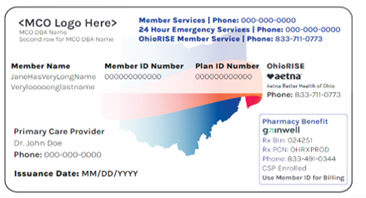
Effective February 1, Ohio Medicaid managed care members should all be using a Next Generation member ID card. These ID cards were mailed to them from their managed care plan and contain all the essential information they need to access their healthcare and pharmacy benefits. See the sample below to ensure members are using a Next Generation Member ID. If a member does not have their member ID card, please see the guidance below to ensure they can receive the services they need.
If a member actively selected a new plan (Anthem Blue Cross and Blue Shield, AmeriHealth Caritas, or Humana Healthy Horizons) during the member transition and open enrollment period (March 1 - November 30), they should have received their new member ID card.
Members that were receiving benefits from Paramount Advantage, will now receive benefits from Anthem Blue Cross and Blue Shield following Anthem’s acquisition of Paramount’s Ohio Medicaid offering. If they did not actively select a different plan, they should have received a new member ID card from Anthem to begin using on February 1.
Members that have been receiving benefits through Ohio Medicaid fee-for-service and are transitioning to a managed care plan should also have received their new managed care member ID card.
What does the Next Generation Managed Care Member ID card look like?
Next Generation Member ID Card
* Please note that the Member ID Number on Next Generation ID cards is also a member’s Medicaid ID number. This is the number that should be included for claims submissions and authorizations.
Can I continue to provide Medicaid services if a member does not have their ID card? How can I verify eligibility?
Members may still bring their old ID cards to their providers or pharmacies and let them know they are a part of Ohio Medicaid and have an old ID card.
If a member forgets their ID card or brings an outdated card, do not refuse services. Before rendering services, it is important to check member eligibility in the Provider Network Management (PNM) to confirm they are enrolled with a contracted plan, so claims are sent to the correct managed care organization (MCO). As a reminder, please note that a Medicaid ID number may be referred to as a member ID number on Next Generation ID cards.
Additionally, please notify members that they should contact their managed care plan to learn more about how to print their card or access an electronic version. They can find relevant contact information on their managed care plan’s website.
Do you have additional questions?
To learn more about Ohio Medicaid’s February 1 launch, visit the Ohio Medicaid Managed Care website.
Return to Top
Today, February 1, Ohio Department of Medicaid (ODM) launched the new Electronic Data Interchange (EDI) module as part of the Next Generation program. This launch includes significant new functionality as part of a comprehensive effort to modernize ODM’s management information systems.
What does this mean?
ODM has implemented the new EDI to be the new exchange point for trading partners on all claims-related activities. The Fiscal Intermediary (FI) will assist in routing managed care claims submitted to the EDI and adjudicate and pay fee-for-service (FFS) claims. Providers who have a trading partner should confirm their trading partner is authorized to work with Deloitte, the new EDI vendor. EDI claims – FFS and managed care – can be submitted by trading partners to the new EDI vendor. This does not include MyCare.
Where do I submit prior authorizations?
All FFS prior authorizations should continue to be submitted via direct data entry (DDE) to the Provider Network Management (PNM) module. All managed care prior authorizations should be entered directly into that specific plan's managed care portal. Learn more about submitting prior authorizations on the Next Generation website.
What about direct data entry claims?
Providers who submit FFS claims by direct data entry should continue to submit to the PMN module. Providers who enter managed care claims by direct data entry should submit into that specific plan's managed care portal. All claim attachments for managed care, and FFS must be submitted via their respective portals. Trading partners will not submit attachments or prior authorizations on behalf of providers. Learn more about submitting claims on the Next Generation website.
Now that the new EDI has launched, here are few things to check and understand:
-
Check that your trading partner is authorized to work with ODM. All clearinghouses or trading partners who are already authorized to submit claims to ODM continue to have access to submit claims on behalf of providers – but we encourage these trading partners to practice submitting claims to the new system prior to submitting claims. Providers should validate that their trading partner is authorized to work with ODM and has practiced submitting claims through the new system. Trading partner readiness can be checked here.
-
Provider claims submitted to trading partners must include the Medicaid member's ID (MMIS ID). The Medicaid ID should be obtained with each visit. Member eligibility can be verified using the ID through the PNM module, which redirects to MITS.
-
Pay attention to each claim’s date of service when submitting for adjudication. Effective February 1, all FFS claims must be submitted to the new EDI. Managed care organization (MCO) claims with a date of service on or after February 1 must be submitted through the new EDI. MCO claims with dates of service prior to February 1 may be submitted to the new EDI, but providers have the choice to send everything through the new EDI or split claims by dates of service. Please see the ODM Companion Guides for specific instructions and additional guidance.
-
Each managed care claim must include the internal managed care payer ID and a receiver ID. If you submit your own claims through the EDI, please refer to the ODM Companion Guides for the updated receiver and payer IDs list for the managed care plans. FFS claims also require a payer and receiver ID but they remain the same.
- For EDI‐related claims submissions, ODM now requires one rendering provider per claim at the header level, rather than the detail level, for professional claims for both FFS and managed care recipients. Different rendering providers at the detail level are no longer acceptable. Exceptions for FFS Federally Qualified Health Center (FQHC) and Rural Health Clinic (RHC) providers are detailed in the Medicaid Advisory Letter 622.
-
FFS provider payments from EDI-submitted claims are sent by the Fiscal Intermediary (Gainwell Technologies) on behalf of Ohio Department of Medicaid. FFS claims submitted through the PNM module will continue to be paid by Ohio Administrative Knowledge System (OAKS), the State of Ohio’s accounting system.
-
Trading partners will not submit attachments on behalf of providers when the new EDI launches on February 1. All managed care attachments will be handled by each managed care entity (MCE). Providers should work with each MCE to submit attachments following the process outlined by the applicable MCE. For FFS claim attachments, these will be submitted in a MITS portal page accessed via the PNM module.
Do you need assistance?
For payment and claims questions, contact the Integrated Helpdesk (IHD) at 800-686-1516 or IHD@medicaid.ohio.gov. Representatives are available during special hours February 1-24:
- 7 a.m.-7 p.m. Monday-Friday, except Monday, February 20, hours are 8 a.m.-5 p.m.
- 8 a.m.-5 p.m. Saturdays and Sundays.
After February 24, regular hours of 8 a.m.-4:30 p.m. will resume Monday-Friday.
Return to Top
|