From the State Veterinarian's Office
Dr. Dennis Summers, State Veterinarian
In recent years, livestock disease events in the United States, such as HPAI in Dairy Cattle, cattle Tuberculosis, and threats of New World Screwworm (NWS), have demonstrated the continued challenges with animal disease traceability (ADT). Ohio continues to advance and progress ADT though progressive initiatives and actions to increase RFID tag use in cattle and swine and increase the use of electronic interstate certificates of veterinary inspection (iCVI). Several states are moving away entirely from paper iCVIs due to numerous electronic platforms that offer superior advantages to producers, accredited veterinarians, and state animal health officials. Kansas, Oklahoma, and Minnesota have eliminated the distribution of paper iCVIs for accredited veterinarians in their states. Many other states are taking progressive steps to move into a digitized and electronic system for iCVIs to improve ADT and support disease control efforts.
As Ohio continues to move in a similar direction, I encourage accredited veterinarians to use electronic ICVI technology. There are several great platforms available. Stay tuned for more updates in the future!
|
Reportable Diseases Reminder
ODA's Animal Disease Diagnostic Laboratory (ADDL) provides a variety of tests for both endemic and transboundary or foreign animal diseases. If you have a case that raises your suspicion of a disease of concern, please let us know about it. In addition, when ADDL receives submissions that have key words like "vesicles," they notify the Animal Health veterinary team. It is best if you, as the veterinarian, call the State Vet's office (or your local ODA VMO) to give us a heads up that you are submitting those samples. Even if the suspicion is low, it helps put those cases on our radar, so we are aware.
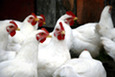
As a reminder- here is a list of ODA's reportable and actionable animal diseases.
Also- on the ODA website there is an Ohio Accredited Veterinarian manual. This is an extremely valuable resource that includes a wide variety of information on ODA/USDA programs, ADT information, foreign animal and reportable diseases, and contact information for a variety of state and federal entities. This is updated frequently to include the most up to date information for accredited veterinarians in Ohio.
In addition, Highly Pathogenic Avian Influenza (HPAI) is still very prevalent in the United States with cases reported weekly. Ohio had a backyard flock detection in Auglaize County in October 2025 and Clermont County in November 2025. If you see poultry that are displaying clinical signs compatible with HPAI - please notify the State Vet's office - (614) 728-6220. We can help identify the appropriate tests needed as well provide resources if requested to help sample those birds. If HPAI is detected in a backyard flock, ODA and USDA follow up with regulatory action in that flock.
Lastly, we would prefer you be overly cautious and call us if there are any concerns or questions related to animal diseases. The veterinary team at ODA is happy to answer questions or point you in the right direction if resources are needed.
|
At the end of November, the ODA State Veterinarian's office was made aware on a national call about an outbreak of Equine Herpes Virus (EHV1)/Equine Herpesvirus Encephalopathy (EHM) in horses that were at barrel racing and rodeo-type events in Texas and Oklahoma. Since that time, there have been many confirmed cases of EHM throughout the U.S. associated with these events. These cases are currently being tracked on the equine disease communication center (EDCC) website.
As of 12/2/25, to the knowledge of ODA, there have been no confirmed cases of EHM in Ohio associated with this event. The ODA Division of Animal Health has been in close communication with the Texas and Oklahoma Departments of Agriculture on trace out animals of horses that were at those events. As we receive the names of exhibitors and horses that have traveled back to Ohio, our Animal Health staff are actively reaching out to those individuals to ask some more in-depth epidemiological questions (e.g., who their primary veterinarian is, health status of the animal, location of animals, etc.) and take appropriate follow-up action.
This outbreak serves as a reminder of the potential disease risks associated with large commingling equine events. It underscores the importance of timely reporting of diseases and ensuring that movement requirements are followed, including veterinary inspection and health certificates prior to travel.
As a veterinarian, if you see a horse with signs of acute neurologic disease, please contact our office at (614) 728-6220. We can help provide guidance on isolation and testing. Diagnosis of EHV/EHM can be difficult, as periods of viral shedding and viremia may vary — paired samples, including a deep nasal swab and whole blood, are critical.
As a reminder, only the neurological form of EHV-1 (EHM) is actionable and reportable to the State Veterinarian's office in Ohio.
The EDCC website is a great location for not only finding outbreaks of certain equine diseases, but also to report active cases as a referring veterinarian. On the website, every state lists what equine diseases are reportable and not. If it is not considered a reportable disease in that state, then the referring veterinarian can submit the case to the website (For example, in Ohio: West Nile Virus, EHV1- Respiratory, Strangles, and Equine Influenza).

Past Equine Infectious Anemia (EIA) Outbreak in Texas
The USDA continues to investigate an outbreak of EIA that occurred in Autumn 2024. A cluster of EIA positives were found in the Autumn of 2024 that were all traced back to one Texas equine clinic. All of the EIA infected horses had been hospitalized in the ICU at the clinic and had an IV catheter placed and flushed.
As of May 2025, 21 cases were confirmed positive in four states: California, Colorado, Oklahoma, and Texas. It is believed that more will be found.
The incubation period of horses with EIA is 15-45 days. There is no treatment or vaccine for EIA. Work with your veterinarian to test your horse when appropriate, especially if the animal travels for shows, exhibition, trail riding, boarding, or goes interstate. Also, per Ohio's regulations, all equids should be tested if there is a change in ownership and prior to being offered for sale.
This highlights the importance of proper training of veterinary personnel to help prevent the spread of disease via iatrogenic transmission.
For more information: EDCC Article
|
All accredited veterinarians must use a USDA-approved Coggins test form when testing for EIA, which can be either an electronic or paper form. Electronic Coggins forms offer many advantages including reduced time required to complete and submit the form with fewer errors and omissions that may delay testing. Digital photos allow for improved animal identification compared to hand drawings in paper forms, and results are uploaded by the laboratory and available in real-time in an electronically searchable record system.
USDA’s VSPS (Veterinary Services Process Streamlining) is a free system that allows veterinarians to create and submit electronic Coggins test forms. The program can also be used to issue large animal electronic health certificates. More information on the VSPS program is available on USDA’s website including an informational guide for completing an EIA test record.
There are additional programs that offer electronic Coggins forms (fees may apply):
Melanie Prarat, Associate Laboratory Director
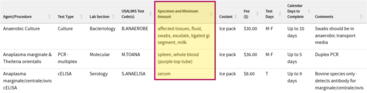
The Animal Disease Diagnostic Laboratory (ADDL), located in Reynoldsburg, Ohio, is an AAVLD-accredited veterinary diagnostic laboratory that provides specialized bacteriology, histology, molecular, pathology, sequencing, serology, and virology diagnostic services. The ADDL offers nearly 350 different tests and services, including required regulatory testing and elective diagnostics, and performed more than 504,000 tests in 2024. When submitting a specimen for testing, it is critical to submit the proper sample type. You can find a list of offered services and acceptable sample types on the ADDL Tests and Services webpage. The ‘Specimen and Minimum Amount’ column provides guidance on the proper sample type to submit for a specific test.
The ADDL is open Monday – Friday, 8:00 AM – 5:00 PM. Submission information, including the laboratory address and best practices for sample collection, can be found on the ADDL website. Including the correct ADDL Submission Form with your submission is a critical step towards ensuring high quality, quick turnaround of results; general and specialized submission forms are available here.
Reminder: when submitting samples to ADDL, you can either hand deliver your samples, use FEDEX, or use UPS but NOT the US Postal Service (USPS).
Questions regarding your samples and test offerings can be directed to (614) 728-6332 or submissions@agri.ohio.gov.
New World Screwworm (NWS)
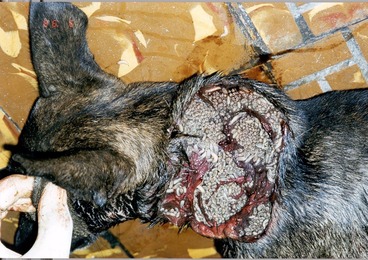
The response to New World Screwworm in Mexico continues to be a priority area and focus for the USDA as they work with the Southern States (Texas, Arizona, New Mexico, and California) on surveillance for NWS.
As a reminder for accredited veterinarians- NWS can infest livestock, wildlife, as well as pets, including dogs and cats! All accredited veterinarians need to familiarize themselves with the clinical signs of NWS myiasis. If you see concerning signs of larvae infestation in animals, please contact the Division of Animal Health at (614) 728-6220.
USDA has enacted a five-pronged plan under the direction of Secretary Rollins to protect the nation's livestock, wildlife, and public health from the threat of NWS. This includes the construction of a domestic sterile fly dispersal facility, as well as a domestic sterile fly production facility in Texas. There is also active surveillance occurring in the Southern U.S. states, including Texas, Arizona, and New Mexico.
The U.S ports remain closed to imports of cattle, bison, and horses from Mexico. There are currently no cases of NWS in the United States.
Dectomax- CA1 has been conditionally approved to prevent and treat NWS infestations in cattle. The FDA has issued an emergency use authorization for Credelio (lotilaner) to treat infestations of NWS in dogs.
Visit the USDA website for outreach and education material on NWS.
Veterinary Medicine Loan Repayment Program (VMLRP)
VMLRP is a program offered by the National Institute of Food and Agriculture (NIFA) at USDA to veterinarians that serve in designated "shortage areas" throughout the United States. If you commit to at least three years to providing veterinary services in those shortage areas, NIFA may repay up to $40,000 of your student loan debt per year.
This past year due to some government changes, the program was not offered nationally. State Veterinarians have been told that this year the program will resume with application periods to open sometime after the first of the year.
When ODA receives word that the applications are open, we will pass that information on to all accredited veterinarians. The shortage areas for the next year can be found here.
If you believe that you serve in an area in Ohio that is a shortage area for food animal/large animal veterinarians or have a question about this program, please reach out to kristy.shaw@agri.ohio.gov.
Foot and Mouth Disease- Continuing Education learning opportunity at Midwest Veterinary Conference
Dr. Helen Jones, OSU ODA Joint Resident
Don’t Miss Out on this Important Continuing Education FAD Training Opportunity to Help Safeguard Ohio’s Livestock Industry!
Foreign Animal Diseases (FADs) can result in catastrophic and widespread impacts on animal health and the agriculture industry, all of which will significantly impact practicing veterinarians. Ohio licensed and accredited veterinarians will serve as the first barrier when it comes to defending the U.S. against these FADs. You will play a fundamental role in FAD response by working with the State to minimize the impacts from a FAD, not only Ohio livestock and poultry industry, but to your own clients and practice.
Due to the vital role Ohio licensed and accredited veterinarians would play during a FAD outbreak; we would like to invite you to participate in a Continuing Education (CE) approved interactive tabletop exercise entitled When Disaster Strikes and Decisions Matter: Responding to FAD Outbreaks. Developed in partnership with the Ohio Department of Agriculture, United States Department of Agriculture, and The Ohio State University – College of Veterinary Medicine, this interactive tabletop will provide you with a unique opportunity to learn about this decision-making process on how Ohio veterinarians should collaboratively work with the State to respond to a high-consequence FAD. The decision-making process followed in this exercise will include teachings about Ohio’s FAD notification system, the various response strategies to a FAD employed by the State, the enhanced biosecurity measures that will be utilized to protect Ohio livestock, and how to interact with diverse stakeholders who will be a part of the FAD outbreak response decision-making process.
This CE approved tabletop exercise will be offered at the upcoming Midwest Veterinary Conference on Friday, February 27, 2026, (lunch is included). Early registration is strongly encouraged as this is a group-based exercise with active roundtable discussions and space is limited. You can register for MVC and the tabletop exercise by clicking here.
Although the U.S. has remained free of many high-consequence FADs for decades, the increase in the movement of animals, animal products, and people through international travel and the expanding global trade market has increased the risk that these FADs could enter Ohio and affect a largely naïve livestock population. Your participation in this CE approved tabletop exercise will serve as a critical training opportunity to educate you on how to effectively protect against and respond to FADs in Ohio.
Free online CE- Farmed Cervid CWD Program
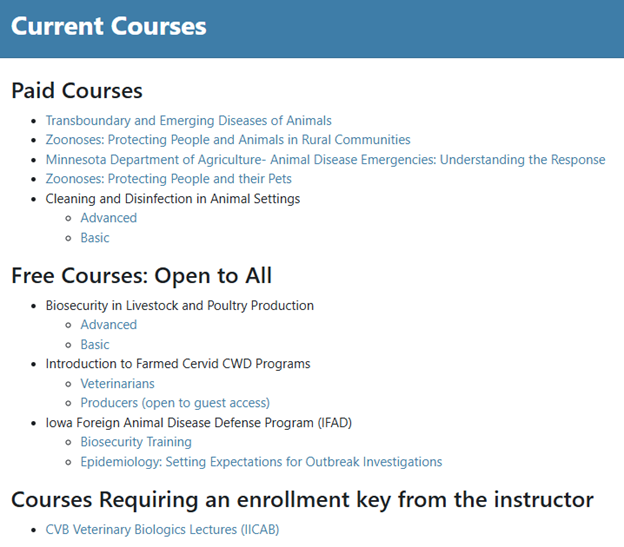
The Center for Food Security and Public Health (CFSPH) is a great resource for continuing education as well as biosecurity resources and handouts. As part of a grant, the CFSPH created a continuing education module on farmed cervid CWD programs in the United States. It is a free course, and veterinarians can receive three (3) hours of CE.
After you enroll in the "Introduction to Farm Cervid CWD Programs for Veterinarians" you will take two (2) general lessons and the third lesson allows you to pick the specific state you reside in (Ohio).
If you have any questions about Ohio's Herd Certification Program, please reach out to cindy.bodie@agri.ohio.gov.
Ohio was notified in May 2025 about a large tuberculosis trace-out investigation from Texas. Traces were sent out to a large number of states for follow up and testing in their respective states. For Ohio, 45 exposed animals were identified that moved within 60 months prior to confirmed detection from the affected herd in Texas. These moved to a single dairy farm in Western Ohio.
ODA and Ohio USDA staff worked with the dairy farm in Ohio to conduct further tracing and epidemiological investigations. All exposed animals were removed from the herd and a whole herd test was done (CFT) on approximately 4,000 animals on the farm. Gamma tests were drawn on all "suspect" animals and the respective gamma responders were necropsied. So far, all animals that were necropsied with tissues submitted for culture have come back negative.
|