2026 Veterinary Summer Internship Program
Do you know a current veterinary student who is interested in gaining more experience in regulatory veterinary medicine? The ODA Division of Animal Health will once again be offering their Dr. Tony Forshey Summer Internship Program (TFSIP). This is open to any current veterinary student and is a 10-week paid summer internship. This individual will be spending time with veterinarians within the Division of Animal Health, Division of Meat Inspection, and the Animal Disease Diagnostic Laboratory. The program is designed to allow the intern to gain exposure to the various career paths that exist in regulatory medicine
Applications can be found here and questions can be directed to kristy.shaw@agri.ohio.gov.
Applications are due January 1, 2026
|
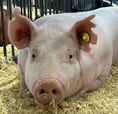
No Cost Swine RFID Tags for Sows and Exhibition Swine
In August, the United States Department of Agriculture Animal and Plant Health Inspection Service (USDA APHIS) announced a new initiative to provide no-cost RFID (radio frequency identification) eartags for swine beginning in fall 2025. These tags will be available for sow and exhibition swine producers and available directly from Merck Animal Health.
For more information about this program, including the ordering process, requirements, and number of tags that can be ordered based on sow/exhibition swine numbers, visit the USDA web page.
See the full press release here.
|

Updated Animal Health License Fees
|
The Ohio Department of Agriculture (ODA) Division of Animal Health would like to share important, upcoming adjustments to Ohio’s Animal Health Licensing and Registration fees. The recent state budget bill, HB 96, amended the registration/licensing fee for Livestock Dealers, Livestock Weighers, and Captive White-tail Deer premises registered under Ohio Revised Code (ORC) Chapter 943.
Effective September 30, 2025, new fees are required for the renewal of the following licenses/registrations:
- Small Dealer/Captive White-tail Deer - $50
- Livestock Dealer - $250
- Small Dealer or Livestock Dealer Late Fee (Received after 3/31) - $100
- Livestock Weigher - $30
- Employee of Livestock Dealer - $30
To avoid the late fee, please ensure renewal applications and updated fees are returned to ODA’s Division of Animal Health no later than March 31, 2026.
Should you have any questions, feel free to contact the Division of Animal Health at (614) 728-6220 or the program administrator within the respective programs.
New World Screwworm (NWS) Update
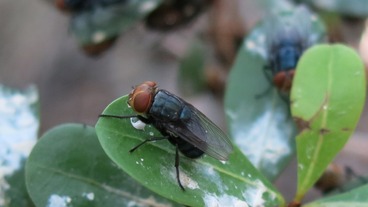
On September 21, 2025, USDA APHIS confirmed a case of New World screwworm (NWS) in the state of Nuevo Leon of Mexico, less than 70 miles from the U.S.-Mexico border. This is the northernmost detection of NWS during this outbreak and of high concern for the American cattle and livestock industry.
USDA has enacted a five-pronged plan under the direction of Secretary Rollins to protect the nation's livestock, wildlife, and public health from the threat of NWS. This includes the construction of a domestic sterile fly dispersal facility as well as a domestic sterile fly production facility in Texas. There is also active surveillance occurring in the Southern US states including Texas, Arizona, and New Mexico.
The U.S ports remain closed to imports of cattle, bison, and horses from Mexico.
NWS is a devastating pest and the larvae (maggots) burrow into the flesh of a living animal. NWS can infest livestock, pets, wildlife, birds, and in rare cases people. If you see concerning signs of larvae infestation in your animals, please contact your local veterinarian and the Division of Animal Health (614-728-6220)
Visit the USDA website for outreach and education material on NWS.
See the most recent press release for additional details.
Epizootic Hemorrhagic Disease (EHD)
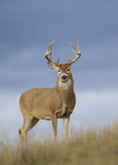
EHD is a virus that mainly affects wild and domestic deer, especially white-tailed deer. This fall, ODNR has reported a higher-than-normal number of cases of EHD in wild white-tailed deer, particularly in Southeastern and Eastern Ohio. The ODNR website has an interactive map showing the number of dead deer reported in each county along with the detections of EHD.
EHD is a virus spread by biting flies or midges. The virus is not directly contagious and needs to be spread through the bite of a fly/midge.
|
Cattle can become affected, but this is less common. Often cattle herd death and losses are from co-infections with other diseases, such as tick-borne diseases (like Anaplasmosis and Theileriosis). Clinical signs of EHD may include excessive salivation, fever, lameness, and weight loss.
If you are concerned about EHD in your cattle, please contact your veterinarian. Samples can be submitted to ADDL through your veterinarian to test for EHD as well as tick-borne diseases.
Click here for an ODA Fact Sheet.
West Nile Virus in Horses

The Division of Animal Health is seeing an uptick in detections of West Nile Virus (WNV) cases in Ohio, particularly in horses. As a reminder- work with your veterinarian on appropriate diagnostics when you have an animal displaying clinical signs of West Nile virus (neurologic, fever, decreased appetite and lethargy).
|
Veterinarians in Ohio can submit diagnostic samples for a variety of equine diseases to the Animal Disease Diagnostic Laboratory (ADDL)
Detections of WNV should be reported to the Ohio Department of Health (zoonoses@odh.ohio.gov)
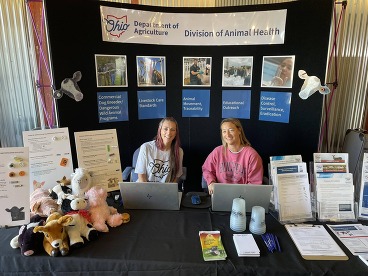
The Animal Health team had a presence at the Farm Science Review where we were able to distribute 1,200 free RFID tags to Ohio swine and cattle producers.
To learn more on how to obtain a Premises ID as well as receive free RFID tags please reach out to our office (614-728-6220 or animal@agri.ohio.gov)
|