In this issue
- Ticks in Ohio
- New World Screwworm
- County Fair Time!
- Animal Health Staff
Field VMOs: Dr. Ellen Yoakam, Dr. Angela Rospert, Dr. Cynthia Wise, Dr. Lauren Vesprani, Dr. David Contini
Field Animal Health Inspectors: Kalin Turner, Kelsey Short, Molly Roberts, Danny Sweitzer, Heidi Johnson, Nick Wells, Zach Sims, Arlis Young, John McIntyre
Office Personnel: Dr. Dennis Summers, Dr. Kristy Shaw, Cindy Bodie, Heidi Allen, Reagan Crock, Charity Conn, Sarah Martin, Jacquie Keller-Potvin, Joni Vance, Kendra Rowell, Tyler Dollhausen, Lyndsey Biddle, Elizabeth Smith
Commercial Dog Breeding: Dr. Melissa Simmerman, Mike King, Ann Wyant, Michele Hanna, Candice Ryan, Caitlin Morelock

Contact us
Ohio Department of Agriculture
Division of Animal Health
8995 East Main Street
Reynoldsburg, OH 43068
Phone: (614) 728-6220
Fax: (614) 728-6303
animal@agri.ohio.gov
Interested in free RFID tags? Find out more!
Moving animals out of state? Find the requirements here:
InterstateLivestock.com
Growing Ohio Magazine: Presented by ODA
Your feedback is important to us
To provide comments about the newsletter or to get additional information on any covered topic or service content, please
contact us.
|
|
Ticks in Ohio
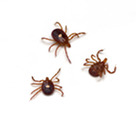
Ohio is home to a variety of tick species, most commonly the American Dog tick (Dermacentor variabilis), the Blacklegged or Deer tick (Ixodes scapularis), the Lone Star tick (Amblyomma americanum), and more recently, the Asian Longhorned tick (Haemaphysalis longicornus). Ticks can carry a variety of pathogens that cause illness in humans and animals such as Lyme Disease, Anaplasmosis, Babesiosis, Ehrlichiosis, and Alpha-gal allergy, among numerous others. With the emergence of the Asian Longhorned tick in Ohio over the past 6 years, there is new concern for diseases like Theileriosis as well. Large infestations of ticks on livestock, even in the absence of pathogenic disease, can lead to loss of production, abortion and stillbirth, and potentially death.
If you find a tick on yourself, household pets, or livestock, you can submit the tick to the OSU Parasite and Pathogen Ecology Lab or the Ohio Department of Health for free species identification. The OSU lab also now offers Buckeye Tick Testing for a fee. To submit a tick for identification, please follow the instructions in the links provided above.
The Animal Disease Diagnostic Lab at ODA offers testing of animal specimens for tick borne pathogens such as Anaplasma spp., Theileria orientalis, Ehrlichia canis, and Borrelia burgdorferi (Lyme disease). Please see the ADDL webpage for the full list of testing options and specimen requirements or call the lab at 614-728-6220 with any submission questions.
If you would like more information on the tick species present in Ohio, how to protect you and your animals from ticks, or the diseases carried by ticks, please see the following webpages:
|
New World Screwworm
New World Screwworm (NWS, Cochliomyia hominivorax) is a devastating pest. When NWS fly larvae (maggots) burrow into the flesh of a living animal, they cause serious, and often deadly, damage to the animal. NWS can infest livestock, pets, wildlife, occasionally birds, and in rare cases people. New World Screwworm
NWS is endemic in many Central and South American countries. NWS has been eradicated from the US, but there is a constant risk or re-introduction in the US, especially following the emerging of many cases in Mexico. In May 2025, USDA Secretary Rollins closed the Mexican border to bovine and equine imports to the US through US ports of entry. USDA is closely monitoring the situation and the Secretary has recently announced a plan to combat NWS and its spread. This includes a five-pronged plan which can be found in this USDA press release.
USDA introduced a phased reopening to the border ports in June, however in the most recent press release on July 9, Secretary Rollins shut down the US Southern Border ports once again due to additional northward spread of NWS in Mexico.
If you or your animals have had recent travel to Mexico, Central/South America and you see suspicious wounds or infestations, reach out to your local veterinarian.
Photo taken from USDA website.
|
County Fair Time!
It is summer which can only mean one thing - it is fair time! County and independent fairs in Ohio take place from June to October with The Ohio State Fair taking place at the end of July. For a list of county fairs and dates check on the 2025 Ohio Fair Schedule.
Fairs are a great place to showcase animal agriculture and the wonderful projects exhibitors have worked so hard on throughout the year. As a reminder - exhibitors should show healthy animals and it is important to have a relationship with your local veterinarian on health issues that arise before the fair. Every county and independent fair has an official fair veterinarian that is available for the duration of the show to check on the health and well being of all the animals and to help enforce ODA's exhibition rules.
If any questions arise with county fairs and exhibitions you can reach out to the animal health office at 614-728-6220 or animal@agri.ohio.gov.
See you at the fair!
Animal Health Staff
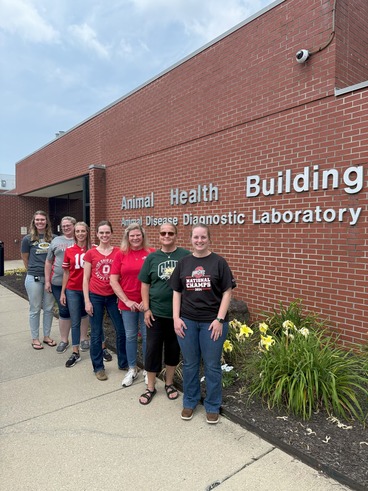
Animal Health office staff showing some "team spirit" on campus!
|
|