Epizootic Hemorrhagic Disease Virus Types 2 and 6 circulating in Ohio's White-Tailed Deer Population
Qirui Zhang, PhD, Molecular Diagnostics Section Head
Epizootic haemorrhagic disease (EHD) is an infectious viral disease transmitted by biting midges, an insect of the genus Culicoides. The virus is pathogenic to both domestic and wild ruminants, primarily cattle and white-tailed deer (WTD). To date, at least seven serotypes are currently identified. The disease caused by EHDV-1, -2, and -6 is characterized by fever, anorexia, ulcerative stomatitis, swelling of eyelids, respiratory distress, nasal and ocular discharge, redness and scaling of muzzle and lips, lameness, erythema of the udder and difficulty swallowing.
In the U.S. an exotic strain of EHDV-6 was isolated from moribund and dead white-tailed deer in Indiana and Illinois in 2006. In Ohio, the first case of EHDV-6 was reported by ADDL in September 2020 from one captive WTD in Trumbull County. Later that year, both EHDV-2 and EHDV-6 were detected in wild WTD. In 2021, EHDV-2 and EHDV-6 were continuously detected in both captive and wild deer populations in Ohio, with most of the detections being EHDV-6. In, 2022, EHDV-2 was the dominant strain detected in wild WTD submitted by ODNR interestingly, in 2023 neither EHDV-2 nor EHDV-6 was detected in wild WTD samples. By the end of September 2024, both EHDV-2 and EHDV-6 had been detected in both wild and captive WTD, with EHDV-6 being most prevalent. ODNR has more information about EHD, including a map of EHD in Ohio, on their website.
For monitoring and detecting different types of EHDVs in Ohio WTD, ADDL offers a real-time PCR for detecting bluetongue virus and EHDV at the same time, and a fast multiplex real-time PCR for typing EHDV-1, -2, and -6 simultaneously from EHDV-positive and suspect cervid samples. The appropriate sample types are spleen, lymph node, lung, and whole blood. ADDL also offers AGID and virus neutralization specifically for EHDV-1, -2, and -6 from serum samples. The samples should be kept frozen or refrigerated until tested. Please visit our laboratory website or call the laboratory at 614-728-6220 for any questions.
References:
1) OIE Manual of Standards for Diagnostic Tests and Vaccines. EPIZOOTIC HAEMORRHAGIC DISEASE (2021)
2) Jiménez-Cabello L, Utrilla-Trigo S, Lorenzo G, Ortego J, Calvo-Pinilla E. Epizootic Hemorrhagic Disease Virus: Current Knowledge and Emerging Perspectives. Microorganisms. 2023 May 19;11(5):1339.
 Ohio ADDL Adds IBR ELISA to Test Offerings
Anne Parkinson, BS, Serology Section Head
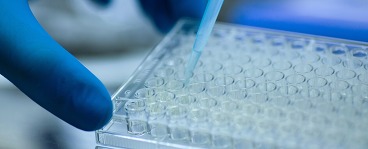
The Ohio ADDL has added an IBR ELISA to its current test offerings. Infectious Bovine Rhinotracheitis (IBR) is a highly contagious and infectious disease that is caused by bovine herpesvirus 1(BoHV-1). This test detects BoHV-1 antibodies specific to IBR in individual samples of bovine serum, plasma, or milk. It is important to note that antibody responses induced by vaccines that contain the glycoprotein B (gB) component of BoHV-1 will be detected by this ELISA. The IBR ELISA will be offered on Mondays at the ADDL, reported same-day at a cost of $12.00 per test.
Beyond the Bench: Outreach in Action
Liane Davila-Martin, DVM, MPH, Animal Health Veterinary Epidemiologist
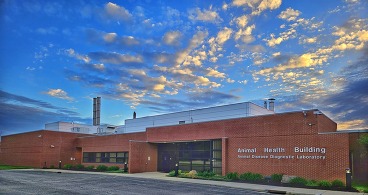
The Ohio ADDL plays a vital role in supporting the state’s livestock industries, performing over 500,000 tests each year. As the demand for diagnostic testing continues to rise, our laboratory’s team of veterinarians, scientists, and technicians work tirelessly across various disciplines (bacteriology, virology, molecular diagnostics, pathology, serology, and histology). Beyond laboratory testing, ADDL is dedicated to engaging with Ohio’s animal agriculture community to ensure our support is accessible and effective.
Recently, a group of ADDL staff visited a swine farm in Ohio as part of an educational outreach initiative. The goal was to explore how ADDL can better assist the swine industry. One suggestion from the farm’s workers, many of whom are Hispanic, was to make our lab submission forms available in Spanish. Understanding the importance of this request, we updated our swine submission form to include both English and Spanish, ensuring greater accuracy and efficiency in sample submissions. This change will help reduce errors, improve compliance, and speed up processing, enabling farms to get their results quickly and continue their operations with minimal delays.
We also had the opportunity to meet with the farm’s managers to discuss these changes and provide training on proper sample collection and submission. By working closely with farmers and improving communication, ADDL aims to contribute to the health of Ohio’s livestock population and support the local economy. If you are interested in meeting with our ADDL team to learn more about the lab and what we can do to better serve your needs, we’d love to come visit your clinic or farm – please email Melanie Prarat, Associate Laboratory Director, to discuss further: melanie.prarat@agri.ohio.gov.
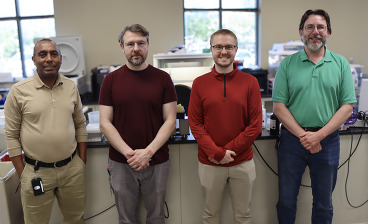 L to R: Abraham Ayele, Dr. Stephen Vadia, Dr. Andrew Woodruff, and Brock Miniard
Meet the newest staff of the ADDL
Dominika Jurkovic, PhD, Central Receiving Section Head
ADDL welcomed four new laboratory scientists to the Molecular Section: Brock Miniard, Dr. Andrew Woodruff, Dr. Stephen Vadia, and Abraham Ayele.
Brock holds a BA in Microbiology and Genetics from Ohio Wesleyan University and an M.S. in Biological Sciences from Wright State University. He brings experience in PCR, ELISA, flow cytometry, and bacteriology from vaccination and therapeutic studies. Outside of work, he enjoys spending time with his wife and three children, practicing taekwondo (2nd-degree black belt), gaming, and volunteering with his church.
Dr. Woodruff earned a BS in Microbiology from Miami University and a PhD in Microbiology from The Ohio State University. His doctoral research in the Anderson Lab focused on fungal genetics and Candida albicans, with emphasis on morphogenesis, CRISPR-Cas9, and genome assembly. He brings extensive molecular biology expertise to the team.
Dr. Vadia received his undergraduate degree from Case Western Reserve University and a PhD in Microbiology from The Ohio State University, where he studied Listeria pathogenesis. He completed postdoctoral work at Washington University in St. Louis, MO and has held roles in diagnostic testing, biotech, and the federal BioWatch program. His hobbies include gardening, stock investing, and producing a YouTube channel and podcast about vintage Magic the Gathering.
Dr. Ayele earned his DVM from the Agricultural University of Havana and practiced small animal medicine before moving to the U.S. He later worked as a veterinary assistant and medical laboratory technician at Idexx Laboratories. He joined ADDL in 2024, first in Central Receiving and now as part of the Molecular Section. Outside of work, he enjoys family time, visiting parks, and going to the gym.
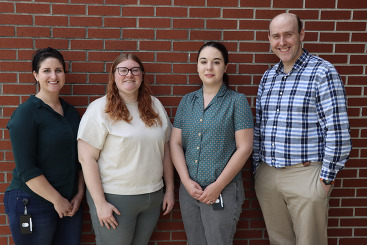 L to R: Dr. Annalise Black, McKenzie Mullis, Tori Peachey, and Dr. Kyle McIntosh
Dr. Annalise Black is ADDL’s newest Veterinary Pathologist. She became a board-certified Anatomic Veterinary Pathologist in 2024 after completing her residency at Midwestern University. She holds dual BS degrees in Environmental Studies and Zoology from the University of Wisconsin–Madison and earned her DVM from Colorado State University in 2021. Her professional interests include infectious disease and the livestock-wildlife interface. In her free time, she enjoys outdoor activities, crafting, and spending time with her dog and cat.
McKenzie Mullis joins ADDL as an APHL Fellow focusing on biosafety procedures and risk assessments. She earned a BS in Biology from the University of North Georgia and an M.S. in Biology Research from Georgia State University. She is currently pursuing a second M.S. in Public Health Communications at Boston University. McKenzie’s interests include infectious disease, vaccinology, videography, hiking, and singing.
The Virology Section has welcomed two new team members: Tori Peachey, Laboratory Technician, and Dr. Kyle McIntosh, Laboratory Scientist. Tori holds a BS in Biology with a minor in Entomology from The Ohio State University. In addition to her lab work, she fosters kittens for Colony Cats and supports local animal rescue efforts. Dr. McIntosh joined ADDL in January 2025 and brings a strong background in pharmacology and toxicology. He earned both his Master’s and PhD in Pharmacology/Toxicology and Experimental Therapeutics from the University of Toledo, where he conducted cancer research. Outside the lab, Kyle enjoys biking, church activities, family visits, and time with his cat.
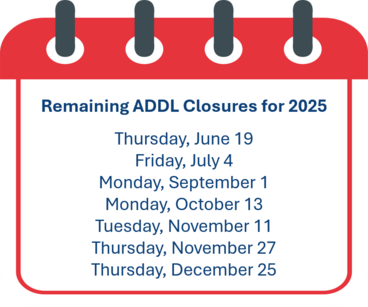
 In observance of Memorial Day, Ohio ADDL will be closed on Monday, May 26, 2025
If you need to contact us regarding an urgent matter, please use our after hours phone number: (888) 456-3405.
|