New Avian Metapneumovirus (aMPV) Tests Offered At The ADDL
Qirui Zhang, PhD, Laboratory Scientist 3 and Ashley Johnson, MS, Section Head Molecular Diagnostics & Sequencing
Anne Parkinson, BS, Serology Section Head
Two avian Metapneumovirus tests are being introduced by the Molecular and Serology Sections of the ADDL for the state’s poultry producers in response to the presence of aMPV in Ohio. AMPV has recently emerged as a significant problem for poultry producers in Ohio and across the US and has been diagnosed in turkeys, broiler chickens, egg layer chickens, turkey breeders and chicken breeders. Originally known as turkey rhinotracheitis (TRT), this virus is highly infectious and contagious with initial infection commonly complicated by a variety of secondary bacterial invaders which result in a high morbidity and a variable, but most often times, high mortality. The disease manifests differently in turkeys versus chickens – particularly severe and a primary pathogen in turkeys, whereas in chickens is generally involved as part of a multi-faceted respiratory disease complex. Infection of susceptible birds of any age or production type can result in serious economic losses if not managed effectively.
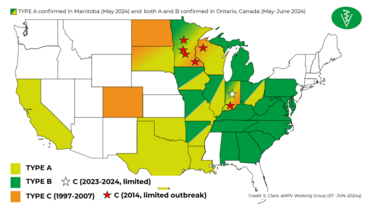
AMPV belongs to the family Paramyxoviridae/subfamily Pneumovirinae/genus Metapneumovirus and has four described subgroups classified as A, B, C, and D based on genetic and antigenic differences. Three subgroups of aMPV are recognized as confirmed and circulating in the US since 2023 – subgroups A, B, and C. Most recently in Ohio, subgroups A and B have been detected. Subgroups A and B are of European origin, whereas the more recent subgroup C is of U.S. origin.
Distribution of aMPV in the US as of June 2024.
AMPV is an enveloped, single stranded, negative sense RNA virus with a genome of around 13 Kb. Based on this characterization, the Ohio ADDL has developed a fast, real-time RT-PCR assay for the rapid detection of aMPV nucleic acids from avian samples. Appropriate specimens include, but are not limited to, tracheal swabs, oropharyngeal swabs, choanal swabs, trachea and other affected tissues. Viral transport media should be used for the collection and transport of swabs to the ADDL – using Dacron or other compatible swabs for sampling. The charge for aMPV PCR testing at the ADDL is $36 per test and is performed Monday through Friday. The PCR test will detect and differentiate between all three subgroups of aMPV.
The ADDL will be using an indirect ELISA platform to detect antibodies to aMPV in turkey and chicken serum that uses a samples/positives (S/P) ratio relationship to generate a result. The test will detect antibodies present for aMPV subgroups A, B, and C – but will NOT differentiate between the subgroups NOR will it differentiate vaccinated from non-vaccinated status birds. The cost of the aMPV ELISA test will be $5.00 per sample, and samples will be tested on Tuesdays and Thursdays. When used in conjunction with the PCR now available at the ADDL, these two assays are highly sensitive tools to aid practitioners and producers in the detection, monitoring and control of aMPV in the state’s poultry flocks.
In order to preserve the diagnostic integrity of all samples submitted to the ADDL, please remember to ship samples cooled with ice packs during this warmer period of the year and that samples need to be IN the laboratory the day BEFORE the actual listed test day in order to be set and reported as scheduled. For more information on tests, fees, and test days, or to reference our resource pages - please refer to the Ohio ADDL website.
Interested practitioners can learn more and follow the progression of aMPV through the efforts of the aMPV Working Group, an “ad hoc group of 200+ poultry veterinarians, researchers, regulatory and animal health professionals, mostly USA participants from commercial production, trade associations, government, and allied industry.” The group is headed up by Dr. Steven Clark, DVM, Dipl ACPV and seeks the exchange of knowledge on current, relevant information regarding the epidemiology, diagnosis, pathogenesis, and control of aMPV in US poultry flocks. If any practitioner or producer would like to participate in this working group and follow the emergence and spread of aMPV in the U.S., please contact Dr. Clark to be added to this discussion.
New Staff Join ADDL
Dominika Jurkovic, PhD, Central Receiving Section Head
ADDL is excited to welcome three new employees to the laboratory: Laura Kutz (Molecular Diagnostics), Halle Andrews (Central Receiving), and Lauren Blanchong (Bacteriology).
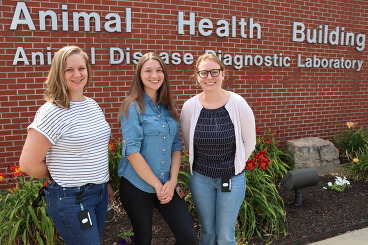 L to R: Laura Kutz, Halle Andrews, and Lauren Blanchong.
Laura Kutz is originally from West Virginia and earned a Bachelor's Degree in Biochemistry from Ohio University in 2013 and her PhD in Biomedical Research from Marshall University in 2019. After completing her PhD, Laura undertook a postdoctoral fellowship at OSU, where she studied the mechanisms of muscle atrophy after disuse. Outside of work, Laura's hobbies include gardening, traveling, and hiking.
Hailing from Southeast Ohio, Halle Andrews grew up on a family farm where she was actively involved in 4-H and FFA. She showed horses in AQHA competitions and raised beef cattle and Golden Retrievers. Halle graduated from Ohio University in May 2024 with a Bachelor's Degree in Biological Sciences. During her time at Ohio University, she served as a teaching assistant for Microbiology labs, a lab technician for Microbiology labs, and a Biological Sciences Ambassador. In her spare time, Halle enjoys singing, art, graphic design, and videography.
Lauren Blanchong graduated in 2022 with a Bachelor's Degree in Microbiology from The Ohio State University. She has a background in veterinary, environmental, and clinical lab settings. Before joining ADDL, Lauren worked for the Louisville Metro Public Health and Wellness Department conducting recreational water testing for Escherichia. coli and Pseudomonas aeruginosa. Additionally, she was involved in STI testing and blood lead testing for pediatric and pregnant patients, contributing to the childhood lead poisoning prevention program (CLPPP). When she's not working, Lauren enjoys boating, hiking, playing pickleball, and exploring new restaurants with friends and family.
Welcome Summer! (and arboviruses)
Qirui Zhang, PhD, Laoratory Scientist 3, Molecular Diagnostics & Sequencing
As summer arrives, so does warmer weather and the increased activity of mosquitoes. These pests can be carriers of diseases such as West Nile Virus (WNV) and Eastern Equine Encephalitis (EEE) virus. Both viruses can cause fever, neurological symptoms, and even death, and are collectively known as arboviruses due to their transmission through arthropods.
Birds including crows, ravens, house sparrows, and robins are the natural reservoirs for WNV. WNV transmission is maintained in the mosquito-bird-mosquito enzootic cycle, and it is transmitted to vertebrates via mosquito bites. Humans and horses are considered dead-end hosts. Over 80% of humans infected WNV are asymptomatic and less than 1% of infected people develop neuroinvasive symptoms including meningitis and encephalitis. WNV infected horses mainly show neurological signs, may demonstrate mild to severe ataxia, encephalitis, or encephalomyelitis. Some horses may have fever. Currently there are commercial WNV vaccines for horses, but not for humans. The mortality can reach 30-50% in unvaccinated horses.
The disease caused by EEE in horses is characterized by fever, anorexia, and severe depression. In severe cases, the disease can progress to hyperexcitability, blindness, ataxia, severe mental depression, recumbency, convulsions, and death. The best practice for preventing WNV and EEE from your horses is vaccination. Consult your veterinarian about the appropriate vaccination frequency based on the location of your horses. Additional preventive measures include: keeping horses indoors during dawn and dusk, using insect repellents, and installing fans to reduce mosquito bites.
For PCR testing, submit EDTA whole blood samples (purple top). Accompanying serum samples (red top) are also encouraged for potential IgM ELISA testing at NVSL when appropriate. For deceased animals, brainstem is the best tissue for PCR testing, but other affected tissues like cerebrospinal fluid, spinal cord, spleen and liver may be used. Samples should be kept frozen or refrigerated until tested. For more information, please visit our laboratory website or call us at 614-728-6220.
Meet the ADDL Summer Interns
Dominika Jurkovic, PhD, Central Receiving Section Head
This summer, the Animal Disease Diagnostic Laboratory (ADDL) has five summer interns: Aleena Cain (Central Receiving), Carroll Cannon (Molecular Diagnostics), Hannah Foraker (Serology), Mikayla George (Pathology), and Olivia Johnson (Bacteriology).
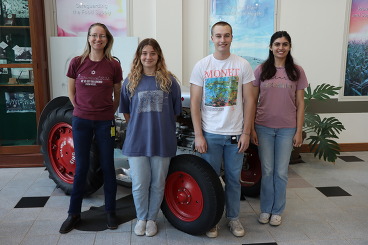 L to R: Hannah Foraker, Aleena Cain, Carroll Cannon, and Mikayla George.
Aleena Cain, a student at the University of Cincinnati, is majoring in Biology of Animals. Her interest in large animals and desire to gain experience in a different aspect of animal health led her to an internship at the ADDL. This summer, Aleena has been working with central receiving, sorting samples, accessioning samples and learning about the variety of tests offered by the ADDL.
Carroll Cannon is an upcoming senior at Penn State University, majoring in Biochemistry and Molecular Biology. Carroll was drawn to an internship at the ADDL to gain hands-on experience in a high-throughput lab and explore the governmental side of research. This summer, Carroll has been focusing on using nanopore whole genome sequencing as an alternative to Illumina sequencing. Outside the lab, Carroll is an active member of Penn State's fencing team.
Hannah Foraker attends The Ohio State University where she is pursuing a degree in Animal Sciences with a focus on animal nutrition. Having prior military experience, Hannah is no stranger the benefits of working in government and being able to gain experience at the ADDL while a student is incredibly valuable. This summer, Hannah is working in the Serology section assisting with BLV, Johnes, Q-fever, and BTV ELISA tests. In addition to her work at the ADDL, Hannah is working part-time in the OSU ruminant lab. Hannah is fascinated by dairy nutrition and methane mitigation, a field increasingly focused on sustainability.
Mikayla George, a student at The Ohio State College of Veterinary Medicine, decided to intern with the ADDL to step out of her comfort zone and explore a non-traditional path in veterinary medicine. Currently in her second year, Mikayla has developed a keen interest in pathology. During her internship, she has been assisting with necropsies on various species—including cows, horses, chickens, ducks, and fish—while also learning to write detailed histopathology and necropsy reports. Outside of her studies, Mikayla loves traveling and outdoor activities such as kayaking, hiking, fishing, and bouldering. She aims to visit all U.S. National Parks and has already visited seven.
Olivia Johnson is a student at Wright State University studying biology and will begin her Master's in Biological Sciences this fall. Intrigued by the intersection of microbiology and agriculture, Olivia returned for her second summer at the ADDL, working in the bacteriology section. Her main focus has been salmonella testing, which includes handling thousands of eggs. Olivia is also gaining expertise in culturing various bacteria based on their environmental and nutritional needs. Outside of ADDL, Olivia dedicates her time to raising and training service dogs for veterans and children with autism. She is currently training a golden retriever named “Brian” on scent tracking.
Olivia preparing media for Salmonella testing.
Field Day at ODA!
Emily Janovyak DVM, USDA ORISE fellow
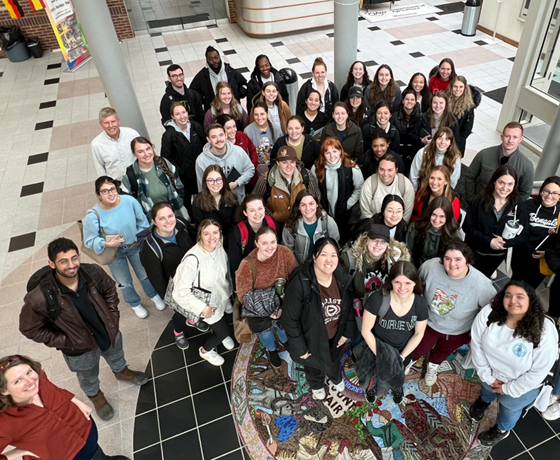
In April, the Ohio Department of Agriculture and ADDL hosted the entire second-year class from The Ohio State University College of Veterinary Medicine for a field day. The event was integrated into the veterinary school’s new curriculum, designed to expose students to the laboratories on the ODA campus and the services provided. Students took tours and interacted with lab staff from the Ohio Department of Health rabies lab and vector borne surveillance program, the Consumer Protection Lab and the Analytical Toxicology Lab as well as the ADDL.
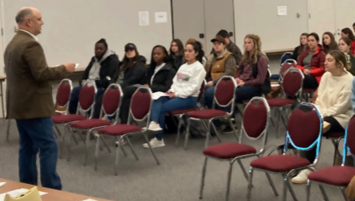
Director Brian Baldridge addresses veterinary students.
The event included addresses from ODA Director Brian Baldridge and Assistant Director Tracy Intihar, and short presentations from State Veterinarian Dr. Dennis Summers and State Field Veterinary Medical Officer Dr. Angela Rospert. The students worked through a ‘What do you do next?’ case report exercise around Brucella canis, and a hands-on exercise evaluating students’ skills at packing a diagnostic sample to ‘ship’ to the ADDL concluding with real feedback on their work thanks to Central Receiving’s Sarah Schmidt and Quality Assurance Manager Kerri Lawrence, who opened the boxes and critiqued the submissions. The Field Day was well received by all participants and will continue on an annual basis.
OSU Veterinary Students visit ODA.
Exploring Microbial Communities: Insights from the OSU Symposium
Daniela Peña Hernández, DVM, MS, Virology Section Head
On April 12, The Ohio State University (OSU) hosted a vibrant gathering of researchers and enthusiasts delving into the intricate world of microbial communities. Co-hosted by the Infectious Diseases Institute Microbial Communities Program and the Center of Microbiome Science, the symposium offered a rich agenda of talks, poster sessions, and networking opportunities.
The event kicked off with a warm welcome and introduction. One highlight was the announcement of the Center of Microbiome Science (CoMS) Trainee Travel Awards, a testament to the commitment of fostering talent and collaboration within the field.
The opening session featured distinguished speakers Dr. Karen Dannemiller and Dr. Darryl Wesener. Dr. Dannemiller's keynote shed light on microbial functions indoors (carpets are a microcosmos!), emphasizing their impact on maintaining healthier built environments both on earth and in space. Meanwhile, Dr. Wesener captivated the audience with his research on in vivo manipulation of human gut Bacteroides fitness by abiotic oligosaccharides, offering intriguing prospects for therapeutic interventions.
Following the enlightening talks, attendees had the opportunity to join a poster session, exploring abstracts showcasing cutting-edge research in microbial communities. Abstracts from the session are available here. The general session delved deeper into specific aspects of microbial research, with talks by Dr. Miqdad Dhariwala, Dr. Alison Bennett, and Dr. Karna Gowda. Topics ranged from commensal-myeloid crosstalk in neonatal skin to selenium-driven evolution in soil microbiomes.
The symposium turned its focus to their special guests: this year featuring a session on Microbiome Science and Latin America. Dr. Barbara Piperata, Dr. Soledad Benitez Ponce, Dr. Luis Martinez Villegas, and Christian Quiles led a session highlighting research endeavors, discoveries in this region, the global relevance, and collaboration opportunities within the field. The day culminated in a stimulating panel discussion with the specialists, where participants had the chance to ask questions and further explore key themes.
Overall, the OSU Microbial Communities Symposium proved to be an enriching platform for knowledge exchange, collaboration, and inspiration, fostering new connections and paving the way for future advancements in this dynamic field.
|