HPAI Update From the State Vet's Office

Dr. Dennis Summers, State Veterinarian and Division Chief of Animal Health
|
HPAI Update
Currently, Ohio does not have any active cases of HPAI in livestock or poultry. The previously affected dairy herd has been reclassified as non-affected and has been removed from USDA’s HPAI map. We continue to be very active in diagnostic and surveillance testing for HPAI at ADDL. It is imperative that all of us in animal agriculture take measures to prevent disease transmission between animals regardless of the disease. Biosecurity resources are available on the ODA website.
Voluntary Herd Testing Pilot Program with USDA
USDA has initiated a pilot program for interested dairy producers for bulk tank milk testing. This program, which is voluntary, would allow herds to achieve a ‘status’ through repeated weekly bulk tank tests for HPAI. If enrolled and status achieved, you would be able to move dairy cattle interstate without individual animal testing under the current Federal Order. Currently, there is one (1) Ohio herd enrolled. If you wish to enroll, please reach out to Dr. Jamie Davis, USDA APHIS Area Veterinarian In Charge jamie.l.davis@usda.gov. For more information visit: vs-hpai-dairy-herd-status-program.pdf (usda.gov).

UPDATED Livestock Exhibitions Rules are in Effect
Jacquie Keller-Potvin, Emergency Operations and Program Manager
The Livestock Exhibitions Program has updated applicable chapters of Ohio Administrative Code just in time for the start of Ohio Fair Season. The Ohio Department of Agriculture (ODA) is tasked with determining the regulatory framework for exhibitions of livestock to ensure the food safety of market livestock, health and welfare of the livestock, and provide consistent regulations for the competition. ODA distributes testing supplies and performs urine sample testing for select market livestock exhibited at county, independent, and state fairs. The testing is critical to ensuring the market livestock tested are safe for consumption.
Chapters 901:1-18 and 901-19 became effective on May 23, 2024. The Ohio Advisory Committee on Livestock Exhibitions have been working on the draft regulations since 2022 in efforts to streamline, update, and simplify the regulations for exhibition livestock. Specifically, chapter 901:1-18 pertains to the importation requirements for exhibition livestock and chapter 901-19 pertains to the practices in preparation to and at the exhibition. To read the regulations in their entirety, please click the links below. Also, take time to browse Ohio Fair Manager’s Association’s webpage to find a fair near you!
Chapter 901:1-18
Chapter 901-19
|
County fairs are a great place for individuals to come together to celebrate agriculture and often there are livestock projects exhibited and showcased. There are many practices that county fairs and individuals can put into action to have a safe and successful event. We want exhibitors, fair goers, and animals to remain safe and healthy throughout the fair season!
Some of those recommendations include:
- Do not bring sick animals to the fair/exhibition
- Know who the Fair Veterinarian is and have their contact information
- Practice good hand hygiene including washing your hands
- Follow all rules in the fair book for the respective county fair
See the ODA website for the complete list and Exhibition Guidance and Best Practices Guideline.
USDA Updates Official ID Requirements for Cattle and Bison
Dr. Cynthia Wise, Field Veterinarian
The USDA published the final Animal Disease Traceability rule on the Use of Electronic Identification Eartags as Official Identification in Cattle and Bison on May 9, 2024. Beginning November 5, 2024, all official eartags sold for or applied to cattle and bison must be readable both visually and electronically.
This final rule does not change the types of animals required to have official identification for interstate movements which includes all sexually intact cattle and bison 18 months of age or over, all female dairy cattle of any age, all male dairy cattle (including dairy-beef crosses) born after March 11, 2013, cattle and bison of any age used for rodeo or recreational events, and cattle or bison of any age used for shows or exhibitions.
The final rule does not change the categories of animals that are exempted from official identification requirements which includes beef feeder cattle under 18 months of age, direct-to-slaughter cattle, and cattle and bison that do not move interstate.
Visual-only official eartags used in cattle (such as metal NUES tags) applied prior to November 5, 2024 will be recognized as official ID for the life of the animal. ODA encourages accredited veterinarians to use RFID tags if official ID is required when issuing CVIs or performing official regulatory testing. Free RFID tags for cattle are available for Ohio accredited veterinarians and cattle producers. Metal cattle NUES tags can be returned to ODA. Call the ODA Animal Health office at 614-728-6220 ext. 1 for more information.
The final rule also updated recordkeeping requirements for veterinarians or other entities that distribute official identification. For additional information, please see USDA APHIS Animal Disease Traceability Website and the FAQ on Animal Traceability Rule 9 CFR 86. More information on official identification can also be found on the ODA Animal Health website.
Dr. Tony Forshey Animal Health Building and Ohio Veterinary Diagnostic Laboratory
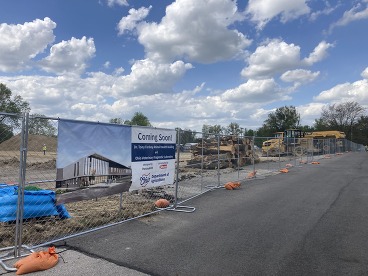
Construction has begun on the new Dr. Tony Forshey Animal Health Building which will house the Ohio Veterinary Diagnostic Laboratory. Construction is set to be complete in 2026.
Be Prepared for Fair Season With Your Sheep and Goat Projects! What to Know About Scrapie ID.
Jennifer Reynolds, USDA Animal Health Technician
When you have picked out your fair goat or sheep project, make sure the breeder has officially identified the sheep or goat before it leaves the farm. The most common form of official ID is a scrapie tag that will have a U.S. shield on the tag and will start with a state abbreviation according to the premises where the animal was born (flock/herd of origin). Other forms of official identification can be found in our USDA Official ID Types Handout . Always make sure the exhibition you are showing the sheep or goat at accepts the form of official ID you are using. If you are using official tattoos or 840-approved microchips for official identification, remember that tattoos must be legible, you must have your corresponding paperwork in the form of a registration paper or owner statement, and microchips should be in the correct location. You should arrange for a microchip reader to be available at ID check time at the fair. The important thing to remember about official ID is that it cannot be duplicated and it’s unlawful to remove. There is no reason why a sheep or goat should have two scrapie tags – it only needs one which identifies it to the flock of birth.
Scrapie is an incurable, fatal, degenerative disease that affects the central nervous system of sheep and goats. It is classified as a transmissible spongiform encephalopathy, the same class of disease as BSE, otherwise known as Mad Cow Disease. Sheep and goats are exposed to scrapie at birth if they are born into an infected flock and may not show signs or symptoms of the disease until 2-5 years of age. This is why flock of birth/flock of origin identification is so important. You can learn more about scrapie and disease resistant genotypes for sheep on the USDA Scrapie website page. If you are a sheep or goat producer and have not yet signed up for scrapie ID and live in Ohio, please call our Ohio USDA APHIS VS office at 614-856-4745 to get a scrapie flock identification number assigned.
 |
|
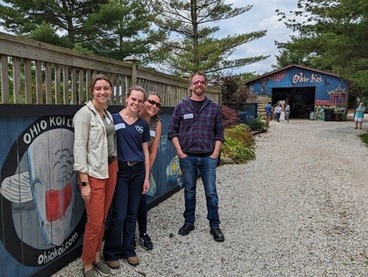
Representatives from the Ohio Department of Agriculture Animal Health and Legal Divisions attended DISCOVER OHIO AQUACULTURE, hosted by Ohio Sea Grant. The agenda was full of producers sharing their business models and discussing issues the aquaculture industry is facing. As presented during the program, Ohio Aquaculture is composed of food fish farms, sport fish farms, baitfish farms, and ornamental fish farms. Additionally, participants were given the opportunity to visit a producer’s operation and observe the various production tanks. For more information on Ohio Aquaculture, please see the links below!
|
https://ohioseagrant.osu.edu/
https://ohioaquacultureassociation.com/
https://www.nationalaquaculture.org/
|