Staff Updates
Dr. Lauren Vesprani - Field Veterinarian
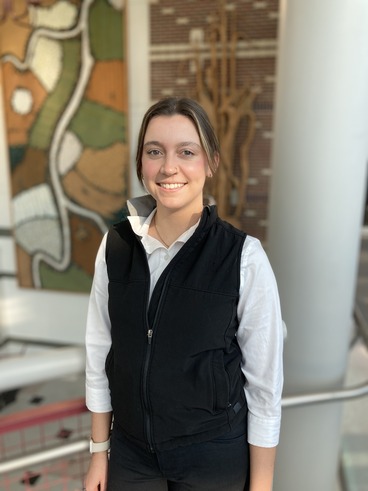
Dr. Lauren Vesprani grew up in Cincinnati, Ohio where she attended Ursuline Academy. After high school, she attended the University of Michigan where she received a Bachelor of Science in Ecology & Evolutionary Biology as well as Evolutionary Anthropology. While at Michigan, she played intercollegiate polo, studied lizards in Greece, and worked at an emergency veterinary hospital. She then returned to Ohio to attend the Ohio State University’s College of Veterinary Medicine where she focused on Veterinary Public Health, including pursuing a Master’s in Public Health, which she is scheduled to complete this summer. Previously, Vesprani worked for the United States Department of Agriculture Food Safety Inspection Service in red meat and poultry inspection. In February 2024, she joined the Ohio Department of Agriculture as an Animal Health Veterinarian Administrator for Central Ohio.
Outside of work Dr. Vesprani enjoys cooking, exploring local coffee shops and metro parks, and playing weekly pub trivia with friends.
Join me in welcoming Dr. Vesprani to the Animal Health Team!

Field Veterinarian Job Opening
Are you a Veterinarian interested in joining the team at ODA in the Division of Animal Health? There is currently an opening for a Field Veterinarian in East Central Ohio. In this role, you will assist in regulatory programs, emergency response, and inspection activities in Ohio. Animal Health has a great team of veterinarians, inspectors, and administrative staff.
Eastern Ohio Animal Health Veterinarian Administrator – Various Counties, PN 20045741 - Job Posting
Interested or have more questions? Please reach out to Dr. Kristy Shaw at 614-728-6253.
|
The Division of Animal Health has amended two chapters of the Ohio Administrative Code with the intent of having new regulations in place for the 2024 Exhibition Season. The primary objectives of the rule review are to update, clarify, simplify, and reduce the regulations for livestock exhibitions.
Currently, the amended rules are under the Joint Committee on Agency Rule Review (JCARR) jurisdiction with a final opportunity for stakeholder input. A public hearing is scheduled for April 11, 2024 at 10 a.m. on ODA’s Campus as an opportunity to provide testimony. To view the amended rules or obtain more information on the public hearing, please visit the Ohio Department of Agriculture Legal Division Website.

Highly Pathogenic Avian Influenza Poultry Update
For the past two years, the update has been the same as HPAI cases are still occurring throughout the United States. Ohio has had eight (8) avian cases in the past five months. Continue to remain vigilant and practice good biosecurity.
Please see the ODA and USDA websites for HPAI outbreak information as well as biosecurity recommendations.
If you have sick or dying poultry please call ODA at 614-728-6220.
|
Equine Herpes Virus - 1 Update

In February and March, ODA and USDA responded to multiple Neurological Equine Herpes Virus-1 detections in Northeast Ohio. All exposed equines in the respective cases were identified and additional precautions taken. This included official quarantines and monitoring by regulatory personnel. At this time, all cases appear to be isolated incidents.
Equine Herpes Virus (EHV) is a common DNA virus that occurs in horse populations worldwide. It is unknown what causes some infected horses to develop the serious neurological form associated with EHV1. See AAEP for FAQs.
When boarding or traveling with your horse or attending shows, practice good biosecurity. If you are concerned about EHV exposure or you have a sick horse with clinical signs consistent of EHV-1, contact your private veterinarian.
For videos and resources on Equine biosecurity - visit EDCC.
|
Best Practices for Submitting Swabs for PCR testing to ADDL
Dr. Ashley Johnson, Molecular Diagnostics and Sequencing Section Head ADDL
The following are general guidelines for submitting swabs for PCR testing to the Ohio ADDL. Exceptions to these guidelines include, but are not limited to, avian sampling using either 3 or 5.5 mL BHI tubes and FMD sampling using TBTB media. If you have additional questions, you may call the ADDL at 614-728-6220 or email the Molecular Diagnostics section at AGR-Molecular@agri.ohio.gov.
1. Swabs should be made of synthetic materials such as polyester and nylon. Organic materials such as cotton inhibit PCR and are unacceptable. 6” swabs are standard for most samples.
2. Swabs should be placed in sterile tubes with no additives. Snap cap tubes are preferred, but red top and other tubes with a stopper are also acceptable. Tubes with additives such as heparin inhibit PCR and are unacceptable.
3. For best collection practices, place the swab in the tube and snap the upper portion of the plastic shaft off. This prevents the portion of the shaft that is being handled from entering and contaminating the sterile tube.
4. Swabs should be submerged in ~1 mL of viral transport media. If you do not have viral transport media (preferred), PBS and sterile saline are acceptable alternatives. Bacterial transport media can inhibit PCR and is unacceptable. A minimum volume of 0.2 mL is needed to perform the PCR test.
5. Swabs must be kept cold (refrigerated or on ice packs) immediately after collection until they arrive at the ADDL and testing is initiated.
6. Swabs must be tested withing 7 days of collection, but sooner is better.
Reminder: B. canis is a Reportable Disease in Ohio
Dr. Melissa Simmerman, Commercial Dog Breeding Veterinarian Administrator
Canine brucellosis is an infectious and zoonotic disease caused by the bacterium Brucella canis (B. canis) and has been reported worldwide. In dogs, canine brucellosis manifests with abortion, reproductive failure, enlarged lymph nodes, and can affect the osteoarticular system. The occurrence of asymptomatic infections in dogs is not uncommon. Treatment of infected dogs is associated with a high frequency of relapse and is not curative. Currently there are no commercially available vaccines for prevention of canine brucellosis.
In Ohio, canine brucellosis is a reportable disease Rule 901:1-21-02 - Ohio Administrative Code | Ohio Laws and there are certain regulatory requirements that must be followed when testing a dog for brucellosis. These include:
- Any blood samples which are taken to conduct a B. canis test shall only be taken by an accredited veterinarian, or by a registered veterinary technician who is supervised by an accredited veterinarian
- Information regarding the owner of the dog
- Information regarding the dog
- Official identification of the dog
All regulatory requirements can be found here: Rule 901:1-5-12 - Ohio Administrative Code | Ohio Laws If any of these requirements are missing, it can slow down the reporting process.
You can find answers to all you B. canis sample submission questions here: Canine Brucellosis Testing | Ohio Department of Agriculture
Additionally, any sample submission to ADDL needs to be accompanied by a submission form. A link to ADDL’s electronic submission form can be found here: General Submission Form (electronic) | Ohio Department of Agriculture A hard copy of this form must be included with the samples and the electronic copy needs emailed to submissions@agri.ohio.gov
Notice: B. canis rules:
OAC 901:1-5-12 & 13 are due for their 5-year rule review. Are you on Animal Health’s stakeholder list? Do you need to update your email address with ODA? Please email Jacquie Keller-Potvin at jacquelyn.keller-potvin@agri.ohio.gov. You can find all of ODA’s proposed rules that have been submitted for stakeholder review at Administrative Rules | Ohio Department of Agriculture.
Additionally, you can register at eNotifications Sign Up | Governor Mike DeWine (ohio.gov) to be alerted when a rule is open for review and comments. And finally, you can register with RuleWatch Ohio to receive an email alert whenever there is any activity related to that rule.
RFID Reader Loan Program
Dr. Cynthia Wise, Field Veterinarian
RFID readers that can scan eartags quickly and accurately are a critical tool for fairs, veterinarians, and producers using RFID eartags. Last fall, ODA sent a survey to Ohio fairs and exhibitions to learn more about how they are using RFID technology. A frequent challenge noted by fairs was the lack of readers and the high cost to purchase them.
To help meet this need, the ODA RFID Reader Loan Program makes RFID readers available for short-term loan, free of charge, to Ohio accredited veterinarians, Ohio fairs and exhibitions, and Ohio livestock producers. A variety of models are available so that users can try different systems before purchasing their own including:
- Agrident APR 500 BC Handheld
- Allflex RS 420 Wand
- Allflex AWR 300 Wand
- TruTest XRS2i Wand
- Gallagher HR5 Wand
A comparison chart on the available readers is available on ODA’s website. All models can scan different brands and types of RFID eartags or microchips (that are ISO 11784/11785 compliant), however each device has its own interface and capabilities. ODA encourages all borrowers to test readers out beforehand to increase their comfort level and familiarity and can provide basic instructions on use as well. Borrowers are welcome to borrow different models to find which works best for their system.
To request an RFID reader loan, contact ODA Division of Animal Health Office at 614-728-6220 or email animal@agri.ohio.gov. Please provide the dates requested, reader brand/model preference, number of wands, and contact information. If you do not have a reader preference, please send information about what you will be using the reader for and the coordinator can help match you with a reader. Additionally, you can fill out the ODA RFID Reader Request Form and email it to animal@agri.ohio.gov.
An ODA staff member will reach out to confirm your request and coordinate delivery and pick-up. Readers are not guaranteed and will be arranged based on equipment availability. Borrowers will also need to review and sign the ODA RFID Reader Loan Acknowledgement.
Highly Pathogenic Avian Influenza Detection in Ohio Dairy Cattle
The Ohio Department of Agriculture has received confirmation of a detection of highly pathogenic avian influenza (HPAI) in an Ohio dairy cattle herd.
The U.S. Department of Agriculture (USDA), Food and Drug Administration (FDA) and Centers for Disease Control and Prevention (CDC), as well as state veterinary and public health officials, continue to investigate the emerging illness among dairy cows that is causing decreased lactation, low appetite, and other symptoms.
On Monday, March 25, state animal health officials were notified when federal agencies confirmed the detection of HPAI in dairy herds in Texas and Kansas that had cattle exhibiting these symptoms. USDA’s NVSL has since confirmed the presence of HPAI in additional dairy cattle herds in Idaho, New Mexico, and Michigan.
See the full press release on ODA's website.
See the USDA website for additional HPAI information.
|