ODA Hosts Groundbreaking Ceremony For New Diagnostic Lab
Melanie Prarat Koscielny, MS, Laboratory Operations Manager
The Ohio Department of Agriculture (ODA) held a groundbreaking ceremony on November 16, 2023 to celebrate the start of construction on the new Dr. Tony Forshey Animal Health Building and Ohio Veterinary Diagnostic Laboratory (OVDL). Construction of the new laboratory also brings a name change, as the current title of Animal Disease Diagnostic Laboratory (ADDL) will be retired once the new laboratory is operational. Construction on the building is set to begin in December, with an estimated completion date in 2026. Read more about the groundbreaking ceremony here.

Q Fever ELISA Added to Serology Offerings at the ADDL
Anne Parkinson, B.S. Serology Section Head
The Serology Section of the ADDL has now added a Q Fever (Coxiella burnetii) ELISA test to the lab’s test offerings. The assay is an antibody detection test that can be used for serum, plasma, and milk samples from ruminants and also as a diagnostic tool or for general herd health screenings. Samples are tested individually, and the test is not validated for the pooling of samples. The cost of an individual test for Q Fever ELISA is $12 and it runs on Mondays and Wednesdays and reported COB on those days. The lab recommends shipping samples for Q Fever ELISA on ice for best transport to the lab. Please refer to our website for additional information about testing and best shipping practices.
FDA GenomeTrakr Meeting
Melanie Prarat Koscielny, MS, Laboratory Operations Manager
Two ADDL staff, Katie Shiplett and Jonah Perkins, attended the annual FDA GenomeTrakr meeting in October in College Park, MD. This meeting brings together public health and university laboratories who contribute to the FDA GenomeTrakr network to hear updates from GenomeTrakr collaborators, network with their peers, and learn about how genomic data is utilized during foodborne outbreak investigations. At ADDL, staff use MiSeq instruments to perform next generation sequencing of bacteria. Sequence data is shared with the FDA GenomeTrakr network and can also be publicly accessed through NCBI.
Overlap of Asian Longhorned Tick Populations and Positive Theileria orientalis Cases in Bovines
Reid Neinast, Researcher 3, Virology
Hannah Adams, Intern, Molecular Diagnostics
Theileria orientalis is an emerging tickborne disease in the U.S. The protozoon currently affects bovine populations in the U.S. by infecting red and white blood cells, causing infectious anemia. The symptoms of T. orientalis resemble anaplasmosis with lethargy, anemia, and yellowing mucous membranes. The Asian longhorned tick (ALHT) is the primary vector for T. orientalis, and there is a correlation seen between bovine theileriosis and the presence of ALHT on infected cattle. This tick is not native to the U.S. but has been increasingly identified across the east coast and Appalachian Mountains. ALHTs have been shown to carry and transmit both animal and human disease outside of the U.S. Identification of the ALHT in the U.S. is now known to have occurred as early as 2010 but was originally misidentified as an American Dog Tick. The ADDL lab in Ohio has primarily dealt with cases seen in West Virginia and Ohio counties. Most positive cases were seen between November of 2022 and April of 2023. This means that this tick is hearty enough to not only survive the winter months but can still adequately spread disease during “low tick risk” months.
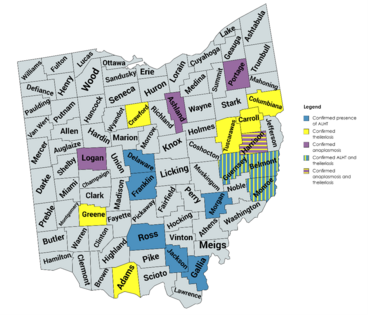 Map of Ohio counties with T. orientalis infections identified through the Ohio ADDL and known ALHT populations
In April 2022, the Ohio ADDL started offering a single tube duplex real-time PCR assay that can detect Anaplasma marginale and Theileria orientalis concurrently. Since then, Ohio ADDL has completed over 200 PCR tests with a total of 57 tests for Ohio and 180 tests for West Virginia. Out of those tests, 40.35% were positive from Ohio and 93.33% were positive from West Virginia. The bovine submissions to ADDL were analyzed and compared to the counties in Ohio with known ALHT populations. There is an overlap of T. orientalis in counties with ALHT’s and a correlation with bovine theileriosis, although causation is not proven, and additional studies should be conducted.

Meet the Section: Central Receiving
Dominika Jurkovic, Ph.D., Central Receiving Section Head
The Central Receiving Section in the ADDL is the critical hub for the intake, organization, and initial processing of all samples submitted to the laboratory for testing. This section plays a pivotal role in ensuring the smooth flow of laboratory operations and is often the first point of contact for incoming specimens. Central Receiving is led by Dominika Jurkovic, PhD and is comprised of: Sarah Schmidt RVT, recently promoted to the Lead Central Receiving Technician, Abbie Bohler (Laboratory Technician 2) and Erika Cline, B.A. (Laboratory Technician 1).
Sarah Schmidt, RVT graduated from Belmont College in 2013 with an Associate’s of Science Degree and then attend Bradford School where she earned an Associates of Science in Veterinary Technology in 2014. Prior to joining ADDL in 2018, Sarah worked in a small animal clinic gaining valuable experience in triaging and managing the clinic’s schedule. Sarah grew up on a dairy farm in eastern Ohio and has been married for 13 years and has two sons. In her free time, Sarah enjoys mountain biking and playing basketball.
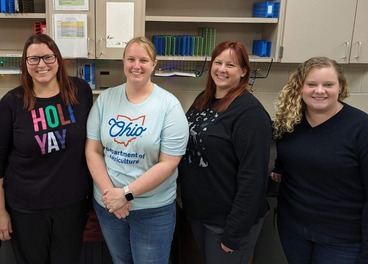 L to R: Dominika, Sarah, Abbie, and Erika
Abbie Bohler joined ADDL in May 2023, after working at the The Ohio State University Medical Center for 15 years, primarily in equine and farm animal work. She earned her degree in Veterinary Technology in 2007 from Columbus State Community College. Abbie has one daughter, Lily, a 2023
graduate from OSU, and a cat named Murder Mitts. In her free time, Abbie enjoys hiking, fiber arts, and historical reenactment.
Erika Cline graduated from Malone University in 2018, earning Bachelor of Arts Degrees in both Zoo and Wildlife Biology and Psychology. After graduation, she interned on two whitetail deer ranches in Texas, which led Erika to a full-time position as Deer Herd Manager on a farm with high end genetics. In 2022, Erika moved to Texas to work on a range with whitetail and exotics. After working hands-on with deer for years, Erika was ready for a change and joined the ADDL in October 2023. Erika has two dogs that drive her crazy, in the best way, and in her free time enjoys hunting, fishing, and reading murder mystery books.
Clostridium perfringens Genotyping Gets an Update
Alescia Roberto, Ph.D., Laboratory Scientist 2, Molecular Diagnostics
The genotyping scheme for the anaerobic gram-positive spore-forming rod, Clostridium perfringens, has undergone a revision from its predecessor, which was finalized in the 1960s by Wilsdon (Rood et al., 2018). The expansion of the genotyping scheme is based on the discoveries of other toxins that have been documented in specific C. perfringens-mediated diseases. In general, C. perfringens is the causative agent of histotoxic and enterotoxic diseases in both humans and animals. The four key exotoxins (e.g., cpa [α-toxin], cpb [β-toxin], etx [ε-toxin], and itx [ι-toxin]), produced during pathogenesis, were the bases in which the five toxinotypes, A through E, were established.
Exotoxins are a group of soluble proteins secreted by the bacterium and catalyze covalent modification of host cell physiology. Each toxin is classified based on its mode of action, whether it be membrane-acting (Type I), membrane-damaging (Type II), or intracellular effector (Type III). However, the five toxinotyping scheme is outdated since up to 16 toxins, including enterotoxin (cpe) and beta2 toxin (cpb2), in various combinations with the other four exotoxins, are responsible for gastrointestinal infections in most mammalian species (Rood et al., 2018). Based on the criteria proposed by Rood et al., 2018 our genotyping scheme will be expanded. Currently, seven virulence-associated genes are examined by the polymerase chain reaction assay at the Ohio ADDL, which are now divided into six different genotypes: A through F (Table 1).
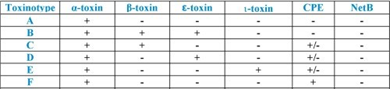 Table 1: Clostridium perfringens genotyping scheme proposed by Rood et al., 2018.
Julian I. Rood, Vicki Adams, Jake Lacey, Dena Lyras, Bruce A. McClane, Stephen B. Melville, Robert J. Moore, Michel R. Popoff, Mahfuzur R. Sarker, J. Glenn Songer, Francisco A. Uzal, Filip Van Immerseel, Expansion of the Clostridium perfringens toxin-based typing scheme, Anaerobe,
Volume 53, 2018, Pages 5-10, ISSN 1075-9964, https://doi.org/10.1016/j.anaerobe.2018.04.011.
Upcoming Holiday Closures
Ohio ADDL will be closed on Monday, January 15 in observance of Martin Luther King Jr. Day. Normal lab hours will resume on Tuesday, January 16.
Ohio ADDL will be closed on Monday, February 19 in observance of Presidents' Day. Normal lab hours will resume on Tuesday, February 20.
If you need to contact us regarding an urgent matter, please use our after-hours phone number: (888) 456-3405.
|