|
After being with the ODA Division of Animal Health for 34.5 years, Dan Goeglein (Agricultural Inspections Manager) retired on December 31.
Additionally, Dr. David Frew, field veterinarian with the ODA Division of Animal Health retired on December 31 after being with the Division for 25.5 years.
A huge thank you to both of them for their time and commitment to this agency. Good luck to both of them in retirement - they will be sorely missed!!
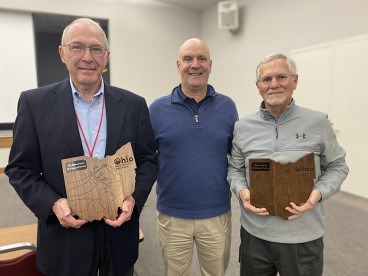
L to R: Dr. Dave Frew, ODA Director Brian Baldridge, Dan Goeglein
ODA Division of Animal Health Veterinary Job Openings
Are you a Veterinarian interested in joining the team at ODA in the Division of Animal Health? There are currently TWO openings for Field Veterinarians. In these roles you will assist in regulatory programs, emergency response, and inspection activities in Ohio.
Eastern Ohio Animal Health Veterinarian Administrator – Various Counties, PN 20045741 - Job Posting
Central Ohio Animal Health Veterinarian Administrator – Various Counties, PN 20040126 - Job Posting
Interested or have more questions? Please reach out to Dr. Kristy Shaw at 614-728-6253.
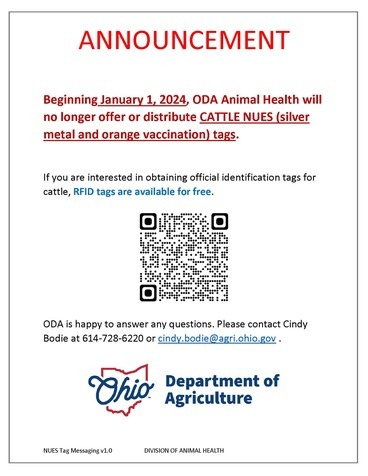
Free Cattle RFID tags
Ohio Veterinary Diagnostic Laboratory Groundbreaking
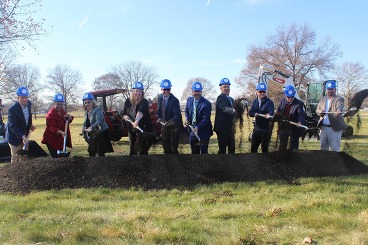
On November 16, leaders in the agricultural community gathered at ODA for a groundbreaking ceremony of Ohio's new Ohio Veterinary Diagnostic Laboratory and Dr. Tony Forshey Animal Health Building. This has been a project many years in the making and is projected to be finished in 2026.
Dr. Angela Rospert, Field Veterinary Medical Officer
As the agricultural industry continues to embrace advancements in technology, ODA is finding ways to help aid in the forward progression. One of these technology advancements includes RFID technology- both RFID ID tags for animals as well as various RFID reading devices and panels. The Ohio State Fair and many of our county and independent fairs have embraced RFID technology when it comes to tagging and checking certain animals into the fair. RFID technology can make this process more accurate and efficient.
If you are a county or independent fair interested in using RFID technology, please join ODA at the Ohio Fair Managers Association (OFMA) convention for a Q&A panel with other fairs that have been utilizing RFID technology. Learn about the benefits RFID can offer and some of the challenges that other fairs have worked through. The Q&A is on January 6 from 2-3 p.m.; see OFMA’s schedule for more information.
ODA understands that the incurred costs associated with RFID technology can be considered an obstacle that may be hard for some to overcome. In an effort to help offset some costs ODA, through federal ADT funding, has been able to purchase several RFID reading devices. These devices are from a variety of manufacturers and have different capabilities. They are available for loan to fairs, veterinarians, and producers. We do have a limited number of readers and they are available on a first come basis. If you are interested in borrowing a reader, please contact ODA’s Animal Health front desk at 614-728-6220 to be put in contact with someone for more details.
Electronic CVIs
Beginning January 1, 2024, ODA Animal Health will limit orders for paper CVI booklets.
There are many different options and platforms available for electronic CVIs (Certificate of Veterinary Inspection). One of them is VET CVI - which is free. ODA hosted a webinar in the fall describing the use of electronic CVIs and the recording can be found here: eCVI - ODA.
There are many benefits to eCVIs over the paper forms including:
- eCVIs are more efficient and can save time
- Most of the programs automatically submit the CVI to the Department
- eCVIs are easier to read than paper forms, which leads to faster processing
- eCVIs are critical in assisting State Animal Health Officials in tracking livestock movements in and out of states, reducing the producer and economic impacts in an animal disease event
- eCVIs are easier to search and locate specific certificates, which leads to faster and more efficient tracing of animals in a disease event, which lessens the impact to producers
- Storage of these documents can be done electronically, reducing office space for paper documents
- Sharing of information is faster and more efficient between all parties
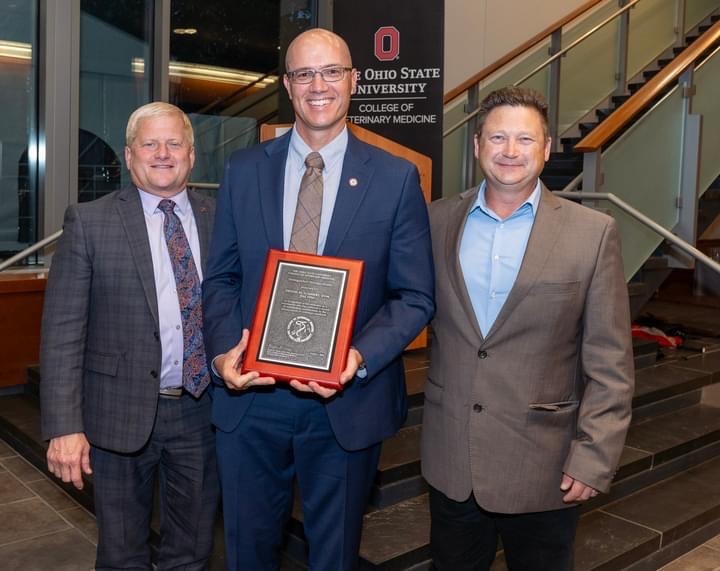
During Homecoming weekend at The Ohio State University, State Veterinarian Dr. Dennis Summers was one of the recipients of the 2023 Distinguished Alumni Award from The Ohio State University College of Veterinary Medicine.
Congrats Dr. Summers!
 |
|
Highly Pathogenic Avian Influenza (HPAI) cases are still being detected in commercial and backyard flocks in Ohio and throughout the country. ODA, USDA, and the Ohio Poultry Association continue to push out the message and importance of good biosecurity. The ODA website has many great resources on biosecurity as well as a list of the cases that have occurred in Ohio.
If you have sick or dying poultry call ODA at 614-728-6220.
|
Rabbit Hemorrhagic Disease Virus
Dr. Jessica Scelba, Field Veterinarian with USDA APHIS VS
USDA’s Center for Veterinary Biologics (CVB) has approved an Emergency Use Authorization (EUA) for a US-developed Rabbit Hemorrhagic Disease Virus serotype 2 (RHDV2) vaccine. The conditional license was approved for a year and will expire October 31, 2024.
RHDV2 is a highly contagious foreign animal disease with a high mortality rate, that affects both domestic and wild rabbits. Clinical signs include fever and sudden death, with signs of hemorrhage. This is a hardy virus that spreads through direct contact, infected secretions, contaminated materials, and blood.
If you are interested in vaccination against RHDV, contact your local veterinarian. Rabbit owners and veterinarians can call their local USDA APHIS Veterinary Services office for assistance with suspected cases of RHDV2.
For more information on RHDV2 in the United States, please visit the USDA APHIS VS Animal Health Risk Identification website.
The Ohio Department of Agriculture’s (ODA) State
Veterinarian’s Office has been made aware of a canine
respiratory disease being reported over the past several
months. As this incident continues to evolve across the
United States, ODA continues to monitor and gather
information from neighboring states and our animal
health officials and partners. Currently in Ohio, these
cases are not reportable to the state veterinarian.
The department’s Animal Disease Diagnostic Laboratory
(ADDL) provides diagnostic testing to private veterinary
practitioners. To date, no cause of infection has been
confirmed related to the disease.
For more information, please see this FAQ document on the ODA website
|