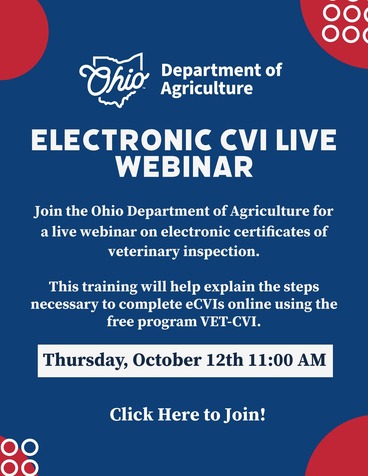
Beginning January 1, 2024, ODA Animal Health will limit orders for paper CVI booklets.
Questions? Please join our webinar on October 12th for more information
Dr. Angela Rospert, Field Veterinary Medical Officer
CVIs (Certificate of Veterinary Inspection) or health certificates, are official documents signed by accredited veterinarians, typically written for animals going to shows/exhibitions or to accompany them for a movement out-of-state. CVIs are legal documents that attest to the fact that the animal or animals have been inspected by a licensed veterinarian and are found to be free of infectious or contagious diseases. This ensures we are not spreading diseases and provides information of specific animal movements for animal traceability.
CVIs are available in two different formats, paper and electronic. Paper CVI booklets are available in a limited number for purchase from the Department of Agriculture. There are a variety of electronic CVI (or eCVI) software programs available including Global Vet Link, VET CVI, Vet Sentry, VSPS, and others. Several of these programs do incur some sort of cost (subscription or fee per CVI submitted) but some are free to users.
There are many benefits to eCVIs over the paper forms including:
- eCVIs are more efficient and can save time
- Most of the programs automatically submit the CVI to the Department
- eCVIs are easier to read than paper forms, which leads to faster processing
- eCVIs are critical in assisting State Animal Health Officials in tracking livestock movements in and out of states, reducing the producer and economic impacts in an animal disease event
- eCVIs are easier to search and locate specific certificates, which leads to faster and more efficient tracing of animals in a disease event, which lessens the impact of producers
- Storage of these documents can be done electronically, reducing office space for paper documents
- Sharing of information is faster and more efficient between all parties
VET CVI is an eCVI program that can be used to create both small and large animal eCVIs and is free for users. The app can be downloaded to any Android, IOS or Windows device. VET CVI also offers the capability to create TB and Brucellosis charts. For more information contact ODA. There are also resources including instructions for signing up for VET CVI and step-by-step videos for filling out a CVI on VET CVI on Kansas Dept of Agriculture Division of Animal Health website: Electronic Interstate CVI (ks.gov)
We hope you will join us for our upcoming webinar on VET CVI on October 12th.
RFID Technology
Dr. Cynthia Wise, Field Veterinary Medical Officer
|
Electronic identification tags are becoming more and more common across livestock species. This year, numerous county fairs and the Ohio State Fair utilized electronic ID to track and manage their market exhibition animals. Livestock exhibitors also reported that national shows such as the North American International Livestock Expo and World Dairy Expo promote or specifically require the use of official electronic IDs. This trend coincides with a proposed USDA rule change that is in the final stages of being processed and if finalized would require official ear tags for cattle and bison to have both a visual and electronic component to it. (Unless meeting specific exemptions, official ID is required for the interstate movement of cattle and bison.)
Advantages
RFID eartags offer the advantage of accurate and rapid identification. When integrated into producer’s recordkeeping system, RFID tags can aid with a variety of management tasks from tracking health treatments and breeding information to recording and tracking weights and production data. In the context of a disease outbreak scenario, RFID technology has the potential to facilitate faster and more accurate identification and tracking of infected and exposed animals.
Types of RFIDs
RFID tags can be categorized by the radio frequency range they use to communicate. Low frequency (LF) tags are most common. They can be read through interference from tissue, dirt, and water, but are limited to a distance 1 to 1.5 feet. Ultra-high frequency (UHF) tags can be read faster and across greater distances of up to 20 feet, requiring less restraint and handling. Some tag manufacturers offer dual LF/UHF frequency tags. Microchips are injectable low frequency RFID transponders. While less commonly used in livestock, some microchips for horses and captive deer/elk have additional capabilities such as built-in biosensors to allow safe and quick temperature measurements.
Official vs non-official RFIDs
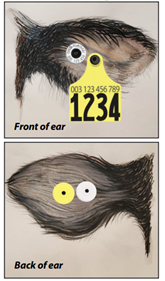
Official USDA-compliant RFID eartags are stamped with the US Shield logo and have a unique 15-digit number stored within and printed on the tag. Official eartags and microchips start with the three-digit country code 840 and are available to veterinarians and producers with a registered USDA Premises ID. Ideally these tags should be placed at the farm of origin by the producer or veterinarian. (Note: Visual 840 tags do not contain RFID and these tags should not be used in situations requiring RFID such as international live animal export.)
How to obtain RFID tags or borrow RFID readers
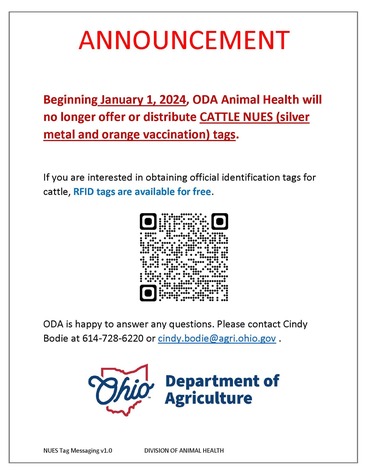
Free low frequency cattle RFID eartags are available for Ohio accredited veterinarians and cattle producers. A premises Identification Number (PIN) is required, which can be applied for through the ODA website (https://agri.ohio.gov/divisions/animal-health/animal+id/premise-registration-form-fillable). Additionally ODA has RFID wand readers available to loan to registered producers or veterinarians.
To request these tags or a reader loan, contact ODA at animal@agri.ohio.gov or call 614-728-6220.
 Staff Updates
John McIntyre, Animal Health Inspector

John McIntyre is from Yale, Michigan. He moved to North Central Ohio in 2017 to work for the Ohio Department of Agriculture as an inspector in the Division of Meat Inspection. Prior to coming to Ohio, John worked for a meat processing facility in Michigan. He enjoys being actively involved within the agriculture industry. John and his wife, Katie, raise livestock on their small family farm and welcomed their first child in June. In John’s free time he enjoys hunting, watching sports, and managing his farm. John is looking forward to using his agricultural experience to better serve the Division of Animal Health. John joined the Animal Health division in April.
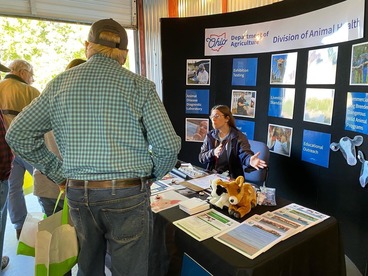
Outreach at Farm Science Review
Animal Health staff was able to give away 1,000 free RFID tags to cattle producers at this year's event.
Tony Forshey Summer Internship Program (TFSIP)
This past summer, the Division of Animal Health hosted its first veterinary intern as a part of the Dr. Tony Forshey Summer Internship Program. Named after previous State Veterinarian Dr. Tony Forshey, the internship involves spending time in 4 areas of regulatory medicine: the Animal Disease Diagnostic Lab, the Division of Meat Inspection Field Operations, the Division of Animal Health Field Operations, and the Division of Animal Health Administration.
This program will be offered again in the summer of 2024 and the application is now available! This is a 10-week paid summer internship. If you know a current veterinary student who might be interested in this opportunity, please reach out to kristy.shaw@agri.ohio.gov with questions.
Applications are due January 1, 2024 to HR@agri.ohio.gov.
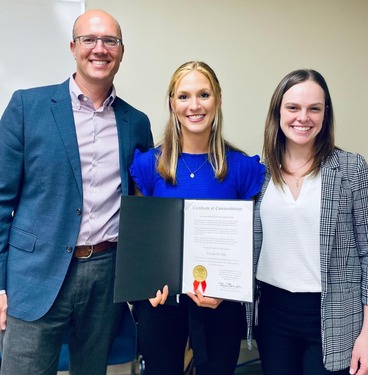
Pictured is Elizabeth Ohl, the TFSIP recipient from 2023, who is a second-year veterinary student at The Ohio State University. Also pictured is Dr. Dennis Summers, State Veterinarian, and Dr. Kristy Shaw, Assistant State Veterinarian.
Dr. Liane Davila-Martin, AH Epidemiologist
During the hunting season, hunters are able to submit their deer heads/samples to ODA for Chronic Wasting Disease (CWD) testing. One of the tests that is used is called ELISA and it is available at ADDL.
What is ELISA? ELISA stands for “Enzyme-linked Immunosorbent Assay” which tests for the presence of infectious prions. ELISA is also approved to test a vast amount of different infectious diseases.
ELISA testing has some additional advantages, when compared with Immunohistochemistry (IHC), such as a faster turn-around time (up to 14 days) and cost. An ELISA test is $30 for test + $8 accession fee + disposal fee.
What specimen(s) to submit? Fresh retropharyngeal lymph nodes and obex. Alternatively, the entire head can be submitted and our pathology section will collect the appropriate samples.
What are the submission requirements?
- Submit specimen(s) with an ice pack in a leak-proof insulated cooler on ice packs
- Ship/submit within 24 hours from sample collection
- Complete CWD ADDL sample submission form
Call 614-728-6220 or e-mail submissions@agri.ohio.gov if you plan on dropping specimens. The deer head must be shipped/submitted within 24 hours from when the deer was harvested.
Samples can be submitted/shipped to:
Ohio Department of Agriculture
Animal Disease Diagnostic Laboratory
8995 East Main Street, Building 6
Reynoldsburg, OH 43068-3399
Hours of operation: 8:00am – 5:00pm, Monday through Friday.
Field Training and Exercise
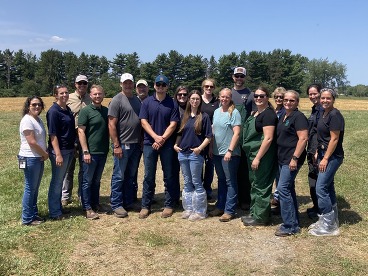
In July, Animal Health staff participated in a foaming trial with The Ohio State University Animal Science and Preventative Medicine professors.
Dr. Kristy Shaw, Assistant State Veterinarian
All veterinarians and producers should be aware that there are certain diseases in animals that rise to the concern of regulatory oversight. This could be because the disease is highly contagious and infectious, it has a public health/food safety concern, or the disease itself (if diagnosed) would have a detrimental impact on the respective animal commodity groups or industry (cattle, swine, poultry, etc). These are commonly referred to as reportable animal diseases (and a subset of those are considered foreign animal diseases). The list of Ohio’s reportable animal diseases can be found in Ohio Administrative Code (Rule 901:1-21-02 - Ohio Administrative Code | Ohio Laws) and include diseases such as African Swine Fever, Highly Pathogenic Avian Influenza, Scrapie, and Brucellosis.
The USDA has a list of notifiable diseases as well. Some of those overlap with the reportable diseases in Ohio. National List of Reportable Animal Diseases (usda.gov)
As a veterinarian, if you see a patient that has clinical signs that are of concern and raise alarm for a reportable disease, call the ODA Division of Animal Health at 614-728-6220 and ask to speak to the State Veterinarian or Assistant State Veterinarian. We can answer questions you may have and decide if ODA wants to take further action. ODA may either have you as the veterinarian collect and submit samples to the lab, or one of our field staff will assist and come take samples of the animal(s).
All samples should be sent to ODA’s Animal Disease Diagnostic Laboratory (ADDL). ADDL is located in Reynoldsburg at the Ohio Department of Agriculture main campus and also houses the Animal Health administrative offices. ADDL can test for a variety of regulatory and non-regulatory diseases. (Welcome to the Animal Disease Diagnostic Laboratory | Ohio Department of Agriculture) Samples sent to ADDL should be done under the guidance of a veterinarian.
If the test comes back positive for a reportable disease (like Highly Pathogenic Avian Influenza), then ODA’s Animal Health staff will work with USDA APHIS Veterinary Services as well as the referring veterinarian on the procedures that follow (which may include a quarantine, site visit, and additional measures).
There are diseases that can mimic or have some of the same clinical signs as reportable or foreign animal diseases but turn out to be something else non-regulatory. For example, poultry could have Infectious Coryza, but it looks like Highly Pathogenic Avian Influenza. If the test comes back as “not detected” or “negative” for some of those diseases of concern, then it will be up to the referring veterinarian to decide on appropriate follow up and additional non-regulatory tests that may be required to identify the problem or disease. Our animal health staff veterinarians are not private practitioners and cannot give medical advice on treatments for non-regulatory diseases.
For any additional questions reach out to our office!

Equine Herpes Virus (EHV-1) and EHM
Dr. Josh Bukoski, former field Veterinary Medical Officer
|
With fall here, horse owners should be looking for signs of a common but potentially worrisome virus. Equine herpes virus (EHV) is a virus found worldwide and most commonly affects young horses in fall and winter months. Although EHV has an increased prevalence in fall, horses can be exposed at any time, especially when co-mingled for shows or fairs.
There are multiple strains of EHV which present as various forms of disease including respiratory disease, abortions, and neurologic disease. One strain of EHV that is particularly important to the horse industry is EHV-1. This strain of EHV most commonly causes respiratory disease but is also associated with a neurologic disease called Equine Herpesvirus Myeloencephalopathy (EHM). Initial signs of EHV-1 include fever, nasal discharge, and cough. Many horses continue to recover from these signs, but others can develop signs of neurologic disease consistent with EHM. Horses with EHM can have mild to severe signs of neurologic disease including incoordination, urine dribbling, a head tilt, and inability to stand. Unfortunately, treatment of these horses is only supportive and carries a guarded prognosis in severe cases.
There are multiple ways to prevent horses from being exposed to EHV. The most common route of transmission for the virus is through exposure of respiratory secretions. The virus can also spread through contaminated objects such as shared buckets, halters, and clothing worn by people working with infected horses. If a horse is diagnosed with EHV, it is important to follow thorough biosecurity practices. These include isolating the horse away from other horses, using separate equipment, and changing clothing after working with the positive horse. Vaccines for EHV are also available but are unfortunately not labeled to prevent EHM.
If an owner notices their horse has developed symptoms of respiratory, reproductive, or neurologic disease, they should work with their veterinarian to develop a plan for testing and treatment. This is especially important if the horse has been exposed to new horses or traveled with the past 2 to 3 weeks. If a horse is ultimately diagnosed with EHM, a veterinarian from ODA will contact the owner and their veterinarian to develop a plan to prevent further spread of the virus.
|