Detection of Canine Herpesvirus (CHV) by real-time PCR now offered at Ohio ADDL
Qirui Zhang, Laboratory Scientist 3, Molecular Diagnostics
The Canine Infectious Respiratory Disease Complex (CIRDC), also referred to as kennel cough or canine cough, is caused by several different bacteria and viruses. One of these viruses is canine herpesvirus (CHV) of the alphaherpesvirinae subfamily, which also contains equine herpesvirus 1 (EHV-1) and bovine herpesvirus1 (BHV-1) among many other herpesvirus of veterinary significance. CHV is widespread and causes fatal hemorrhagic disease in neonatal puppies. Adult dogs infected with CHV normally do not show any clinical signs, however infection of susceptible puppies at 1–2 weeks of age can lead to a generalized necrotizing, hemorrhagic disease. Diagnosis of the disease in puppies is best accomplished by necropsy with confirmation tests by antibody/antigen testing or nucleic acid testing. The necropsy findings normally include hemorrhages in the kidneys, liver, lungs, and gastrointestinal tract.
ADDL now offers a fast real-time PCR for CHV nucleic acid detection from canine samples. The test targets a 136-bp region of the CHV glycoprotein B gene in the CHV genome. It has high sensitivity and can detect as little as 2 copies of CHV DNA in samples. Appropriate specimens for testing include: nasal swab, tracheal swab, conjunctival swab, vaginal swab, lung, kidney, spleen, liver, brain, and other affected tissues. Samples should be kept frozen or refrigerated until tested. The fee for CHV PCR testing is $36 per test. Please visit our laboratory website or call the laboratory at 614-728-6220 with any questions.
References:
1) DeCaro N, Amorisco F, Desario C, Lorusso E, Camero M, Bellacicco AL, Sciarretta R, Lucente MS, Martella V, Buonavoglia C. Development and validation of a real-time PCR assay for specific and sensitive detection of canid herpesvirus 1. J Virol Methods. 2010 Oct;169(1):176-80.
2) Miyoshi M, Ishii Y, Takiguchi M, Takada A, Yasuda J, Hashimoto A, Okazaki K, Kida H. Detection of canine herpesvirus DNA in the ganglionic neurons and the lymph node lymphocytes of latently infected dogs. J Vet Med Sci. 1999 Apr;61(4):375-9.
Meet the Section: Pathology
Rachel Amos, BS., RVT., Veterinary Pathology Assistant
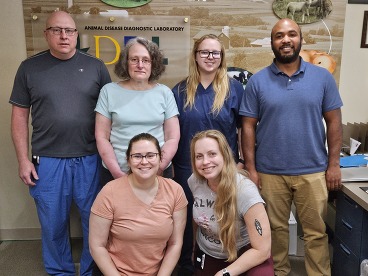 Front Row (L-R): Rachel Amos and Annie Rorick. Back Row (L-R): Scott Fox, Dr. Alice Roudabush, Megan McGrath, and Dr. Ryan Yanez. Not Pictured: Dr. David Newman
The pathology section is primarily responsible for performing necropsies, post-mortem examinations on non-human animals, in addition to recommending ancillary testing for general diagnosis, surveillance, and prevention. The pathology section also includes the histology laboratory, whose primary responsibility is preparing various tissues for microscopic examination.
Pathology is spearheaded by Section Head Ryan Yanez, DVM, DACVP, and veterinary pathologists, David Newman, DVM, and Alice Roudabush, DVM, DACVP. Support staff includes two veterinary pathology assistants, Rachel Amos, BS, RVT, and Megan McGrath, RVT, and two histology technicians, Scott Fox, QIHC, and Annie Rorick, HTL.
In addition to performing diagnostics, the section also hosts veterinary and veterinary technician students for internships throughout the year. So far this year, pathology has hosted six veterinary students and two veterinary technician students for rotations and internships, with more students scheduled for the upcoming academic year.
If you are a student interested in a rotation or internship in the ADDL’s pathology section, please contact Rachel Amos (rachel.amos@agri.ohio.gov). In 2022, necropsies and biopsies were performed on various animals from different taxonomies including avian, bovine, camelid, canine, caprine, equine, feline, ovine, porcine, and a variety of other wild and exotic animals.
Ohio outbreak update: Infectious Coryza
Emily Janovyak, DVM, USDA ORISE Fellow
In 2023, Ohio and surrounding states have seen higher than normal numbers of Infectious Coryza (IC) cases. While it appears that outbreak-related testing peaked in May and June, the ADDL continues to support the poultry industry with same-day IC PCR results as long as samples are in the laboratory by 10:30 a.m.
IC is a respiratory disease primarily affecting chickens, though other species can be infected. The disease typically affects older birds and is often seen in backyard flocks where birds of multiple ages are housed together. IC is caused by the bacterium Avibacterium paragallinarum and although the bacteria cannot survive outside the host animal for more than a few days, it is introduced into flocks by chronically ill or asymptomatic carriers and spreads rapidly between birds. It may also be spread by contact with contaminated equipment, feed and water. Clinical signs appear within a few days of exposure and include facial swelling, sneezing and conjunctivitis. This disease can mimic the clinical signs of Highly Pathogenic Avian Influenza (HPAI).
Prevention consists of good biosecurity and flock management practices. If you have the misfortune to have IC in your flock, the surest method of elimination is to depopulate the flock and follow with thorough cleaning and disinfection of your facilities. Treatment is possible for affected birds, though recovered birds may become lifelong carriers and perpetuate infection within the flock. There are vaccines against IC - consult with your veterinarian for information about vaccinating your flock.
Preferred sample types for PCR consist of swabs (tracheal/sinus/air sacs) or tissues (tracheal/lung tissue). Testing is performed M-F. Consult with your veterinarian and call the lab with any questions (614-728-6220). If you wish to submit a sample for bacterial culture, please contact the lab prior to sampling and shipping to ensure you follow optimal sample collection methods as Avibacterium paragallinarium is notoriously difficult to grow in laboratory conditions. The laboratory can also perform whole genome sequencing to characterize the isolate (serotype, virulence genes, antimicrobial resistance genotype, etc.)
IC is not a reportable disease but state animal health officials appreciate notifications of positive cases as sharing outbreak information can help to advise and protect Ohio’s poultry populations.
 NVSL NAHLN African Swine Fever Laboratory Preparedness Workshop
Ryan Yanez, DVM, DACVP, Pathology and Histology Section Head
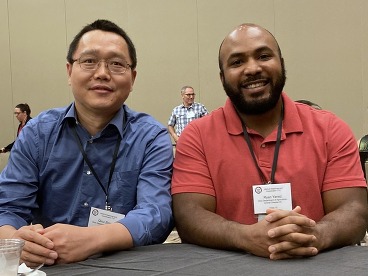
In June 2023, NAHLN (National Animal Health Laboratory Network) and NVSL (National Veterinary Services Laboratory) provided funding for all accredited NAHLN laboratories to send representatives to Manhattan, Kansas for an African Swine Fever preparedness workshop. The ADDL sent Ryan Yanez, DVM, DACVP, and Qirui Zhang, PhD, to represent the state of Ohio.
Thirty-seven states were in attendance and all attendees took part in a weeklong workshop alongside members of USDA Animal and Plant Health Inspection Service, Veterinary Services (APHIS VS), NVSL, NAHLN, Plum Island Animal Disease Center (PIADC) and National Bio and Agro-Defense Facility (NBAF).
Representatives collaborated and participated in exercises, attended lectures, and discussed a variety of topics such as surge testing strategies, prolonged high tempo operations, lab readiness and inter-laboratory support. Attendees were also allowed to tour the NBAF, a state-of-the-art facility that will protect the nation’s agriculture and citizens against serious animal and zoonotic diseases. NBAF will replace the PIADC in the coming years.
Enhancing Quality
Kerri Lawrence, BA, ADDL Quality Assurance Manager
Quality management systems are the backbone of laboratory operations, essential for ensuring the accuracy and reliability of results. In August, Dominika Jurkovic, PhD, and Kerri Lawrence attended the NAHLN/AAVLD Quality Management System Training at the National Centers for Animal Health in Ames, Iowa.
The training was comprised of foundational and advanced courses, equipping participants with knowledge and skills to uphold rigorous accreditation standards and improving quality management systems. NAHLN laboratories like the ADDL play a pivotal role in disease surveillance, outbreak detection, and rapid response. Their ability to provide accurate and reliable testing services directly impacts animal health and public safety. By participating in this training, the ADDL reaffirms its commitment to maintaining the highest standards of quality in laboratory operations.

Ohio ADDL earns LAAF Accreditation for Salmonella Enteritidis Egg Testing
Dominika Jurkovic, PhD, Central Receiving Section Head
In 2021, the Food and Drug Administration (FDA) proposed the final rule on Laboratory Accreditation for Analyses of Food (LAAF) as part of the Food Safety Moderinzation Act. LAAF is required by existing FDA food safety regulations, such as the FDA Egg Safety Final Rule, to improve the accuracy and reliability of food testing through the uniformity of standards established by the FDA. In 2021, ADDL added Egg Testing for Salmonella Enteritidis (SE) to the laboratory's ISO 17025 scope in anticipation of the LAAF rule. The ADDL was approved for continued ISO 17025 accreditation from the American Association for Laboratory Accreditation (A2LA) through July 2025 and is now an LAAF-accredited laboratory for egg testing.
As of a result of this accreditation, all submissions of eggs for SE testing at ADDL must now include:
- Written sampling plan for collection of eggs
- Written documentation of the samplers' qualifications
Effective September 1, 2023, eggs submitted to ADDL for SE testing must be accompanied by the Salmonella Enteritidis Egg Testing Submission Form. Completing this form fulfills the written sampling plan mentioned above. Producers must also submit written documentation of the sampler's qualifications that can be stored in our laboratory information system (LIMS) for future submissions.
For questions on the new submission process, including training documentation, please contact Dominika Jurkovic (dominika.jurkovic@agri.ohio.gov) or Kerri Lawrence (Kerri.Lawrence@agri.ohio.gov). For questions on egg testing, please contact Bacteriology Section Head, Dr. Jing Cui (Jing.Cui@agri.ohio.gov).
|
Columbus Day Lab Closure
Ohio ADDL will be closed on Monday, October 9th in observance of Columbus Day.
If you need to contact us regarding an urgent matter, please use our after hours phone number: (888) 456-3405.
|