Influenza A Virus in Swine: Update
Jonah Perkins, MPH, Virology Laboratory Scientist
Influenza A virus (IAV) is a common cause of respiratory illness in swine, humans, other mammals and birds. IAV continues to be a concern for both the swine and poultry industries and public health. Swine IAV infections, also referred to as ‘swine flu’ or ‘SIV’, are endemic in the US causing respiratory illness year-round, with an increase in cases occurring in the spring and fall. The ADDL uses a polymerase chain reaction (PCR) test to identify SIV infections, followed by additional PCR tests to determine the hemagglutinin (HA) and neuraminidase (NA) subtype. The ADDL also offers whole genome sequencing (WGS) for IAV, which generates the genetic code for all 8 segments of the IAV genome. WGS can provide information on the source of infections, chains of transmission between farms, new variants of the virus and transmission events between humans and swine.
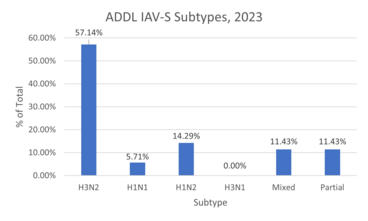 Frequency of SIV subtypes detected at the ADDL in 2023, as of 5/19/2023. ‘Partial’ refers to isolates where only the HA or NA subtype was able to be determined.
The most common IAV subtypes in swine are H3N2, H1N1 and H1N2. In the past four years, all three of these subtypes have been detected in samples submitted to the ADDL. Occasionally, animals can be infected with more than one subtype at the same time, referred to as a ‘mixed’ infection. The graph above shows the frequency (represented as the percentage of total isolates subtyped) of each IAV subtype detected in swine samples at the ADDL and, in the graph below, in cases submitted to the Swine Disease Reporting System (SDRS), a collaborative program with veterinary diagnostic labs in Iowa, Minnesota, South Dakota, Kansas and Ohio.
 Frequency of SIV subtypes reported to SDRS in 2023, as of 5/19/2023. ‘Partial’ refers to isolates where only the HA or NA subtype was able to be determined. Data retrieved from Swine Disease Detection Dashboards • Field Epidemiology • Iowa State University (iastate.edu)

Highly Pathogenic Avian Influenza Update
HPAI remains a concern throughout the United States. Whether you suspect HPAI or wish to complete surveillance testing of your flock, the ADDL can help you develop a plan for testing. Visit our HPAI Resource Page for information on sample collection, submission paperwork and how to ship your samples.
IF YOU SUSPECT HPAI, PLEASE CALL ANIMAL HEALTH AT 614-728-6220.
|
Meet the Section: Virology
Ashley Johnson, M.S., Molecular Diagnostics Section Head
The Virology Section is responsible for diagnostics, surveillance and import/export testing of viral pathogens other agents of disease. The top 3 tests completed by Virology are serum neutralization, virus isolation and Brucella canis IFA. The Virology Section contributes to the USDA Swine Influenza Surveillance program, submitting isolates to the repository and has recently added Chronic Wasting Disease (CWD) ELISA, heartworm ELISA and electron microscopy to their testing repertoire. The section is led by Ashley Johnson and is comprised of 7 laboratory personnel: Ashley Johnson (Recently promoted from Virology Researcher to Molecular Diagnostics Section Head), Sandy Blackford (LS2), Melissa Bernhardt (LS2), Jonah Perkins (LS2), René Smith (LS2), Chris Woltjen (LS1) and Matt Gullifer (LT2), with the last three individuals being the newest additions to the Virology team.
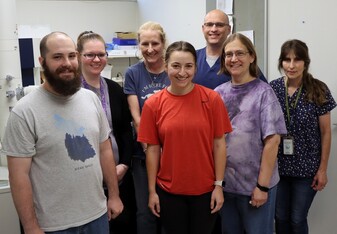
Front Row: J. Perkins, M. Bernhardt, R. Smith, and S. Blackford. Back Row: A. Johnson, C. Woltjen, and M. Gullifer
René Smith joined the ADDL in August 2022 as the Laboratory Scientist 2 for CWD ELISA testing. She received her B.S. in Microbiology from The Ohio State University and has been working at Nationwide Children’s Hospital in Clinical Microbiology and Immunoserology for 12 years. René is married with 5 adult children and 2 foster brothers and considers the ADDL staff to be her second family after coworkers provided life-saving measures to her in March of this year.
Matt Gullifer started with the ADDL in September 2022 as the Laboratory Technician 2 for CWD ELISA testing. He received his B.S. in Biology from Ohio Dominican University and previously worked at The Ohio State University in a cytology prep laboratory for almost 3 years. Matt is married with 1 daughter, who is starting college at the University of Dayton in the fall majoring in Mechanical Engineering.
Chris Woltjen recently joined the ADDL from the ATL as a Laboratory Scientist 1. She received her B.S. (Plant Health Management with a minor in horticulture) and M.S. (Plant Pathology) in Agriculture from The Ohio State University. Chris loves animals and is a huge rock music fan. Her menagerie consists of 3 Siberian Huskies, 2 porch cats, 3 Pygmy goats, 3 Babydoll sheep, 1 hen, 1 guinea cock, 1 cockerel and 7 baby chicks. She is excited to be a part of the Virology Section and have the opportunity to learn more about animal health and diseases.
Emerging Zoonotic Disease - Transmissible Sporotrichosis in Cats
Jing Cui, DVM, Bacteriology Section Head
Emily Janovyak, DVM, USDA ORISE Fellow
In the March Zoonoses & One Health Updates (ZOHU) call, Dr. Ian Hennessee, Epidemic Intelligence Service Officer in the Mycotic Diseases Branch at the Centers for Disease Control and Prevention (CDC), issued a warning about the spread of cat-transmitted sporotrichosis. Dr. Hennessee encouraged veterinarians to notify their local health departments about any suspect cases or unusual sporotrichosis trends.
Sporotrichosis is an infection caused by a group of dimorphic fungi from the genus Sporothrix, including S. schenckii (US) and S. brasiliensis (Brazil and neighboring countries). Fungal spores are widely dispersed in the environment, particularly in tropical and subtropical regions. In humans, Sporotrichosis was traditionally known as “rose gardener’s disease” because contact with plant matter was the most common transmission route. It has been reported in humans, cats, and other mammals. In all species, it classically it presents as cutaneous or lymphocutaneous ulcerated lesions. In humans, skin on the hands or arms is most often affected, and the disease may progress to a disseminated form-especially in the context of immunosuppression- and may manifest as osteoarticular, conjunctival, pulmonary, or neurological disease. Cats can also become infected through wounds or scratches contaminated with the fungi, and infection typically manifests as small ulcerating wounds on the nose, ears, or paws, which may be slow to heal and can worsen over time. Other symptoms may include swollen lymph nodes, respiratory difficulties, and fever.
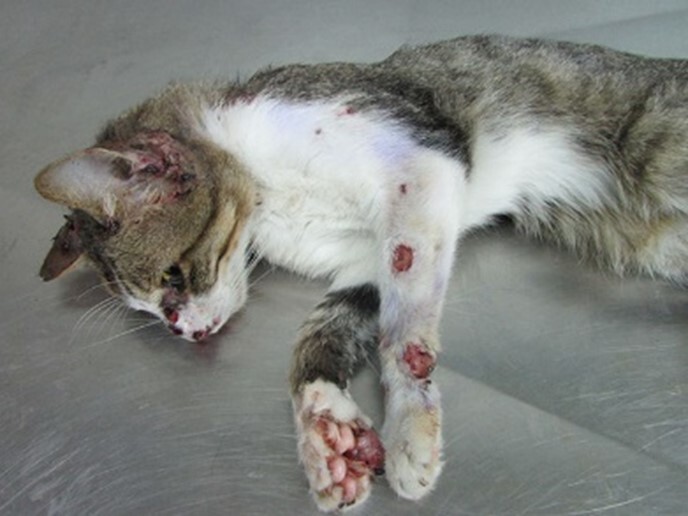 Multiple skin lesions on the cephalic region. Ascending nodular lymphangitis on the left forelimb and tumor-like lesion on the upright paw. Rossow et al., J Fungi 2020 6(4), 247
Diagnosis of sporotrichosis in cats involves tests such as fungal cultures or microscopic examination of skin samples, with adjunctive histology and panfungal PCR. Once diagnosed, treatment involves a prolonged course of itraconazole and potassium iodide medications administered orally or through topical applications. Regular cleaning and disinfection of the affected areas are crucial to prevent further spread of the infection.
Cat-transmitted sporotrichosis (CTS) emerged as a zoonotic epidemic and public health threat in Brazil in the 1990s and is associated almost exclusively with the more virulent S. brasiliensis. The recent publication The first three reported cases of Sporothrix brasiliensis cat-transmitted sporotrichosis outside South America (Medical Mycology Case Reports 39 (2023) 14–17) raises concern for the United States, considered alongside anecdotal reports of increasing feline and cat-transmitted sporotrichosis cases in this country. However, currently, S. brasiliensis has not yet been detected in the US. Dr. Hennessee urged that a “One Health” approach is needed for controlling cat-transmitted sporotrichosis combining the efforts of veterinarians, clinicians, microbiologists, and border health officials. It is essential to work with public health agencies to improve awareness amongst those owning or treating cats from endemic areas to detect signs and symptoms of feline sporotrichosis, obtain early diagnosis and proper treatment, and to prevent zoonotic transmission.
Salmonella Pullorum Tube Agglutination Test Returns to the ADDL
Ali Gibson RVT, Avian Serology Laboratory Scientist
Pullorum disease, also known as bacillary white diarrhea, is a bacterial disease caused by Salmonella enterica subspecies enterica serovar Gallinarium biovar Pullorum and is a reportable disease known to poultry. Symptoms of pullorum can include white diarrhea, fecal pasting around the vent, lethargy, weakness, anorexia, and huddling near a heat source, and high mortality in young chicken pullets and turkey poults. Classic lesions upon necropsy include grey nodules in the liver, spleen, lungs, heart, gizzard, and intestines. At the ADDL, serological testing is initially used to detect potentially positive birds - with isolation, identification, and serotyping of the actual organism being essential to confirm the infection.
Manufacturing issues had prevented access to reagents for the S. Pullorum tube test for about a year. This affected only turkey serum submissions and these samples were tested using the S. Pullorum plate agglutination method as the alternative test. After many months of the Avian Serology Section working to find a solution, a new reagent supplier emerged - allowing the S. Pullorum tube test to be brought back online as a test offering at the ADDL in January of 2023.
To test for S. Pullorum at the ADDL, please submit 0.5 mL of serum per bird with an ice pack and a completed Poultry Sample Submission Form.
NOTE: S. Pullorum is a reportable disease. If you suspect your flock has this disease, please contact the ADDL.
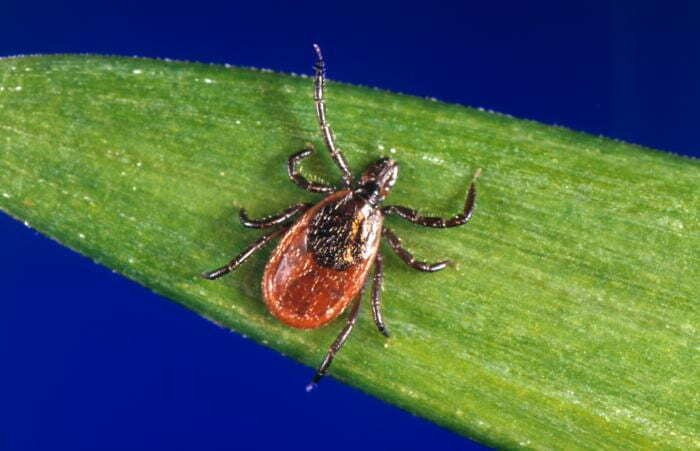 'I come to Suck Your Blood'...Understanding Tick Bites and Prevention
Emily Janovyak, DVM, USDA ORISE Fellow
Spring! With the much-anticipated warm weather and increased sunlight comes the much-dreaded increase in ticks and tickborne diseases. These diseases pose a threat to our livestock, horses, pets and to us humans. Some diseases are specific to one host species whereas others, like Borrelia burgdorferi, the pathogen causing Lyme disease, can infect humans, livestock, and pets alike. Different tick species harbor different diseases and just because a tick has the potential to carry a disease, does not mean every tick is a carrier. Disease risk cannot be determined by examining the tick, sometimes not even with laboratory tests.
The best defense is to identify the tick and know what pathogens it may carry. There are many resources available to help you identify ticks (see below) and assess disease risks to you and your animals. In Ohio, three tick species are considered most important for disease transmission: 1. Blacklegged Tick (Ixodes scapularis) that can carry pathogens that cause Lyme disease, anaplasmosis, babesiosis, and Powassan virus. 2. American Dog Tick (Dermacentor variablilis), possible vectors of tularemia and Rocky Mountain Spotted Fever. 3. Lone Star Tick (Amblyomma americanum) which may carry the pathogens responsible for tularemia, ehrlichiosis, and Alpha-gal syndrome.
At the ADDL we offer several tests for specific pathogens carried by ticks.
- Virology offers a Canine Tick IFA Panel for antibodies against Anaplasma, Ehrlichia and Borrelia as well as individual tests for these pathogens.
- Serology offers an ELISA test for Anaplasma centrale/marginale/ovis.
- Molecular diagnostics offers a PCR test for Anaplasma marginale and Theileria orientalis
Consult our test catalog for shipping requirements and test days. For more specific questions, please call the ADDL to determine how best we can help you to make a diagnosis. For additional information regarding ticks and tick diseases the following resources are available: Tick Season in Ohio, The Companion Animal Parasite Council, Ohio Department of Health: Tickborne Diseases in Ohio, and Ohio State University: Ticks and Tick Diseases.
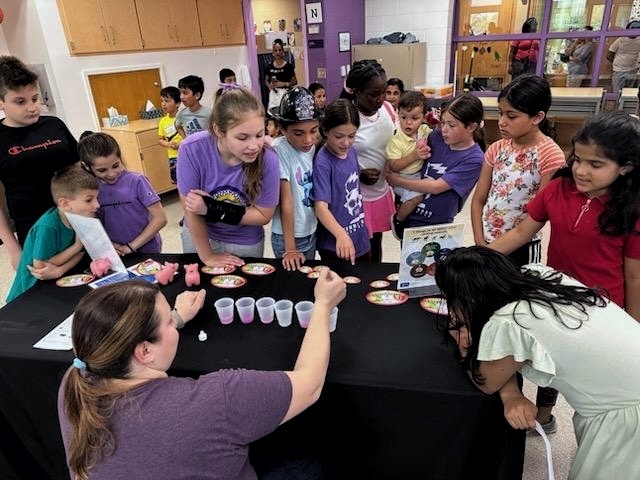 ADDL at STEM Night
Dominika Jurkovic, Ph.D., Central Receiving Section Head
In May, the ADDL participated in Family STEM (Science, technology, engineering and mathematics) Night at Summit Road Elementary School in Reynoldsburg. More than 30 organizations presented STEM activities to students and their families. Melanie Prarat Koscielny (Laboratory Operations Manager) and Dominika Jurkovic (Central Receiving Section Head) presented Become a "Swientist." In this activity, students tracked how a virus moves through a population to discover how scientists and veterinarians work together to stop the spread of disease.
Upcoming Holidays
Ohio ADDL will be closed on Monday, June 19th in observance of Juneteenth and Tuesday, July 4th in observance of Independence Day. Normal business hours will resume on Tuesday, June 20th and Wednesday, July 5th, respectively.
If you need to contact us regarding an urgent matter, please use our after hours phone number: (888) 456-3405.
|