|
Local artist Ron Anderson spoke to the Justices and Court staff last week in recognition of Black History Month.
Six of Anderson's oil paintings, commissioned by the Ohio State Bar Association, are part of the permanent art collection at the Thomas J. Moyer Ohio Judicial Center.
|
|
 |
Anderson's pieces, titled "The History of the Rule of Law," are on display on the 11th Floor in the Law Library Gallery.
"My heart goes out to a lot of these pieces because there's a lot of labor that went into them," Anderson said.
Anderson said he worked closely with the late Chief Justice Thomas J. Moyer and said he paid tribute to him by putting the Chief's image in one of his paintings.
"That was fun to work with him. We decided to put him in the painting, and he's in there permanently looking at you guys," Anderson said to his audience.
"Anderson currently teaches fashion design at Columbus College of Art and Design. He continues to paint professionally.
The 2012 Martin Luther King Jr. Youth Oratorical Contest winner of the junior division, seventh-grader Assata Gilmore, also spoke.
Gilmore, dressed in chef's attire, gave her winning speech about marble cake and the need for remembrance, celebration and action to continue integration in Ohio and across the country. She will represent Columbus at the state Martin Luther King Jr. oratorical competition.
 |
|
The Week 6 biggest Losers are ...
Congratulations to Kimberly Hamiter, deputy clerk, and Rick Stout, maintenance mechanic, who were the "Biggest Losers" in week 6 of the Court's Biggest Loser Wellness challenge. Stout has won the Wellness Cup for three consecutive weeks.
|
Ohio's Oldest Retired Judge Knows Age has No Boundaries
Judge Jean Murrell Capers knows that age has no boundaries.
"I'm 99. I'll be 100 next year," Judge Capers said.
Judge Capers is the oldest living retired judge in Ohio and she just retired from practicing law in 2011. If that's not impressive enough, Judge Capers has a resume most attorneys dream about.
"I didn't feel like I'd broken any barriers because I didn't feel like there were any barriers to start with."
In 1949, Judge Capers became the first African-American woman elected to Cleveland City Council. Throughout her years she worked in Cleveland's prosecutor's office, served as an assistant state attorney general, and in 1977, at age 62, was appointed a Cleveland Municipal Court judge. She won election to a full term, but left the bench in 1986 because of Ohio's age restriction for judges.
|
|
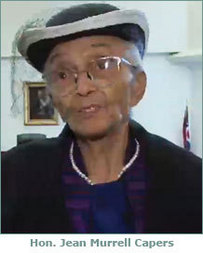 |
"I didn't feel like I'd broken any barriers because I didn't feel like there were any barriers to start with. It depends on what you believe about yourself and our parents had fortified us, but that's because they were educated themselves," Judge Capers said.
Judge Capers grew up knowing the importance of education. Both her parents graduated from a college in Kentucky and became teachers.
Her family moved from Kentucky to Cleveland in 1919, when she was just 6 years old becasue her father wanted her and her four siblings to get the benefit of an integrated education. "He knew our competition wasn't going to be with other Negro students, but rather with whites as well." Judge Capers said. "We were very proud of having the opportunity for an education."
Judge Capers graduated from Western Reserve University, now known as Case Western Reserve, in 1932 with a degree in education. She taught for five years.
Judge Capers felt she could help her community more with law so she earned her degree from Cleveland Law School, now known as Cleveland-Marshall College of Law in 1945. The school honored Judge Capers with an honorary doctor of laws degree in 2009.
Judge Capers said she had the best profession in the world as a private practice attorney. "It's your mind against another person's mind. Not because of the color of your skin, but what you've got under your skin that counts," Judge Capers said.
|