Photo of snowy egret courtesy of Ali holton
In this issue:
Autumn is harvest time in the river, as it is in the fields and forests, when countless numbers of young-of-year fishes are being recruited by their populations. Striped bass, river herrings, Atlantic silverside, Atlantic menhaden, sturgeon, and many other species participate. Predators rejoice. The strength of each cohort is the result of either fortuitous or unfortunate ecological whims. Many of the effects can be subtle and will not be recognized until years later when the new adults return, or fail to return, to spawn.
8/28 – Yonkers, HRM 18: Our research and education team at the Sarah Lawrence Center for the Urban River at Beczak hosted a seining program for members of the NYS Outdoor Education Association. Luckily the retreating tide helped keep the often overwhelming numbers of Atlantic silverside catch in check.
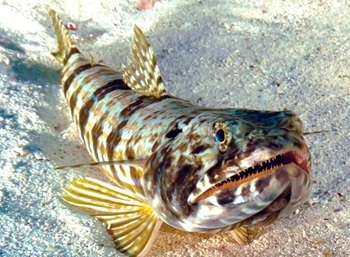
Across four hauls, the eager environmental educators caught 24 silverside, two blue crabs, five comb jellies, and one each striped bass and inshore lizardfish (105 mm). The latter was both a surprise and a real treat. The history of inshore lizardfish off our beach has been minimal (one in 2019; three in 2024). And now two in just a little over a week (8/19, 8/28).
- Christina Tobitsch
[Inshore lizardfish (Synodus foetens) are present in low numbers and is considered a temperate marine stray in our estuary. They are terete in cross-section and have been likened to a large, colorful cigar. While only reaching 18-inches, they have the countenance of an apex predator with tooth-studded jaws and a reptilian look. At various times in the long ichthyological past, because of their tiny adipose fin and impressive teeth, taxonomists have mistakenly placed lizardfish in with the trouts (Salmo sp.) and pikes (Esox sp.).
Years ago, as I was snorkeling along the sandy beach at Croton Point, I drifted over a foot-long inshore lizardfish, stock-still, propped on its pelvic fins, mouth slightly agape, and looking very much like a dragon in wait. Tom Lake]
Photo of inshore lizardfish courtesy of Tom Lake
8/28 – Hudson River Watershed: The 15th annual Great Hudson River Fish Count was conducted on August 1. The Fish Count is a popular annual event, sponsored by a dozen agencies including the DEC's Hudson River Estuary Program and the Hudson River National Estuarine Research Reserve. Each summer, organizations along the Hudson River and New York Harbor participate at riverfront sites to collect, count, and catalog fish species.
- Sarah Mount
8/28 – Mohawk River, HRM 157-158: For a twelfth straight year, DEC’s Region 4 Fisheries (Team Mohawk) organized a productive group effort to collect and display river fishes as our contribution to the annual Great Hudson River Fish Count.
Four separate sampling crews collected fish in two of the four lower branches (tailwaters) of the Mohawk River at the confluences of the upper Hudson River in Waterford and Cohoes (river miles 157-158). Boat electro-fishing resulted in the collection of 27 species and no fewer than 320 individual fish. High count among the fishes was smallmouth bass (61) and young-of-year blueback herring (57). Other significant species included bluntnose minnow (35), largemouth bass (33), and spottail shiner 27).
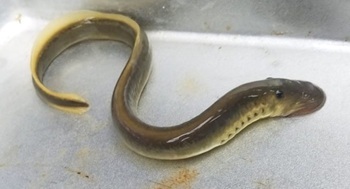
This year we came within two species of our record catch (2017) while adding a new species, a 255 mm adult silver lamprey (Ichthyomyzon unicuspis), to our existing fish roster for the Mohawk. Other unusual catches included a few (rare) adult blueback herring, presumably late returns to the ocean, plus, a surplus of quite small young of year bluebacks, wash-downs from a recent storm.
We counted 121 attendees who engaged us at our tables during the event, including people of all ages, some family and friends of our staff, tourists, and various colleagues from around the Capitol District. Annual events like the Fish Count provide a great summer venue to educate the public about the dynamic Hudson-Mohawk River ecosystem and offer a unique cross-training experience for various program staff. We continue to learn more about our valuable aquatic resources with every survey. Kudos to our dedicated mix-n-match crews for pulling off yet another successful event.
- Scott Wells, DEC Region 4 Stamford Fisheries
[Our Electro-fishing (or shocking) gear uses high voltage pulsed DC (direct current) passing from a cathode to an anode which temporarily stuns fish for capture. Fish experience galvanotaxis which causes them to involuntarily swim toward the electrical field. The size of fish being targeted determines the amount of voltage and amperage applied to the water. Smaller fish tend to be more difficult to stun than larger fish since smaller fish have less surface area that can be affected by the electrical field. Generally, fish are released unharmed. Wes Eakin]
Photo of silver lamprey courtesy of Brandon Brooke
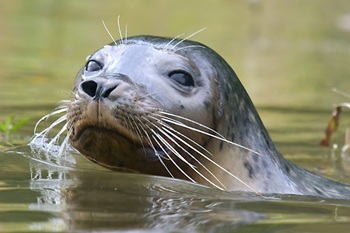
8/28 – Saugerties, HRM 102: Janet McConnell was rowing the tidal Esopus when a harbor seal approached and briefly followed her. Janet was rowing an old restored-refurbished wooden rowboat, with a repaired hull, new gunnels, breast hook, transom knees, painted and varnished. It was not a surprise that the always curious seal came to investigate what this unfamiliar flotsam was up to on his water. This was the male harbor seal known as 2-4-6.
-Jeff Morton
[On April 5, 2018, an orphaned harbor seal was rescued from Lower Goose Island, Harpswell, Maine. The seal was transported to the Mystic (Connecticut) Aquarium Animal Rescue Program where it was determined that the seal was a male. Following long term medical rehabilitation, a satellite tracker, as well as a white tag (2-4-6), was applied to its rear flipper. The seal was released as a yearling (one-year-old), in Rhode Island, on January 17, 2019.
Heading inland from the sea, on August 5, 2019, he found a refuge in Esopus Creek at Saugerties, Hudson River mile 102 (113 miles from the sea). From then on, the seal has been faithfully monitored by Patrick Landewe, Saugerties Lighthouse Keeper.
Today’s appearance by harbor seal 2-4-6 was Day 2,578. Tom Lake]
Photo of harbor seal courtesy of Michael Kalin
8/28 – Manhattan, HRM 1–2: Our Hudson River Park's River Project staff checked our research gear (pots and traps) that we deploy from floating docks on the south-side of Piers 26 and 40 in Hudson River Park for our ongoing Aquatic Ecology Survey.
Across three days this week our gear collected, for discussion, notation, and release, 49 young-of-year to adult oyster toadfish (20-280 mm), 13 black sea bass (27-55 mm), three blackfish-tautog (200-275 mm), a northern pipefish, and a silver perch (75 mm). Among invertebrates, we caught 49 blue crabs (7-20 mm) as well as, and lined water jellies (Rhacostoma atlanticum), a hydrozoan.
- Toland Kister, Siddhartha Hayes, Rashel Coraballo, Luna Horsley, Jade Murphy, James Laske, Paul West
[Crab measurements (size) are calculated in millimeters (mm) point-to-point across their carapace. Tom Lake]
8/29 – Norwalk, CT: In the 19th century, the section of Long Island Sound from the Norwalk River and Norwalk Islands west was one of the richest oyster areas in New England and was considered part of New York City’s East River Oyster Trade. In fact, you can still find the words East River splayed across maps of that area.
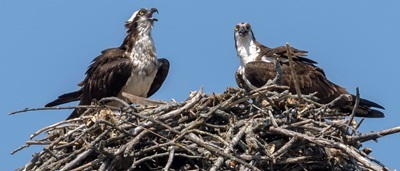
I was recently there looking at osprey nests for the Connecticut Audubon’s Osprey Nation project (there are about a thousand nests in Connecticut). I found the nest I was looking for on a utility pole next to a marsh on the west side of Norwalk Harbor. It may have been active earlier in summer, but there was no sign of anything going on today.
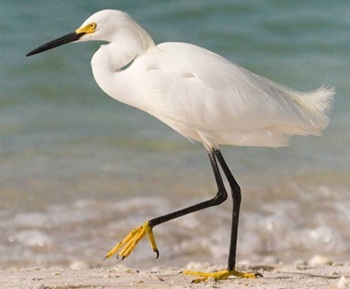
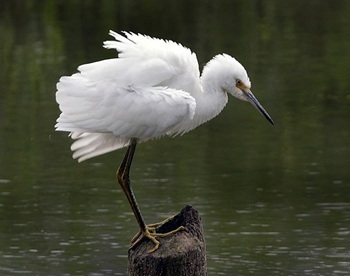
However, in the marsh I saw four gorgeous snowy egrets, one great egret, and one young little blue heron, its plumage white like a snowy egret’s but its bill dark near the tip and lighter as it reaches the bird’s face. My recollection is that little blue herons used to nest on some of the islands in the western sound. But that was in the 1980s. Now it’s hard to tell from eBird if they nest anywhere near there.
I also counted 16 diamond-backed terrapins (Malaclemys t. terrapin) basking on a water-soaked log in the flooded marsh. I recognize that terrapins are part of the local fauna, but I think this was the first time I saw one in the wild. Being turtles, they didn’t do much. They extended their webbed feet; they opened their mouths in the noon sun; they stretched their necks. I guessed that they would slip away into the brackish water as the tide dropped, but for now they were making the most of the warmth and languor of a late summer day.
- Tom Andersen
Photo of osprey courtesy of Jim Yates
[Snowy egret (Egretta thula) is a striking medium-sized wading bird that is common and widespread in North and South America, especially along the coast. The snowy egret is presently in their peak fall migration (August to October) to wintering areas along the Gulf Coast and points south.
I first came upon a snowy egret as a very young birder. I knew nothing of them beyond Roger Tory Peterson’s very apt description of their “golden slippers,” which remains as one of the best diagnostic features in bird identification.
There is some evidence that during the 17th and 18th centuries snowy egrets seasonally wandered up the East coast. However, like many herons and egrets, life has not been easy as they have suffered from over-hunting for the millinery trade [feathers]. By 1910, the snowy egret was nearly extinct in Florida. Frank Chapman (2012) comments "the Florida egrets are near the verge of extermination [extirpation]."
The snowy egret first nested on Long Island in 1949, and then from Connecticut to Maine in 1961. They have since spread to about half the coast but still in small numbers
Stan DeOrsey, Tom Lake]
[Editor’s Note: There are times when an Almanac entry strays from the strict confines of our watershed. Those are instances where the stories we tell enhance our understanding and appreciation of the natural connectivity of our watershed with often faraway places. The Long Island Sound is closely linked with New York Harbor through the tidal strait of the East River. The connections are crucial to all these ecosystems.
--Tom Lake]
Photo of snowy egret courtesy of Deborah Tracy Kral
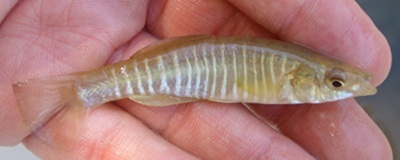
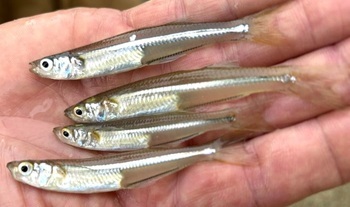
8/30 – Hudson River Watershed: Fish-of-the-Week for Week 382 is the eastern banded killifish (Fundulus diaphanus diaphanus Lesueur, 1817), number 119 (of 240) on our watershed list of fishes. If you would like a copy of our list, e-mail - trlake7@aol.com.
The banded killifish Type Site is Saratoga Lake (HRM 182), where a holotype specimen was first described to science by French naturalist Charles Alexandre Lesueur in 1817.
The banded killifish is one of four members of the killifish family (Fundulidae), all native species, documented for the watershed. The others are mummichog (F. heteroclitus, spotfin killifish (F. luciae), and the striped killifish (F. majalis). Fundulus diaphanus diaphanus is a recognized subspecies of the banded killifish, found in watersheds along the Atlantic Slope.
Banded killifish can be found from the high levels of salinity in the lower Hudson River estuary to the full freshwater reach of the river above tidewater. Traveling in large schools, they appear to be a favorite of many predatory fishes from pickerel to pike, to striped bass and bluefish.
Banded killifish are not large, most are index-finger-size (100 mm), and are marvels of adaptation to their environment. There may not be a prettier fish in the watershed than a courting male banded killifish with its iridescent, blue, lavender and silver highlights. Legendary riverman Everett Nack called them “blue-banded mudminnows” owing to the breeding male’s resplendently beautiful breeding colors. The females are a drab brownish-green, a good example of sexual dimorphism.
The diet of killifish includes aquatic and terrestrial insects, planktonic Crustacea, plant seeds, and fine algae material. It is this predilection toward insect larvae that has made some killifish species important as a bio-control of the aquatic stages of mosquitoes in temporary bodies of fresh water, in particular West Nile virus (Matias 2010).
- Tom Lake
[Note: One-inch equals 25.4 millimeters (mm). Tom Lake]
Photo of banded killifish courtesy of NYS DEC Fisheries
8/31 – Hudson River Watershed: Shorebirds raising young in the Arctic have a very brief breeding season due to the slow thawing of their nesting grounds and the early arrival of cold weather. As a result, eggs hatch and chicks grow at a fast pace, allowing adults to head for their wintering grounds in Central and South America early, often in July. In doing so, they avoid peak predator activity (migrating falcons) and a dwindling food supply.
Shorebirds take the prize when it comes to migration. Not only are they among the earliest to migrate, but they also make the longest nonstop flights. According to Cornell Lab of Ornithology, about twenty species of shorebirds have been recorded making nonstop flights longer than 3,100 miles. No other species of migratory bird has been recorded completing a nonstop flight longer than 2,500 miles.
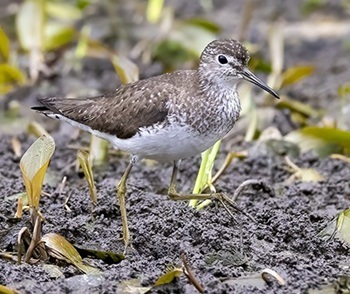
The solitary sandpiper migrates long distances between its boreal forest breeding grounds in Alaska and Canada and tropical wintering areas in South America. It is unlike most sandpipers, as its name implies, and ordinarily migrates alone, not in flocks, and nests in old songbird nests in trees, not on the ground. The peak of its migration through New England occurs in August into early September.
Photo of solitary sandpiper courtesy of Mary Holland
8/31 – Yonkers, HRM 18: Our research and education team at the Sarah Lawrence Center for the Urban River at Beczak made six seine hauls today and were nearly overwhelmed by young-of-year Atlantic silverside (222). We are seeing daily evidence that Menidia menidia has had a robust year class, much to the delight of the river’s ravenous bluefish. The water was 76 degrees Fahrenheit, salinity was 11.0 parts-per-thousand, and dissolved oxygen (DO) was 4.9 parts-per-million.
Jason Muller, Maya Rodriguez
Photo of Atlantic silverside courtesy of Tom Lake
9/1 – Hudson, HRM 119: Recently, I led a group of Adirondack Mountain Club paddlers into the waters in the Furgary in Hudson’s North Bay. Near midday the tide was particularly high, and we noticed many tiny fish jumping out of the water all around us. We were thinking perhaps these were baby shad [they were most likely a relative, young-of-year blueback herring]. We tried to catch one, but they were too slippery. After the paddle, one of the paddlers noticed that a different fish had, unknowingly, jumped into her boat. We later identified that fish as a young-of-year banded killifish (Fundulus diaphanous).
- Jeanette Tully-Baker
[The Furgary is a shantytown at the mouth of Hudson’s North Bay. It is a collection of seventeen small buildings — some of which may date back to the late 1800s — formerly used, now abandoned, as fishing and hunting getaways. Today, only two remain. Iconic riverman Bob Boyle once remarked that this late-spring young-of-year silvery herring phenomenon appears as though someone was tossing handfuls of shiny new dimes out on the water. Tom Lake]
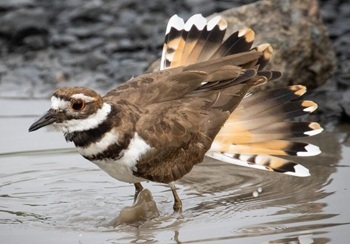
Photo of killdeer courtesy of Matt Zeitler
9/1 – Yonkers, HRM 18: Our research and education team at the Sarah Lawrence Center for the Urban River at Beczak hosted students from the Sarah Lawrence College Pre-Orientation Program and, with their enthusiastic support, we made eight high to mid-tide seine hauls.
It was no surprise that high count among fishes was Atlantic silverside (39) as their late-summer dominance continued. Young-of-year striped bass (95 mm), bluefish (150 mm), and white perch (130-145 mm) also contributed. Comb jellies (71) and moon jellyfish (17) were prominent, along with blue crabs (140 mm).
The river was 76 degrees Fahrenheit, salinity was high at 14.0 parts-per-thousand, and dissolved oxygen (DO) was correspondingly low at 4.5 parts-per-million.
- Jason Muller
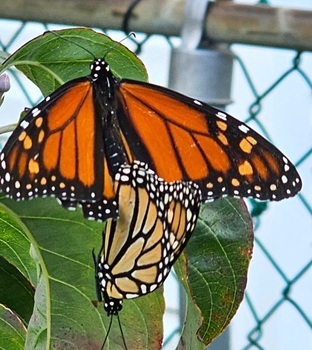
9/2 – Town of Poughkeepsie, HRM 68: This late-summer has provided a bounty of various butterfly species visiting my flowering trees and shrubs. I was fortunate today to come upon a pair of mating monarch butterflies (Danaus plexippus) on a dogwood. The different colors and patterns of the forewings and hind-wings, as well as the dorsal (top) and ventral (bottom) sides are adaptations that serve alternately as camouflage and to cause confusion to predators.
- Audrey Pless
Photo of monarch butterflies courtesy of Audrey Pless
9/3 – Yonkers, HRM 18: Our research and education team at the Sarah Lawrence Center for the Urban River at Beczak made six mid-tide seine hauls and were once again inundated by 256 Atlantic silverside. Quick action by our crew ensured that most of them were safely returned to the warm-water, low oxygen river. Invertebrate highlights included seven blue crabs. The river was 76 degrees Fahrenheit, salinity was 9.4 parts-per-thousand, and dissolved oxygen (DO) was up a bit to 6.6 parts-per-million.
- Jason Muller, Christina Tobitsch, Melissa Rosado
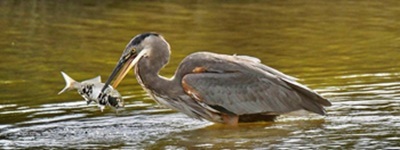
9/3 – Hudson River Watershed: At least 75% of a great blue heron’s diet (Ardea herodias) is fish, but they also frequently eat small mammals (voles, mice, squirrels, chipmunks, and an occasional eastern cottontail), amphibians (frogs, salamanders), reptiles (snakes, lizards), crustaceans (crayfish, crabs, shrimp), aquatic insects and occasionally other birds – basically they will eat almost any small animal they can overpower and fit down their throat. They hunt day and night, slowly wading or standing in wait of prey in shallow water. Once the prey is within striking distance, they use a lightning-fast thrust of their long neck to grab or spear the animal with their dagger-like bill.
While catching all prey demands exceptional skill on the part of a great blue heron, perhaps most impressive is its ability to snag a dragonfly, considering the dragonfly’s exceptional eyesight. With up to 30,000 individual lenses per eye, a processing speed of 200 frames per second, and massive eyes that wrap around their head to provide nearly 360 degree vision, dragonflies are well equipped to both capture prey and escape their own capture. Occasionally, however, they are outdone. Anyone who has tried to sneak up on a dragonfly can appreciate the skill of a predator capable of catching one on the fly.
- Mary Holland
Photo of great blue heron courtesy of Deborah Tracy Kral
Snapshot NY
The NYSDEC, in collaboration with the New York Cooperative Fish and Wildlife Research Unit at Cornell University, has launched Snapshot NY, a citizen science program that allows the public to participate in wildlife monitoring through the deployment of trail cameras. The project will help improve the way DEC monitors and manages more than a dozen wildlife species. For more information on Snapshot NY and how to participate, visit the Snapshot NY website.
Hudson River Lesson Plans
Explore our collection of Hudson River lesson plans, videos and online activities to support hands on investigations of the Hudson River in your classroom.
Hudson River: Striped Bass Cooperative Angler Program
You can share your fishing trip information and help biologists understand and manage our Hudson River striped bass fishery.
Here’s how it works: Fill out a logbook provided by us whenever you fish on the Hudson River (by boat or from shore). You can also use our survey123 app and record your trips using a smart phone or computer.
Record general location, time, gear used, what you caught (or if you didn’t catch anything) and return the logbook when you are done fishing for the season. You’ll receive an annual newsletter summarizing the information in addition to the latest news regarding regulations and the river. Whether you catch-and-release or take home a keeper, you can be part of the Cooperative Angler Program. Online logbook instructions (PDF).
Join today by contacting: hudsonangler@dec.ny.gov
- Jessica Best
Hudson River Miles
The Hudson is measured north from Hudson River Mile 0 at the Battery at the southern tip of Manhattan. The George Washington Bridge is at HRM 12, the Tappan Zee 28, Bear Mountain 47, Beacon-Newburgh 62, Mid-Hudson 75, Kingston-Rhinecliff 95, Rip Van Winkle 114, and the Federal Dam at Troy, the head of tidewater, at 153. The tidal section of the Hudson constitutes a bit less than half the total distance—315 miles—from Lake Tear of the Clouds to the Battery. Entries from points east and west in the watershed reference the corresponding river mile on the mainstem.
To Contribute Your Observations
The Hudson River Almanac is compiled and edited by Tom Lake and emailed weekly by DEC's Hudson River Estuary Program. Share your observations by e-mailing them to trlake7@aol.com.
Was this Newsletter Forwarded to You?
Subscribe today to DEC Delivers Hudson River Almanac topic for weekly natural history journal that covers the Hudson from the High Peaks of the Adirondacks to New York Harbor.
Helpful Resources
National Oceanic and Atmospheric Administration online tide and tidal current predictions are invaluable when planning Hudson River field trips. For real-time information on Hudson River tides, weather, and water conditions from sixteen monitoring stations, visit the Hudson River Environmental Conditions Observing System website.
DEC's Smartphone app for iPhone and Android is now available at New York Fishing, Hunting, and Wildlife App.
|