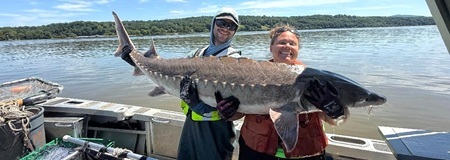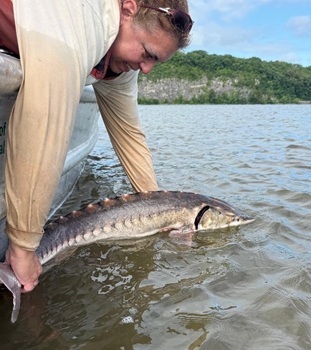
Photo of Atlantic sturgeon courtesy of Amanda Higgs
In this issue:
The flavor of this week’s Almanac includes giant sturgeon, from those who caught them to new research that enhances our knowledge of their life history. We couple this with an Almanac entry from the grandson of a legendry “River Man” whose name is synonymous with giant sturgeon (as well as goldfish).
8/16 – Hudson River Estuary: Late in 2025, using telemetry data, Dr. Shannon White discovered a new population of adult Atlantic sturgeon (Acipenser oxyrinchus) that migrate in from the sea later than the traditional Hudson River spring spawning group. This second group arrives in late June and eventually congregate around Diamond Reef (river mile 67.5) for an extended stay through autumn.
[Telemetry is the in situ collection of measurements or other data at remote points and their automatic transmission to receiving equipment for monitoring. We have a network of 70 receivers in the estuary from Troy to New York Harbor.]
Subsequently, DEC Region 3 Fisheries has conducted considerable reconnaissance sampling (side-scan sonar) and found large numbers of these sturgeon just south of Diamond Reef. Many of the fish were breaching (leaping). The sampling crew set 10 seven-inch-mesh gill nets over three days and caught eight sub-adults and three adult sturgeon. One of the sub-adults was a recapture of a juvenile that had been tagged off the coast of New Jersey in 2018.
Another recovery, a female, had been tagged in the fall of 2021 in South Carolina and had made annual runs into the Hudson River in four of the intervening five years where she stayed a couple of months at Diamond Reef. We heard her tag beep at Diamond Reef and checked her detection history.
Our theory is that Hudson River Atlantic sturgeon may have two distinct spawning cohorts (populations). This seems to fit well with the fact that sturgeon in southern coastal estuaries have spring and fall spawning runs.
- Amanda Higgs
[Atlantic sturgeon have an interesting behavioral trait, a predilection of leaping out of the water for poorly understood reasons. To witness this behavior by large adults — they can exceed 14 feet in length — that weigh hundreds of pounds and are not readily recognized as a common species (they have a Jurassic look) the experience is often startling or at least bewildering. Atlantic sturgeon was added to the federal Endangered Species List in February 2012. Tom Lake]
Photo of Atlantic sturgeon courtesy of Amanda Higgs
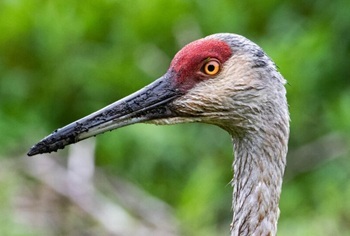
8/15 – Saratoga County, HRM 172: Four sandhill cranes, found earlier today, continued in a meadowy field along (ironically) Crane Road in the town of Charleton just west of the Galway Nature Preserve.
Photo of sandhill crane courtesy of Matt Zeitler
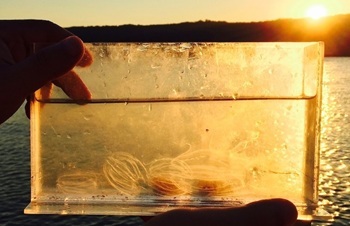
8/15 – Piermont, HRM 25: High tide washed against the shoreline just as the first of the Lamont-Doherty Earth Observatory Science Saturday participants began to arrive at our tent. We carefully moved through the river in waders to avoid cold water sloshing into our boots. After seven slow hauls of our seine, we collected a grand total of 78 Atlantic silverside, 20 striped bass, a young-of-year bluefish, four blue crabs (one male, four female), five moon jellyfish, and two Beroe’s comb jellies (Beroe cucumis). The water temperature was 80 degrees Fahrenheit, the dissolved oxygen (DO) was 9.0 parts-per-million, and the salinity was 5.0 parts-per-thousand.
- Sarah Ortiz
Photo of Beroe's comb jellies courtesy of Margie Turrin
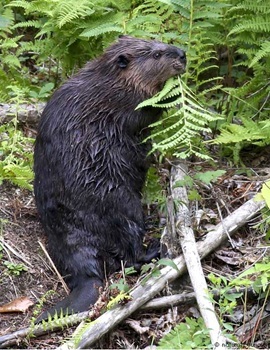
8/16 – Hudson River Watershed: Beavers are strict vegetarians. Their ever-growing incisors equip them to cut down and debark very large trees allowing them to consume the cambium (the soft, nutrient-rich layer of growing plant tissue located beneath a tree’s outer bark). Most of this heavy chewing is done in the fall, with branches cut and stored in a pond for winter consumption with the remaining branchless timber used for building and repairing dams and lodges.
In the spring, when pond ice melts and the growing season begins, a beaver’s fancy turns to lush, succulent herbaceous offerings such as water lilies and their rhizomes, cattails, sedges, grasses, and clover. By midsummer, non-aquatic plants such as jewelweed and ferns become highly prized. As fall approaches and fruits mature, berries and nuts are sought after. Before long, lodge and dam renovations begin, a winter food supply pile built, and their incisors will get a good paring down from the renewed harvest of trees.
- Mary Holland
Photo of beaver courtesy of Mary Holland
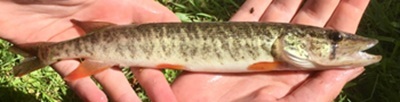
8/17 – Hudson River Watershed: Hudson River Watershed: Fish-of-the-Week for Week 380 is the redfin pickerel Esox americanus americanus Gmelin, 1788, species number 86 (of 240) on our watershed list of fishes. (If you would like a copy of our list, e-mail: trlake7@aol.com.)
We began this weekly feature in the Hudson River Almanac on December 13, 2018, with the firm belief that every fish has a story to tell.
Redfin pickerel is one of four members of the Pike family (Esocids) documented for our watershed. Three of the four are native species. The redfin is less well-known than the other three: northern pike, chain pickerel, and the tiger muskellunge, a northern pike-muskellunge hybrid. Redfin pickerel shares its subspecies taxon with grass pickerel, E. americanus vermiculatus, which is not found in our watershed.
The redfin pickerel Type Site is a rather non-specific “In the vicinity of New York City.” A holotype specimen from this site was used by German naturalist Johann Friedrich Gmelin to first describe Esox americanus to science in 1789.
Our three native Esocids are peri-glacial species, in that they were among the first fishes to arrive in a post-glacial watershed (post-wasting away of the Laurentide ice sheet that covered much of the Northeast). In the Algonquin dialect of the indigenous Mohican people, redfin pickerel is known as Kwnoosaw or Kwnoosaak.
Redfin pickerel is a rather small fish (rarely exceeding a foot-long). most often inhabiting shallow, weedy areas of the watershed. C. Lavett Smith (1985) describes them as having a long, arrow-shaped body, a long broad snout, and jaws with prominent canine-like teeth, marking them a high-end predator in its chosen niche.
My introduction to the redfin pickerel began on June 28, 1996. Bob Schmidt and I were out in search of young-of-year river herring in Hudson River tributaries and chose to haul a small (15-foot) kick-seine at mid-tide in the short tidal reach of Quassaic Creek (river mile 60).
While we professed to be looking for young–of-year river herring, we were game for whatever we found. Our bycatch was welcome, but none were surprising: redbreast sunfish, largemouth bass, fallfish, and our target, young-of-year alewives. On the last short sweep along a creek-side stone wall cloaked in the shadows of overhanging box elder, we caught just one foot-long fish. I drew a blank on its identification. Dr. Bob, however, confidently said “That is a redfin pickerel.” Now I knew redfin pickerel.
- Tom Lake
Photo of redfin pickerel courtesy of Aidan Mabey
8/18 – Germantown, HRM 112: Although I moved away from the Hudson River more than two decades ago, I still visit the area often to see family and spend time along the river. One spot I regularly stop at during these visits is the Roe Jan Creek Boat Club, located on the Roeliff-Jansen Kill, a Hudson River tributary.
Growing up, I spent many days at the small creek-side docks during the spring commercial shad fishing season and at the boat club’s annual events where my family was often found cooking. I spent countless hours wading in the water and fishing. A typical catch consisted of white perch, bullhead, and the occasional American eel.
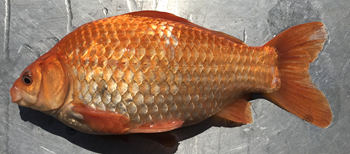
On a recent trip back, I expected to see the usual cast of characters. To my surprise, I was greeted by three bright orange and two dozen olive-gold, goldfish. As far as I can remember, I had never seen so many large goldfish in one place at the same time.
This is a case of shifting baseline syndrome. I’ve heard many stories from my family and read accounts from authors like Robert Boyle and Kevin Krajick about the millions of goldfish that once inhabited the Hudson River.
My grandfather, Everett Nack, built a market around catching and selling goldfish to pet shops during the 1960s and 1970s. The goldfish population had already been significantly reduced by the time I began helping pull the family nets in the 1990s and that period will always serve as my baseline for understanding the Hudson River and its goldfish.
- Christopher C. Nack
Photo of goldfish courtesy of Amanda Higgs
[Bob Boyle, in his The Hudson River A Natural and Unnatural History (1969), speaks often of Everett Nack. Boyle calls Nack “A true river rat,” the highest compliment you can bestow to those who work on the river, sense the pulse of its tides, and feel an incredible awe at its abundant life.
Goldfish (Carassius auratus) is a nonnative introduced species, closely related to the common carp (Cyprinus carpio). Their Type Site is broadly defined as China, from where a holotype specimen was described to science in 1758 by Carl Linnaeus. Goldfish arrived in North America from eastern Asia in the late 17th century.
Fishing in the waters off Columbia and Greene counties, Everett used to net goldfish for sale to wholesale aquarium fish dealers, averaging three to four thousand a year. Boyle remarked that in the 1960s there were “thousands upon thousands of goldfish in the Hudson, some the size of catcher’s mitts.”
Foot-long goldfish in the Hudson River were not rare. Entrepreneurs, like Everett, with a gillnet or seine, captured goldfish for sale to fish dealers or owners of backyard pools and ponds. Small goldfish are still used as live bait by anglers who then release their leftovers, live, at the end of the day helping to sustain the population.
In J.R. Greeley’s A Biological Survey of the Lower Hudson Watershed (1937), the author describes his true feelings regarding goldfish: “This species, in the wild state, constitutes a worthless, although apparently not seriously destructive addition to the fish population.” That seems like a stern and rather narrow definition of the worth of goldfish.
An urban legend suggests that many 5 &10-cent store-bought goldfish made their way into the river via flushed toilets. There was a time when a flushed toilet had a nearly uninhibited path to the river. The backstory to the flush theory would have parents warning their children to “Clean your goldfish bowl, or else!” Eventually the or else became a journey to the river, often via Mom and Dad clandestinely emptying the goldfish bowl. Tom Lake]
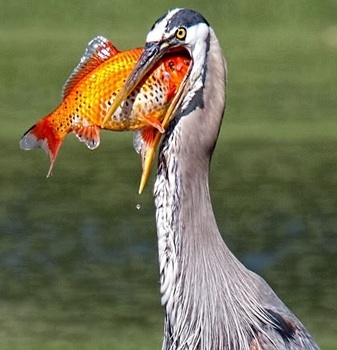
Photo of goldfish with great blue heron courtesy of Tom Lake
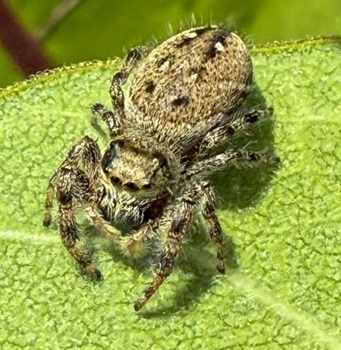
8/19 – Hudson River Watershed: Jumping spiders comprise the largest family of spider species (13%). They are predaceous, but do not spin traditional webs to catch prey. Instead, they are active hunters that use exceptional vision and agility to stalk and pounce on their food (they do produce silk for other crucial purposes, such as safety draglines, nesting, egg protection, and molting).
Jumping spiders are excellent hunters. They can jump more than fifty times the length of their body at a time using increased blood pressure to quickly propel themselves. Their most highly developed sense is sight, which they use in courtship, hunting and navigation. All jumping spiders have four pairs of eyes: three secondary pairs and a principal pair (middle front two eyes) that is larger and face forward.
The brilliant jumping spider (Phidippus clarus) is a relatively large spider found in old fields throughout the Northeast. The male is much more vibrant than the female. In addition to jumping, brilliant jumping spiders often wait lying head down in the top leaves of plants. When prey appears, they drop down and capture it. Next the spider injects digestive enzymes into the prey that liquefy its internal tissues which the spider will then imbibe.
-Mary Holland
Photo of jumping spider courtesy of Mary Holland
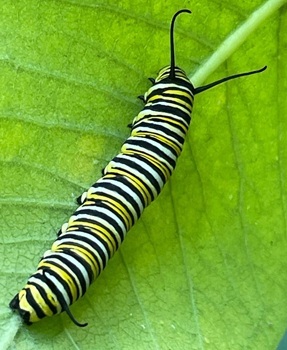
8/20 – Essex County, HRM 284: I was hiking at the edge of a forest this morning when I spotted no fewer than three milkweed [herbaceous, perennial, flowering plants] bearing monarch caterpillars on their leaves along the roadside. This was the second monarch brood of summer.
- Mike Corey
Photo of caterpillar courtesy of Mike Corey
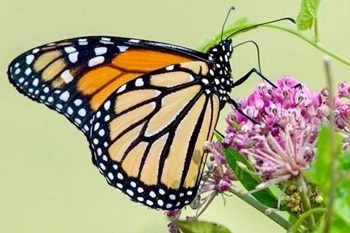
[Monarch butterflies breed in the Hudson River watershed and then migrate south as much as 2,700 miles to a wintering location in a mountain forest near Mexico City. They arrive in large numbers to the same roosts, often to the exact same trees. The length of the journey far exceeds the lifetime of a single monarch, which is less than two months for butterflies born in early summer. The last generation of the summer lives up to seven months, during which time it migrates to their wintering location. This generation does not reproduce until it leaves the following spring. How monarchs manage to return to the same wintering locale over a span of several generations is a mystery. It is their children's grandchildren that return south the following fall.
Monarch populations, like many insects, have always been highly cyclical with years of abundance and scarcity, and our northeastern population that migrates south is but a subset of a much larger population. The phenomenon of mass southward movement in our region has been on a downward trajectory [primarily from anthropogenic causes] with little indications of an impending resurgence. Steve Chorvas]
[While we tend to see fewer monarchs in recent times, there was a not long ago era when September elementary school programs along the river consisted of both seining for fish and watching monarchs. A favorite observation locale to see both was along the base of the Palisades in the lower river. At times, there were so many migrating monarchs that during programs we would dispatch a couple of students to turn their backs to the river and count the monarchs as they fluttered past riding the updraft from the Palisades. For the students it was a real life lesson in wildlife migration. Tom Lake]
Photo of monarch butterfly courtesy of Bob Rightmyer
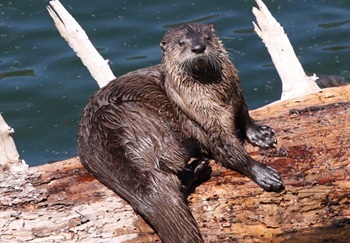
8/20 – Tarrytown, HRM 27: We were walking at the south corner of Pierson Park next to the Tarrytown Metro North railroad station and were surprised to see a river otter jumping across the rocks and deadfalls by the river path. The otter dove into the water not long after seeing us and was quickly gone. This was the first time we had seen a river otter (Lontra canadensis) along the Hudson River.
- Nick Fraearson, Tish Frearson
Photo of river otter courtesy of Tom Serfass
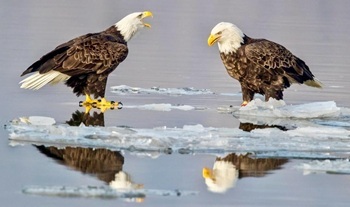
[In mid-winter, several years ago, I was running a Bald Eagle Watch at Norrie Point Environmental Education Center (river mile 85). The tide was dropping and the river was carrying a mass of jumbled ice floes seaward. Several bald eagles caught fish and took them to the privacy of the ice floes to feed. Being part-time scavengers and messy eaters, they would leave much of the fish on the ice when they flew off to catch another. On at least two occasions, as soon as the eagles left, a river otter would climb up onto the floe and dine. With binoculars and spotting scopes it was great “Eagle Theater.” Tom Lake]
Photo of bald eagles on ice courtesy of John Badura
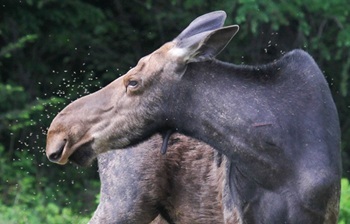
8/21 – Hudson River Watershed: If you see a moose in the summer, it inevitably will have a swarm of flies around its head and on its rump. Smaller than house flies, these moose flies (Haematobosca alcis) are there for a reason. The females suck blood in summer for nutrition needed to lay eggs. When the moose defecates, the flies jump off and lay their eggs on the feces and then get back on the moose. The eggs hatch on the feces and then the larvae overwinter as pupae. Though these flies are not considered a serious pest, moose are plagued by them throughout the spring and summer sometimes suffering sores on their hind legs because of the flies’ bites.
- Mary Holland
Photo of moose courtesy of Mary Holland
Science Saturday at Norrie Point Environmental Center
Join us for our monthly Science Saturday programs and explore Norrie Point. Check out our series by visiting the Hudson River website. Events are free and open to the public. Registration is not required. All programs meet at the Norrie Point Environmental Center, 256 Norrie Point Way, Staatsburg NY, 12580. Dress for the weather and being outside! Otherwise, no special equipment is needed.
Snapshot NY
The NYSDEC, in collaboration with the New York Cooperative Fish and Wildlife Research Unit at Cornell University, has launched Snapshot NY, a citizen science program that allows the public to participate in wildlife monitoring through the deployment of trail cameras. The project will help improve the way DEC monitors and manages more than a dozen wildlife species. For more information on Snapshot NY and how to participate, visit the Snapshot NY website.
Hudson River Lesson Plans
Explore our collection of Hudson River lesson plans, videos and online activities to support hands on investigations of the Hudson River in your classroom.
Hudson River: Striped Bass Cooperative Angler Program
You can share your fishing trip information and help biologists understand and manage our Hudson River striped bass fishery.
Here’s how it works: Fill out a logbook provided by us whenever you fish on the Hudson River (by boat or from shore). You can also use our survey123 app and record your trips using a smart phone or computer.
Record general location, time, gear used, what you caught (or if you didn’t catch anything) and return the logbook when you are done fishing for the season. You’ll receive an annual newsletter summarizing the information in addition to the latest news regarding regulations and the river. Whether you catch-and-release or take home a keeper, you can be part of the Cooperative Angler Program. Online logbook instructions (PDF).
Join today by contacting: hudsonangler@dec.ny.gov
- Jessica Best
Hudson River Miles
The Hudson is measured north from Hudson River Mile 0 at the Battery at the southern tip of Manhattan. The George Washington Bridge is at HRM 12, the Tappan Zee 28, Bear Mountain 47, Beacon-Newburgh 62, Mid-Hudson 75, Kingston-Rhinecliff 95, Rip Van Winkle 114, and the Federal Dam at Troy, the head of tidewater, at 153. The tidal section of the Hudson constitutes a bit less than half the total distance—315 miles—from Lake Tear of the Clouds to the Battery. Entries from points east and west in the watershed reference the corresponding river mile on the mainstem.
To Contribute Your Observations
The Hudson River Almanac is compiled and edited by Tom Lake and emailed weekly by DEC's Hudson River Estuary Program. Share your observations by e-mailing them to trlake7@aol.com.
Was this Newsletter Forwarded to You?
Subscribe today to DEC Delivers Hudson River Almanac topic for weekly natural history journal that covers the Hudson from the High Peaks of the Adirondacks to New York Harbor.
Helpful Resources
National Oceanic and Atmospheric Administration online tide and tidal current predictions are invaluable when planning Hudson River field trips. For real-time information on Hudson River tides, weather, and water conditions from sixteen monitoring stations, visit the Hudson River Environmental Conditions Observing System website.
DEC's Smartphone app for iPhone and Android is now available at New York Fishing, Hunting, and Wildlife App.
|