Photo of oyster toadfish courtesy of Chris Bowser
In this issue:
Our fishes of summer are highlighted this week, Atlantic silverside, oyster toadfish, and young-of-year among them. In the air, the many facets of autumn migration from raptors to shorebirds to butterflies appear to have had an early start.
Following this edition of the Hudson River Almanac, we will go on a short pause for two weeks. In the interim, however, we still need your data, stories, and photos.
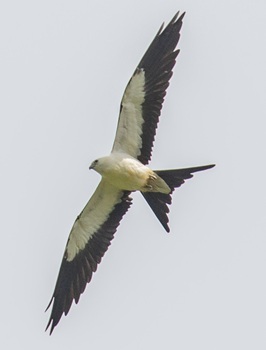
8/8 – Lafayette Township (NJ): This morning I ran to locate the swallow-tailed kite (Elanoides forficatus) that had been reported just over the state line in New Jersey. I was hoping to see this very uncommon bird as it had been more than ten years since I’d seen one in Florida; to see one in our area would be quite remarkable.
The swallow-tailed kite was flying not far away as I arrived and soon came closer, almost overhead. It worked away from me, tangled with a couple of peregrine falcons, and then was out of view.
- Matt Zeitler
[The range of the swallow-tailed includes the southern coastal U.S., as well as Central and South America — an uncommon to rare stray in our area. They are a graceful, uniquely shaped raptor with long, narrow wings and deeply forked tail. They are strikingly black-and-white with shining blue-gray upper-wings. It is usually seen in flight as it soars and glides with deep, fluid wingbeats while twisting its tail. Swallow-tailed kite is found over a variety of woodland areas with a preference for wetter habitats around rivers and ponds. They feed primarily on insects captured on the wing. eBird]
Photo of swallow-tailed kite courtesy of Matt Zeitler
8/8 – Saugerties, HRM 102: My neighbor, John McCarthy, and his grandson Landon, were out on the tidewater reach of Esopus Creek today searching for smallmouth bass. The creek was turbid from all the recent rain and their prospects were dim.
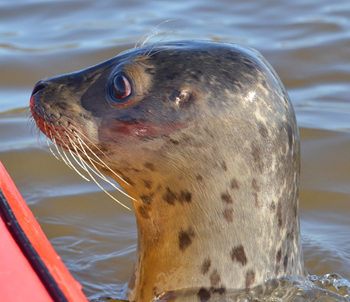
Close by, up popped a harbor seal (known to be number 2-4-6). In what has been a behavioral trait of this quasi-resident seal — curiosity — he came over very close to their boat. They both got a great look. This harbor seal has, on occasion, almost overcome by curiosity, all but jumped into boaters’ kayaks. However, on this occasion, as they tried to get a photo, the seal was too quick or grew bored and left. They did not catch a single smallmouth, but the seal made up for that and much more.
- Jeff Morton
Photo of harbor seal courtesy of Michael Kalin
8/8 – Nyack Beach State, HRM 31: Eleven young participants and their grown-ups attended our Hudson River Clearwater's Community Public Tideline program. It was low tide when we began and with eight hauls of our net, high count went to Atlantic silverside (21). Also in the seine was northern pipefish (140 mm), young-of-year striped bass (50 mm), white perch (150 mm), a tiny bluegill (20 mm), and two blue crabs.
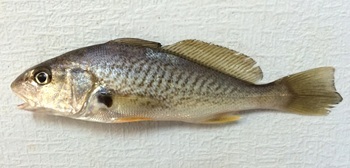
We also caught two young of year fishes (110 mm) tentatively identified as weakfish (Cynoscion regalis), a species that has become increasingly uncommon in the estuary in recent decades likely due to over-harvest (predator mortality) in waters off the mid-Atlantic coast. Another species we considered is the Atlantic croaker (Micropogonias undulatus) — they are both Sciaenids-drums. However, without a photo, we will have to make it happen again.
- Eli Schloss, Caitlin Chung, Helen Fleming
[Note: One-inch equals 25.4 millimeters (mm). Tom Lake]
Photo of Atlantic croaker courtesy of Zachary Randall
8/8 – Piermont Pier, HRM 25: Our students from the Next Gen Interns and Science Saturday Community (Lamont-Doherty Earth Observatory) discovered the return of the young-of-year Atlantic menhaden in our nets today.
Early in the season we had young menhaden filling our nets, but more recently Atlantic silverside have been the overwhelming component of our catches. This continued today with silverside as high count with 754 filling the net through four hauls. The river was 87 degrees Fahrenheit (it rarely gets any warmer) requiring us to count and release the fish right at the waterline to minimize mortality.
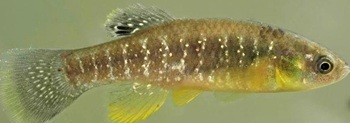
Mixed in with the silverside were 57 young-of-year menhaden, 67 striped bass, three male mummichogs (killifish) with lovely silver bands but much smaller and lacking the yellow highlights of the breeding males, and six thumbnail-sized blue crabs.
Dissolved oxygen (DO) remained high at 12.0 parts-per-million but salinity, with all the recent rain, had essentially disappeared (2.0 parts-per-thousand).
- Margie Turrin
Photo of mummichog courtesy of Robert Muller
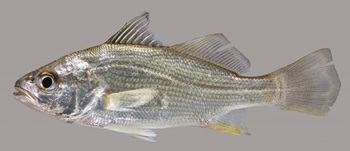
8/9 – Hudson River Watershed: Fish-of-the-Week for Week 379 is the silver perch, Bairdiella chrysoura (Lacepède, 1802), number 191 (of 230) on our watershed list of fishes. If you would like a copy of our list, e-mail: trlake7@aol.com.
We began this Fish-of-the-Week feature in the Hudson River Almanac on December 13, 2018, with the firm belief that every fish has a story to tell.
Bairdiella chrysoura is one of seven members of the drum family (Sciaenidae) in our watershed. Others include freshwater drum, weakfish, spot, northern kingfish, Atlantic croaker, and black drum. Except for the freshwater drum, an introduced freshwater fish, they are all saltwater species found seasonally in the brackish reach of the estuary. Some of the drums have a highly specialized swim bladder that serves as sound-producing organ. This has led to the colloquial name of “drum.”
Silver perch are a rather small marine “panfish” (max 12-inches) that feeds on small crustaceans such as Gammarus (Amphipods), shrimp (Palaemonetes sp.), blue crabs (Callinectes sapidus), mud crabs (Panopeidae), and small fish. They outwardly appear similar to white perch (Morone americana) and are occasionally overlooked in survey catches.
Bairdiella chrysoura is found in coastal waters over sandy and muddy bottoms from New York to southern Florida and eastern and northern Gulf of Mexico. They move into estuaries during summer months and sometimes will enter freshwater. They are silvery, greenish, or bluish above, bright silvery to yellowish on their abdomen, with lower fins that are mostly yellowish. The latter trait has led to its alternate common name goldtail croaker.
The silver perch Type Site is broadly defined as “South Carolina.” That is the origin of the holotype specimen where French naturalist Bernard-Germain-Étienne de Lacépède first described the silver perch to science in 1802.
- Tom Lake
Photo of silver perch courtesy of Zachary Randall
8/10 – Manhattan, HRM 1-2: Our Hudson River Park's River Project staff (The Oyster Toad Team) checked our research gear (pots and traps) that we deploy from floating docks on the south-side of Piers 26 and 40 in Hudson River Park for our ongoing Aquatic Ecology Survey.
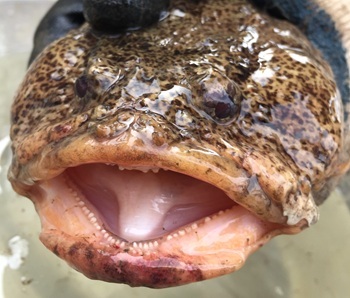
Today’s fish catch included an amazing 18 (young-of-year to adult) oyster toadfish, blackfish-tautog (190-275 mm), northern pipefish (100-108 mm), and four gorgeous black sea bass (40-50 mm).
- Rashel Coraballo, Luna Horsley
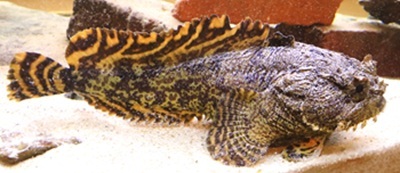
[Oyster toadfish are found from Cape Cod, Massachusetts, to Florida inhabiting inshore waters on rocky bottoms, reefs, and jetties. They are common in the waters around New York Harbor and the lower estuary where they set up shop on the bottom of the river and with a huge mouth, strong jaws, and sharp teeth, they crush and feed on shellfish such as crabs, oysters, and other bivalves.
Oyster toads have very sharp teeth. I once plunged my hand into a bait bucket, without looking, to get a piece of cut bait for my rig. I had forgotten I had sequestered a foot-long live oyster toad in the bucket. Instantly, three fingers were painfully perforated. Blood everywhere.
Although oyster toadfish is quite a handsome fish, it has never been treated well with its nomenclature. They are known colloquially as oyster cracker, oyster catcher, oyster toad, ugly toad, and bar dog. Oyster toadfish are so admired by anglers that, in less-enlightened times, they were lovingly dubbed the “mother-in-law” fish.
Well-preserved oyster toadfish bones and stone tool artifacts have been found in association with excavated oyster middens on Dogan Point (river mile 40) in Westchester County (Cheryl Claassen 1996).The organics radiocarbon dated (14C) to the Late Archaic (5,000 years ago). These data provide archaeological evidence suggesting that indigenous people (ancestral Lenni-Lenape) may have enjoyed eating oyster toadfish with their blue crabs and oysters. Tom Lake]
Photo of oyster toadfish courtesy of Toland Kister
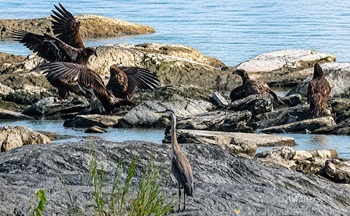
8/11 – Saratoga County, HRM 157: On one day last December, we counted no fewer than 30 bald eagles, mostly immatures, a true gathering of eagles, in the trees lining the Mohawk River flats below the Falls at Cohoes. These were birds in migration one step ahead of ice-in on the Mohawk. We thought of that stretch of the river as “Peebles Island Day Care,” noting the likely connection with the nearby bald eagle nest (NY485) at Peebles Island.
Today there were five immatures and two adults foraging in the shallows of the Mohawk River Cohoes flats. The two adults were possibly from NY485. When they finally left, they flew in that direction.
- Andrew Walters
Photo of bald eagles courtesy of Andrew Walters
8/12 – Manhattan, HRM 1-2: Our Hudson River Park's River Project staff checked our research gear (pots and traps) that we deploy from floating docks on the south-side of Piers 26 and 40 in Hudson River Park for our ongoing Aquatic Ecology Survey.
Contents of our catches have been repeating: nine oyster toadfish blackfish-tautog, and black sea bass (45-50 mm). Invertebrates included three blue crabs (75-113 mm).
- Rashel Coraballo, Jack Nelson, Paul West
[Crab measurements (size) are calculated in millimeters (mm) point-to-point across their carapace. Tom Lake]
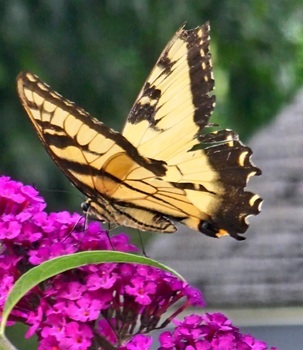
8/12 – Town of Poughkeepsie, HRM 69: In daylight hours, our butterfly bush’s incredible colors and sweet bouquet have been an irresistible lure for butterflies including tiger swallowtails, spicebush swallowtails, monarchs, great spangled fritillaries, and cabbage whites as they duel with bees and hummingbirds. Today, three tiger swallowtails, flitting about with ballet moves, exchanged best access angles for the nectar.
- Audrey Pless
Photo of tiger swallowtails courtesy of Audrey Pless
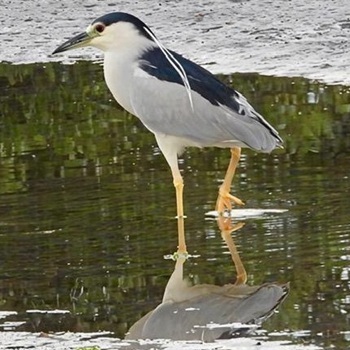
8/13 – Saratoga County, HRM 157: The Mohawk River flats below the Falls at Cohoes were busy again today (see 8/12). Along the verge there were ruby-throated hummingbird and monarch butterflies on flowers. The highlight, foraging the shallows as were yesterday’s bald eagles, was a gorgeous black-crowned night heron.
- Katria Van Tassel
Photo of black-crowned night heron courtesy of Katrina Van Tassel
8/14 – Piermont Pier, HRM 25: The annual late-summer pre-migration congregation of osprey (Pandion haliaetus) at Piermont Pier seemed to start early this year with counts entering the double digits by mid-July. Since the end of July, I have had high counts in the 30s and low 40s on several days, culminating in a high count this morning of 47.
Most of the birds were perched in the trees between Piermont Marsh and Ferry Road making the osprey difficult to count. Instead, I chose a location on the pier where I can look back and see them all at once for a more accurate count.
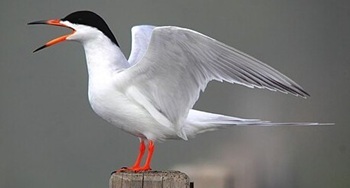
Another remarkable congregation that is becoming an annual occurrence at the Pier is that of Forster's terns (Sterna forsteri). From the end of July to early August daily counts peaked in the 40s. They were most often seen on the dock and on the old wooden pilings, the juveniles begging for fish brought by the adults. Now they are nearly all gone. The abundance of young-of-year fishes as the summer has progressed accounts for high concentration of osprey and terns. The fishing was so good!
- Linda Pistolesi
Photo of Foster's tern couretsy of Terry Sohl
8/14 – Manhattan, HRM 1-2: Our Hudson River Park's River Project staff checked our research gear (pots and traps) that we deploy from floating docks on the south-side of Piers 26 and 40 in Hudson River Park for our ongoing Aquatic Ecology Survey. [Due to ongoing construction, today’s collection came only from Pier26.]
Our traps yielded only two fish species. Not surprisingly, nine of them were oyster toadfish (20-295 mm) as well as one black sea bass (45 mm). Invertebrates included two blue crabs (15 mm), one spider crab (10 mm), a Pacific shore crab (10 mm), and white -fingered mud crabs.
- Jade Murphy, James Laske, Mirei Ueyama, Kumarie Singh
Science Saturday at Norrie Point Environmental Center
Join us for our monthly Science Saturday programs and explore Norrie Point. Check out our series by visiting the Hudson River website. Events are free and open to the public. Registration is not required. All programs meet at the Norrie Point Environmental Center, 256 Norrie Point Way, Staatsburg NY, 12580. Dress for the weather and being outside! Otherwise, no special equipment is needed.
Snapshot NY
The NYSDEC, in collaboration with the New York Cooperative Fish and Wildlife Research Unit at Cornell University, has launched Snapshot NY, a citizen science program that allows the public to participate in wildlife monitoring through the deployment of trail cameras. The project will help improve the way DEC monitors and manages more than a dozen wildlife species. For more information on Snapshot NY and how to participate, visit the Snapshot NY website.
Hudson River Lesson Plans
Explore our collection of Hudson River lesson plans, videos and online activities to support hands on investigations of the Hudson River in your classroom.
Hudson River: Striped Bass Cooperative Angler Program
You can share your fishing trip information and help biologists understand and manage our Hudson River striped bass fishery.
Here’s how it works: Fill out a logbook provided by us whenever you fish on the Hudson River (by boat or from shore). You can also use our survey123 app and record your trips using a smart phone or computer.
Record general location, time, gear used, what you caught (or if you didn’t catch anything) and return the logbook when you are done fishing for the season. You’ll receive an annual newsletter summarizing the information in addition to the latest news regarding regulations and the river. Whether you catch-and-release or take home a keeper, you can be part of the Cooperative Angler Program. Online logbook instructions (PDF).
Join today by contacting: hudsonangler@dec.ny.gov
- Jessica Best
Hudson River Miles
The Hudson is measured north from Hudson River Mile 0 at the Battery at the southern tip of Manhattan. The George Washington Bridge is at HRM 12, the Tappan Zee 28, Bear Mountain 47, Beacon-Newburgh 62, Mid-Hudson 75, Kingston-Rhinecliff 95, Rip Van Winkle 114, and the Federal Dam at Troy, the head of tidewater, at 153. The tidal section of the Hudson constitutes a bit less than half the total distance—315 miles—from Lake Tear of the Clouds to the Battery. Entries from points east and west in the watershed reference the corresponding river mile on the mainstem.
To Contribute Your Observations
The Hudson River Almanac is compiled and edited by Tom Lake and emailed weekly by DEC's Hudson River Estuary Program. Share your observations by e-mailing them to trlake7@aol.com.
Was this Newsletter Forwarded to You?
Subscribe today to DEC Delivers Hudson River Almanac topic for weekly natural history journal that covers the Hudson from the High Peaks of the Adirondacks to New York Harbor.
Helpful Resources
National Oceanic and Atmospheric Administration online tide and tidal current predictions are invaluable when planning Hudson River field trips. For real-time information on Hudson River tides, weather, and water conditions from sixteen monitoring stations, visit the Hudson River Environmental Conditions Observing System website.
DEC's Smartphone app for iPhone and Android is now available at New York Fishing, Hunting, and Wildlife App.
|