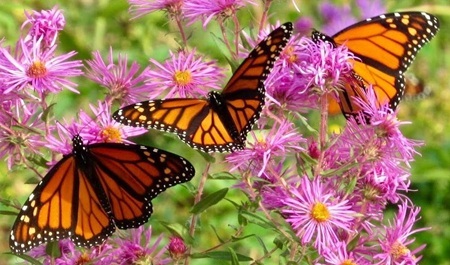
Photo of monarch butterflies courtesy of Tom Mitchell
In this issue:
This was a week highlighted by gorgeous butterflies, stunning colored flowers, and handsome toadfish.
There is mounting evidence that the mother lode of oyster toadfish lives in the river off Pier 40 in Manhattan. If Opsanus tau were gamefish, we'd be saying, in anglers’ parlance, “The oyster toads are running!"
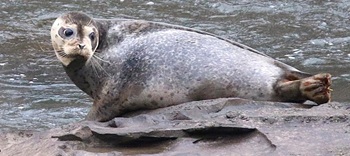
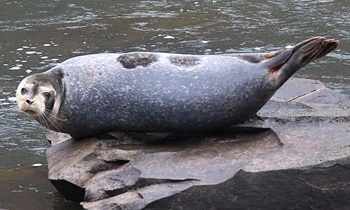
8/5 – Saugerties, HRM 102: Today is the 7th anniversary (since August 5, 2019) — 2,555 days — of a harbor seal’s (Phoca vitulina) semi-residence in Esopus Creek. Truly a saga for this marine mammal.
Our neighbors on Esopus Creek reported the harbor seal heading toward the Hudson River this morning. Guests at the lighthouse later saw the seal swim out of the creek and head up the river. These guests are the same ones who saw the seal here seven years ago when he first showed up. Since then, they have often seen him during their annual August visit to the Saugerties Lighthouse.
- Patrick Landewe
Photo of harbor seal courtesy of Jim Yates
The Story
On April 5, 2018, a young, orphaned harbor seal was rescued from Lower Goose Island, Harpswell, Maine. The seal was transported to the Mystic (Connecticut) Aquarium Animal Rescue Program where it was determined that the seal was a male. Long term medical rehabilitation followed. At its conclusion, a satellite tracker, as well as a white tag (2-4-6) was applied on its rear flipper before the seal was released as a yearling (one-year-old), at Charlestown, Rhode Island, on January 17, 2019.
Once released, the satellite tag imagery revealed that the seal traveled 81 miles up the Connecticut River to the Holyoke Dam, the first impassable barrier. The seal then reversed its course exiting downriver into Fishers Island Sound then across Long Island Sound to the Peconic Bays before going offshore. The seal then traveled down along the south shore of Long Island into the New York Bight and eventually into the Hudson River estuary.
Heading upstream into freshwater on August 5, 2019, he found a home in Esopus Creek at Saugerties, Hudson river mile 102 (113 miles from the sea). From then on, the seal has been faithfully monitored by Patrick Landewe, Saugerties Lighthouse Keeper.
- Tom Lake
Photo of harbor seal courtesy of Jim Yates
8/1 – Hudson River Watershed: The Great Hudson River Fish Count is an annual event, sponsored by the DEC's Hudson River Estuary Program and the Hudson River National Estuarine Research Reserve. Organizations along the Hudson River and New York Harbor participate at riverfront sites to collect, count, and catalog fish species. During the fish count, participating organizations encourage visitors to help collect fish using seine nets, minnow traps, or rods and reels. The fish are identified, discussed, counted, and released.
- Sarah Mount
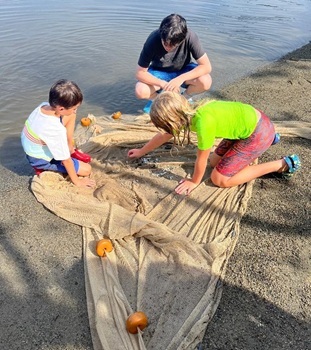
8/1 – Little Stony Point Preserve, HRM 55: Nineteen of us gathered on the beach at Little Stony Point Preserve for our contribution to the 15th annual Great Hudson River Fish Count. We were in Hudson Highlands State Park in the shadow of four magnificent testaments to our geological history: Mount Taurus, Breakneck Ridge, Storm King Mountain, and Crow’s Nest.
After introductions we found our sense of place: Where were we? We were 66 miles from the open sea. As such, we are never surprised as to what might show up off our beach. We have had seals (four species), the occasional dolphin (three species), harbor porpoises, and a decade ago a brief visit a bit downriver of a Florida manatee.
Ninety-nine miles upriver from where we stood on the sand is the head-of-tide, where a Federal dam blocks the ocean’s tidewater. Heading up the non-tidal reach of the Hudson River another 160 miles we come to its source, Lake Tear, in the High Peaks of the Adirondacks, at the foot of Mount Marcy, elevation 5,343 feet (more than one-mile-high). It is a glorious journey that many of us have taken.
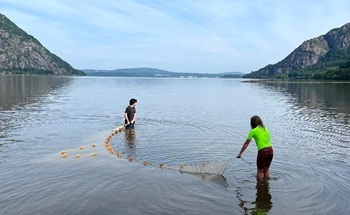
Our crew set about laying out our 35-foot seine. The tide was slack-low, so it made little difference in which direction we hauled. We elicited volunteer help (quick learners) to assist with the net.
Photo of seining courtesy of Tom Lake
Later, after seven hauls, we tallied our catch. We had caught 461 fish of nine species, 99% of which were young-of-year fishes (nearly all were successfully released). That told us a story of the river: Many fish born upriver in the spring were now heading toward the sea. Those included river herring, both alewives (33-44 mm) and blueback herring (12-19 mm), as well as striped bass (28-44 mm). Two other species were heading in the opposite direction, in from the sea: young-of-year Atlantic silverside (17-22 mm) and Atlantic menhaden (35-48 mm). They were enjoying the buffet that the estuary provides in summer. Others, in smaller numbers, included banded killifish, bluegills, white perch, and spottail shiners.
Our young-of-year river herring can pose a tricky path to species identification. They are strikingly similar, even the same to untrained eyes. On the beach, with mostly unsophisticated tools, we are forced to use basic morphology, i.e., peeking at their peritoneum (stomach color) — blueback herring is black; alewife is pinkish. Our on-site investigator for internal fish morphology, Tommy Jackson, chose a few of the larger river herring as volunteers for some mildly invasive surgery. That procedure with those fish disclosed a pinkish peritoneum: The larger river herring were alewives (Alosa aestivalis).
There were hundreds of much smaller young-of-year river herring that required some lab work. We brought at least a dozen back and, using a fine needle as a probe as well as our microscope, found a black peritoneum for each of them. Those very small herring were bluebacks (A. pseudoharengus). These were the first young-of-year blueback herring we had seen this season. Points north, 100-plus miles upriver, had received more than nine inches of rain a few days earlier. Cause and effect? The ensuring freshet from all that runoff likely ushered thousands of young-of-year blueback herring downriver.
The water temperature on the day was 77 degrees Fahrenheit; the salinity, that had been 4.0 parts-per-thousand in the Hudson Highlands three years earlier, was now less-than 1.0 (<1.0). Even that low reading may have been what we call "background noise," an upland contribution.
- Seth Dinitz, Tommy Jackson, Rhys Miklos, Tom Lake
[Note: One-inch equals 25.4 millimeters (mm). Tom Lake]
Photo of counting the fish courtesy of Tom Lake
8/1 – Piermont Pier, HRM 25: An overflowing number of eager participants joined our Lamont-Doherty Earth Observatory science team on the beach today for our contribution to the 15th annual Great Hudson River Fish Count.
They came to help us make eight hauls of our beach seine to catch, count, discuss, and release fish, shrimp, and crabs. The strength of our catch was best expressed in the amazing numbers and diversity, including one of our largest spot (90 mm) of the season (Leiostomus xanthurus), known colloquially as “Lafayette.”
At our finale, when we measured our effort, we discovered we had caught an amazing 1,022 Atlantic silverside, eight striped bass, a young-of-year bluefish, three blue crabs (on male, two female),14 shore shrimp (six gravid), and 20 delightful moon jellyfish. The water temperature was 81 degrees Fahrenheit, the dissolved oxygen (DO) was a healthy 11.0 parts-per-million, and the salinity was 5.0 parts-per-thousand.
- Sarah Ortiz
Photo of spot courtesy of Tom Lake
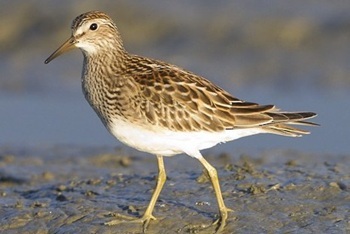
8/2 – Albany, HRM 145: Yesterday, Craig Driggs posted a Hudson-Mohawk Bird Cub notice of a sighting of at least 15 pectoral sandpipers in flooded pools (post nine inches of recent rain) at the Crossings in Colonie. We went there in the evening with other birders and found 40 pectoral sandpipers along with several lesser yellowlegs, at least one greater yellowlegs, and ten killdeer.
- Scott Stoner, Denise Stoner
Photo of pectoral sandpiper courtesy of Brian Sullivan
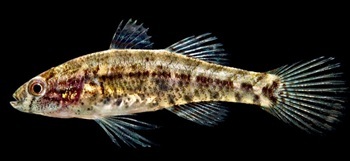
8/3 – Hudson River Watershed: Fish-of-the-Week for Week 378 is the fat sleeper, Dormitator maculatus (Bloch, 1792), number 211 (of 240) on our watershed list of fishes. If you would like a copy of our list, e-mail trlake7@aol.com.
We began this weekly feature in the Almanac on December 13, 2018, with the firm belief that every fish has a story to tell.
The fat sleeper is the only member of its family (Eleotridae) found, albeit rarely, in our watershed. Students snicker when I introduce this fish. Their common name is not a case of body-shaming, but rather an accurate description of their roly-poly shape.
Fat sleeper was named and described to science in 1792 by Marcus Elieser Bloch, a German physician and naturalist. Their genus, Dormitator, comes from the Latin Dormio, meaning sleep, or sleeper. Its trivial name, maculatus, comes from Latin macula, meaning spotted. C. Lavett Smith (1985) calls the fat sleeper “a stubby little fish ... somber brown with lighter spots.” They can reach 25-inches, but most are far smaller.
The fat sleeper is found along the Atlantic slope from North Carolina to southeastern Brazil. Yet, the fat sleeper seems to be a fish without a home. Marcus Elieser Bloch did not name a Type Site in 1792, which is telling. In our watershed, they are considered a Tropical marine stray on the evidence of only a couple of 1973 records including Constitution Marsh, HRM 52 (53.5 mm) and Indian Point, HRM 42 (Smith and Lake 1990). In large inshore ecosystems like the Chesapeake, where you’d expect them to be, they are considered rare (see Hildebrand & Schroeder 1928; Murdy, Birdsong, and Musick 1976).
Adults inhabit marshes, muddy ponds and channels where they primarily feed on invertebrates. They are closely related to the gobies, but are so drably uncommon to rare, that if you caught one, you might not recognize it. They favor fresh water but also can adapt to brackish areas, with a broad tolerance for salinity, a range of 0 to 21 parts-per-thousand.
- Tom Lake
Photo of fat sleeper courtesy of Joel Sartore
8/3 – Yonkers, HRM 18: Our research and education team at the Sarah Lawrence Center for the Urban River at Beczak conducted six seine hauls today. We made up for limited diversity with incredible abundance. High count went to 285 Atlantic silverside. We added four young-of-season blue crabs (60-75mm). The river was 78 degrees Fahrenheit, salinity was 10.0 parts-per-thousand, and the dissolved oxygen (DO) was 7.6 parts-per-million.
- Jason Muller, James Cook, Ryan Newell
8/3 – Manhattan, HRM 1-2: Hudson River Park staff monitored fish traps deployed on Piers 26 and 40 in Hudson River Park as part of our ongoing Fish Ecology Survey. Overnight, our gear caught an amazing 24 young-of-year oyster toadfish, (20-27 mm), and two northern pipefish (170-185 mm). Crustacea included blue crabs (120 mm), spider crab (40 mm), grass shrimp, and sand shrimp.
- Rashel Coraballo, Luna Horsley
[Crab measurements (size) are calculated in millimeters (mm) point-to-point across their carapace. Tom Lake]
8/4 – Town of Poughkeepsie, HRM 69: When the butterfly bush blooms Nature seems to rejoice. Advertising with their incredible color, the butterfly bush gets constant attention by moths, bees, hummingbirds, and butterflies. Today there were three tiger swallowtails exchanging the best access angles, as well as many honey bees (the flowers smell like honey), and a gorgeous monarch, hopefully the first of many to visit my butterfly bushes.
- Audrey Pless
8/4 – Yonkers, HRM 88: Our research and education team at the Sarah Lawrence Center for the Urban River at Beczak conducted eight mid-tide seine hauls today. High count went to Atlantic silverside (158).
In a bit of a surprise, we caught both mummichog and banded killifish. These are very closely related killifish with mummichog favoring brackish water and the banded killifish freshwater. Other fishes included young-of-year bluefish (130 mm) and white perch (170 mm). We also added four blue crabs.
The river was 80 degrees Fahrenheit, the salinity, resulting from extremely heavy precipitation in the upper watershed, dropped to 5.0 parts-per-thousand, and the dissolved oxygen (DO) was 6.9 parts-per-million.
- Jason Muller, James Cook, Ryan Newell, Paul Renda
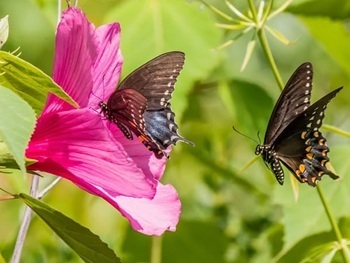
8/5 – Town of Poughkeepsie, HRM 77: I was fortunate to capture a pair of spicebush swallowtail butterflies (Papilio troilus) hard at work. In the photo, the butterfly on the left is a female with blue hind-wings, while the one on the right is a male displaying greenish-blue coloration. They are likely courting, a behavior where the male protects or pursues the female while she feeds on nectar. The butterflies are feeding on a pink hibiscus flower (Hibiscus sp.).
- Bob Rightmyer
Photo of spicebush butterflies courtesy of Bob Rightmyer
8/5 – Yonkers, HRM 18: Our research and education team at the Sarah Lawrence Center for the Urban River at Beczak, with enthusiastic assistance from the Blue Team students at Yonkers High School, conducted six seine hauls today. Atlantic silverside was high count in our catch with 55, as well as striped bass and blue crabs. The river was 80 degrees Fahrenheit, the salinity was 5.2 parts-per-thousand, and the dissolved oxygen (DO) was 7.5 parts-per-million.
- Katie Lamboy Roman, Katherine Lamb
8/5 – Manhattan, HRM 1-2: Manhattan, HRM 1-2: Our Hudson River Park's River Project staff checked our research gear (pots and traps) that we deploy from floating docks on the south-side of Piers 26 and 40 in Hudson River Park for our ongoing Aquatic Ecology Survey.
Today traps held fourteen oyster toadfish, young-of-year to adult (20-300 mm), one blackfish-tautog (210 mm), and two gorgeous black sea bass (40-45 mm). Invertebrates included two blue crabs (135-140 mm), and a Pacific shore crab (25 mm).
- Lawrence Brynes, Jack Nelson, Maren Piersol, Kumarie Singh
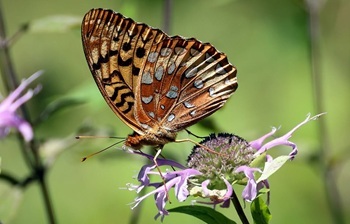
8/6 – Dutchess County, HRM 82: I came upon a beautiful great spangled fritillary nectaring on wild bergamot (Monarda fistulosa) in eastern Dutchess County near Dover Plains.
- Deborah Tracy Kral
Photo of great spangled fritillary courtesy of Deborah Tracy Kral
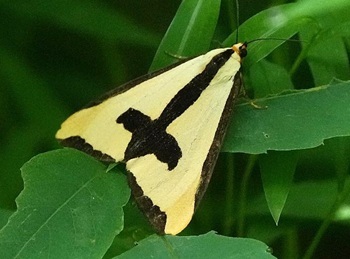
8/7 – Ulster Park, HRM 87: We love seeing one of our favorite mid-summer moth, the Clymene moth (Haploa clymene). We enjoy its delicate coloration and the fleur de lis pattern when the wings are closed. Typical of tiger moths, it has more color in the hind wings, showing a subtle orange when the wings are open such as when flying.
- Peter Relson, Carol Anderson
Photo of clymene moth courtesy of Peter Relson-Carol Anderson
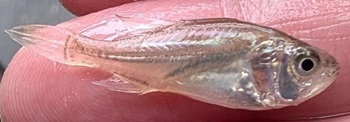
8/7 – Yonkers, HRM 18: Our research and education team at the Sarah Lawrence Center for the Urban River at Beczak conducted six low tide seine hauls today. In a change, blue crab (83) was high count, many of which were less than 10 mm. Atlantic silverside (23) contributed as well as bluefish (140 mm).
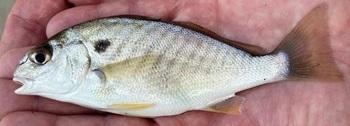
The fish of the day however was our first silver perch (Bairdiella chrysoura) of the season (350 mm). The river was 81 degrees Fahrenheit, the salinity was 4.8 parts-per-thousand, and the dissolved oxygen (DO) was 7.5 parts-per-million.
- Jason Muller, Paul Renda
Photo of silver perch courtesy of Jason Muller
8/7 – Manhattan, HRM 1-2: Our Hudson River Park's River Project staff checked our research gear (pots and traps) that we deploy from floating docks on the south-side of Piers 26 and 40 in Hudson River Park for our ongoing Aquatic Ecology Survey. Today marked the conclusion of an “oyster toadfish week” where we caught 46.
Our gear yielded five species of fish: five (young-of-year to adult) oyster toadfish (25-260 mm), blackfish-tautog (240-275 mm), spot (200 mm), rock gunnel (40 mm), and black sea bass (43 mm). Invertebrates present at our trap site included Pacific shore crabs, blue mussels, and ribbed mussels.
- Jade Murphy, James Laske, Paul West, Kumarie Singh
Science Saturday at Norrie Point Environmental Center
Join us for our monthly Science Saturday programs and explore Norrie Point. Check out our series by visiting the Hudson River website. Events are free and open to the public. Registration is not required. All programs meet at the Norrie Point Environmental Center, 256 Norrie Point Way, Staatsburg NY, 12580. Dress for the weather and being outside! Otherwise, no special equipment is needed.
Snapshot NY
The NYSDEC, in collaboration with the New York Cooperative Fish and Wildlife Research Unit at Cornell University, has launched Snapshot NY, a citizen science program that allows the public to participate in wildlife monitoring through the deployment of trail cameras. The project will help improve the way DEC monitors and manages more than a dozen wildlife species. For more information on Snapshot NY and how to participate, visit the Snapshot NY website.
Hudson River Lesson Plans
Explore our collection of Hudson River lesson plans, videos and online activities to support hands on investigations of the Hudson River in your classroom.
Hudson River: Striped Bass Cooperative Angler Program
You can share your fishing trip information and help biologists understand and manage our Hudson River striped bass fishery.
Here’s how it works: Fill out a logbook provided by us whenever you fish on the Hudson River (by boat or from shore). You can also use our survey123 app and record your trips using a smart phone or computer.
Record general location, time, gear used, what you caught (or if you didn’t catch anything) and return the logbook when you are done fishing for the season. You’ll receive an annual newsletter summarizing the information in addition to the latest news regarding regulations and the river. Whether you catch-and-release or take home a keeper, you can be part of the Cooperative Angler Program. Online logbook instructions (PDF).
Join today by contacting: hudsonangler@dec.ny.gov
- Jessica Best
Hudson River Miles
The Hudson is measured north from Hudson River Mile 0 at the Battery at the southern tip of Manhattan. The George Washington Bridge is at HRM 12, the Tappan Zee 28, Bear Mountain 47, Beacon-Newburgh 62, Mid-Hudson 75, Kingston-Rhinecliff 95, Rip Van Winkle 114, and the Federal Dam at Troy, the head of tidewater, at 153. The tidal section of the Hudson constitutes a bit less than half the total distance—315 miles—from Lake Tear of the Clouds to the Battery. Entries from points east and west in the watershed reference the corresponding river mile on the mainstem.
To Contribute Your Observations
The Hudson River Almanac is compiled and edited by Tom Lake and emailed weekly by DEC's Hudson River Estuary Program. Share your observations by e-mailing them to trlake7@aol.com.
Was this Newsletter Forwarded to You?
Subscribe today to DEC Delivers Hudson River Almanac topic for weekly natural history journal that covers the Hudson from the High Peaks of the Adirondacks to New York Harbor.
Helpful Resources
National Oceanic and Atmospheric Administration online tide and tidal current predictions are invaluable when planning Hudson River field trips. For real-time information on Hudson River tides, weather, and water conditions from sixteen monitoring stations, visit the Hudson River Environmental Conditions Observing System website.
DEC's Smartphone app for iPhone and Android is now available at New York Fishing, Hunting, and Wildlife App.
|